
When Timing Matters to Dividend Investors

The timing of trades matters very little to me on most of my positions. I’m a long-term investor with a timeline of years, potentially decades. Even my “short-term” holdings tend to be for at least a year or two.
Although I occasionally see wild, unexpected price swings in my portfolio, generally, dividend stocks are boring and fairly predictable. I don’t worry much about buying or selling exactly at a particular time. This is more important when the only way for you to make money is to buy and sell at exactly the right time.
I’m here to simply get in at a good price and collect my dividends for the long haul. Once locked in, my income collection is put on autopilot. The dividends hit my account and some are reinvested automatically by my broker. I don’t have to do anything until I’m ready to exit the position.
However, there is a process happening behind the scenes that determines whether or not an investor is eligible for an upcoming dividend. It’s something that happens automatically and we can usually just ignore. That’s not always the case and can cost you a dividend that you were counting on.
That’s what we’re going to look at today.
Know When You’re Eligible
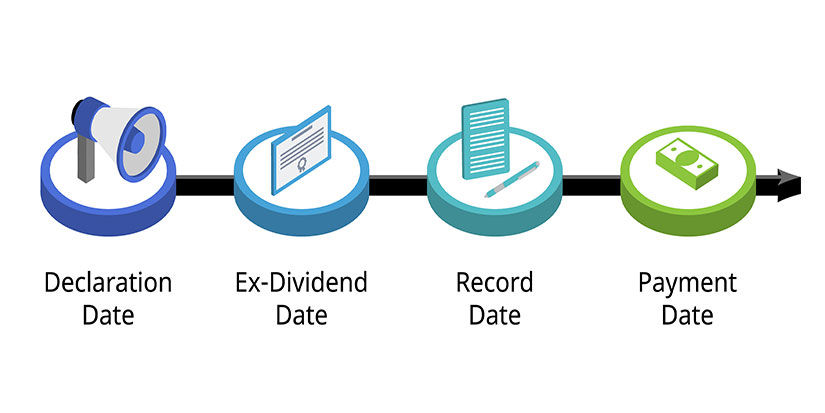
Not all shareholders are eligible to receive a dividend come pay day. Prior to 1990, a trade would take five days to settle. This delay, plus any lag in keeping physical records, made it essential to have a specific “record date” to identify eligible shareholders that was prior to the actual payout date.
Technology has sped up the whole process of record keeping and payments, and trades now settle in just one day. But trades and record-keeping are not immediate. Every dividend payment still has a record date prior to the date the dividend will actually hit your account. You must own your shares by the record date.
Remember that trades take one day to settle. To be eligible for the payment, you must purchase your shares before the market closes the day before the record date.
These dates are not arbitrary. They are provided by a company’s management on a dividend’s declaration date. That’s when a company announces the amount of the dividend payment, the record date, and the payment date.
The most common places to find these announcements are on a company’s investor website, its press release page, or as part of a quarterly earnings release.
It will be worded something like “Company XYZ will pay its next dividend of $X.XX on [insert payment date] to shareholders on record as of [insert record date].” If you bought shares of company XYZ at least the day prior to the record date, you’ll receive that amount per share on the payment date.
One last dividend date commonly used is the ex-dividend date. If you buy shares on this date or later, you’re not eligible to receive the dividend on the payment date. Since you must buy shares the day before the record day to be eligible, and the ex-dividend date is the day after this, the record date and ex-dividend date are the same.
Beware of A Brief Price Drop
If you end up buying shares on an ex-dividend date, not all is lost. Most companies pay dividends regularly, so you’ll be eligible when the next dividend comes around. Long-term investors are planning to stick around anyway, and they might not even consider these dates before buying.
However, there is one more twist to these dates you should know about.
On the ex-dividend date, a stock’s share price tends to drop by roughly the amount of the dividend. This is more prevalent for companies with higher payouts or those with variable dividends. That cash sitting as an asset was being priced in. Once that money is committed to a payout, it’s no longer an asset.
In many cases, it doesn’t take long for shares to recover from a payment date price drop. I’m talking seven to 10 trading days. If shareholders remain bullish on the outlook for the company, it’s onto the next anticipated earnings and dividend payout. Investor sentiment quickly fills in that drop.
An ex-dividend day dip could be your opportunity to get a better price if you don’t mind waiting until the next dividend payment.
You can exploit these dates and price movement for quick gains. But that is speculating and not investing. I personally do not use these tactics. They take away from the long-term, hands-off feel that is one of my favorite traits of dividend investing.
Although we don’t generally have to worry about these dates, they exist for every payment we receive. And every dividend investor should be aware of this process happening behind the scenes of their holdings.
For more income, now and in the future,

Kelly Green
Kelly Green

Permanlink:

RECENT ARTICLES
Back to the “Big Four”
October 21, 2026
A Worthwhile Exit Strategy
October 14, 2026
A Sinking Ship or A Turnaround Bet
October 7, 2026
Mailbag: Are There Dividend ETFs Out There That Are Worth It?
September 30, 2026
Burning a Hole in My Pocket
September 23, 2026
Personal Principles as An Investment Screener
September 16, 2026

Mauldin Economics Dividend Digest
There are lots of generous dividend payments waiting to be collected—if you know where to look. And many of these companies have been paying and boosting their dividends year in and year out for decades. If you want to find the yield that you deserve, sign up for Mauldin Economics Dividend Digest—industry-leading income investing research delivered to your inbox every Wednesday.
Uncover the tips and tricks to navigate the income investing landscape… to find the yield you deserve and add income to your pocket today and in the future.
By opting in you are also consenting to receive Mauldin Economics' marketing emails. You can opt-out from these at any time. Privacy Policy
This is my testimony on how I finally joined the new world order, Illuminati after I have been trying to join for over 2 years now but scammers took money from me several times. I have been searching to join the Illuminati for so long, but scammers keep taking my money until early this year when I meet with Lord Felix online I contacted him and I explained everything to him and he recommended the registration used and I paid for the big member to get me started and I was initiated into the World Order online and I receive the sum of $1,000,000 us dollars in to my bank account instantly after my online initiation ritual and also I will be earning $33,000 us dollars monthly, I'm very happy! And promise to spread the good work of Lord Felix. If you are interested in joining the new world order Illuminati today, contact Lord Felix today instead of accepting scammers to take your money all in the name of helping you join, Contact Lord Felix Via email illuminatiofficial565@gmail.com or WhatsApp +447353027456
To be clear, if the ex-Dividend date is the 15th, you need to buy the stock on the 13th. It settles on the 14th, and then you own the stock at the market open on the 15th.