
China Is Building What Nature Gifted the US

Add paragraph text. Click “Edit Text” to update the font, size and more. To change and reuse text themes, go to Site Styles.
The Situation
In 1803, then-President Thomas Jefferson dispatched James Monroe and Robert Livingston to France. Their mission was simple: Buy New Orleans and West Florida from Napoleon. It was also critical. Spain had ceded its claim to the entire Louisiana Territory to France in 1802, and in so doing revoked the right of Americans to utilize the port of New Orleans, through which passed more than a third of US exports.
Once the Americans arrived in Paris, France’s foreign minister, Talleyrand, advised them that not only New Orleans but the entire Louisiana Territory was for sale. At the time, the crown jewel of France’s North American holdings was Saint Domingue (present-day Haiti), rich in sugar and coffee. Napoleon had planned to use the Louisiana Territory as an agricultural supply base to feed Saint Domingue, but these plans were spoiled by a slave revolt in the colony in 1801 that the French failed to suppress.
If France couldn’t hold Saint Domingue, how could it hope to hold the Louisiana Territory? Moreover, Napoleon was cash-strapped, and worse still, he anticipated imminent renewed war with England. Selling the Louisiana Territory to the United States denied England the prize of New Orleans, built goodwill with the Americans, and offered financial relief. And so, for the small price of $15 million (roughly $445 million today), Napoleon gifted the fledgling American republic the future.

The River That Made America
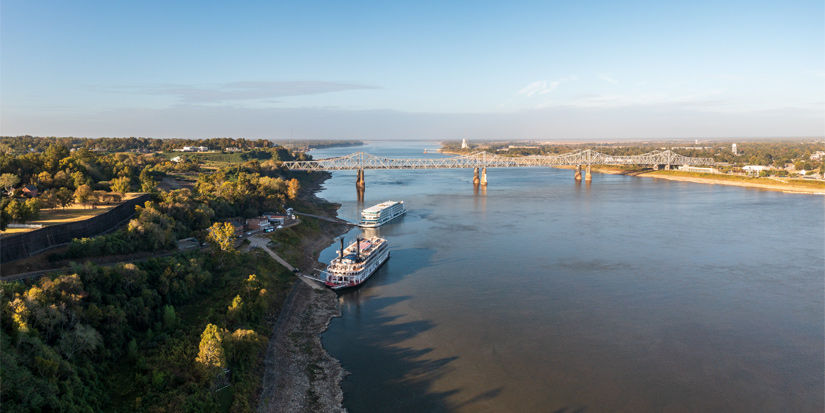
Americans are rightfully proud of the Republic they have built, its institutions, ideals, and culture. But geographically speaking, Americans had it easy. With the purchase of the Louisiana Territory, the US acquired the largest interconnected navigable waterway system in the world. This gave the fledgling United States an incalculable advantage in terms of the capital needed to build modern industrial infrastructure and of stitching together the melting pot of its diverse citizens. The US is defined by its Constitution, but without the Mississippi, that Constitution might not have worked.
Europe has no such system—it has multiple, self-contained systems, which is why Europeans have fought and killed each other for centuries. Russia has no such system—Russian power centers around the Volga and becomes an extractive state to the flatlands around it. China has no such system—the history of Chinese geopolitics is the history of centralized control over the Amur, Yellow, Yangtze, and Pearl rivers.
One of the reasons Africa is so divided is that none of its rivers connect its disparate regions. The only comparable system is the Rio de la Plata in South America, but when Brazil lost the Cisplatine War in the 1820s, it lost the chance to dominate the Rio de la Plata the way the US has dominated the Mississippi for two centuries.
A Wasted Asset
The US takes this massive natural advantage for granted. In terms of both weight and value, more freight in the US is moved by truck, rail, and pipeline, despite the fact that transport by barge is 10–30 times cheaper. Even so, US inland waterways move ~$160 billion of goods annually, “facilitating the transport of one-third of the nation’s gross domestic product.”
The US now builds roughly 0.1% of new ships in the world annually, and new barge construction activity is at historic lows. Some 80% of the lock and dam infrastructure on the inland waterways system exceeds its 50-year design life. According to the 2025 Infrastructure Report Card, “delays and closures caused by the age and capacity of lock and dam infrastructure result in an average delay of 172 minutes, affecting 47% of vessels.”
And it is not just the infrastructure that is suffering; it is the water itself. Water quality has become a major issue in Iowa’s congressional and gubernatorial races due to increasing rates of cancer (Iowa’s cancer rates are now second highest in the nation, with nitrate pollution a likely culprit).
The US government just last month cut how much water Arizona, California, and Nevada can draw from the Colorado River, whose flow has diminished 20% over the last two decades, leaving Lake Mead and Lake Powell at historic lows and jeopardizing power supplies for 5 million Americans and water for another 40 million. The Rio Grande is drying up, jeopardizing water supplies for 15 million Americans and agricultural revenues in the billions. The roughly 150-mile industrial corridor along the Mighty Mississippi between Baton Rouge and New Orleans is called Cancer Alley because the water is so polluted.

The Pinglu Canal
Contrast this with news out of China in recent weeks, where construction on the Pinglu Canal was completed. This is by no stretch China’s Grand Canal, the largest artificial waterway in the world, connecting five of China’s main river basins. But it is an impressive project and China’s “first major waterway in 700 years.” It was built largely on-budget (~$10 billion) and in four years. It will save up to $725 million in annual transport costs and will bring 200 million tons of incremental annual freight volume to the state-owned Beibu Gulf Port over the next nine years.

One of China’s biggest economic problems is the disparity of wealth between its coastal regions and the interior. Even in 2026, goods manufactured in China’s inland provinces are routed to faraway eastern ports for export. This canal now provides a significantly faster alternative, and the speed and success of its buildout could augur a new infrastructure frenzy in China. It also provides a potential outlet to the world’s oceans for Chinese goods in case the East China or South China Seas are blocked for whatever reason.
To be sure, China will have to pour massive amounts of investment to stitch its inland waterway system together. But this is where authoritarian regimes often have an advantage because, for the government, direct returns on investment are not driving the decision to build. Instead, Beijing sees an internal economic problem that infrastructure can help solve. China’s economic model right now is one where the government takes on projects that are too big (or rather, too unprofitable) for the market, and then allows ruthless competition to take place between economic actors with equal access to that infrastructure. Dan Wang’s recent book, Breakneck: China’s Quest to Engineer the Future, examines this dynamic well—and juxtaposes China as a society led by engineers against the United States, which is led by lawyers.
A Tale of Two Countries
Readers might have expected me to focus this week on the recent Xi-Trump summit at the White House. But from my point of view, that summit was heavy on pageantry and bereft of substance. Sure, there were pledges to cut tariffs on a handful of relatively meaningless products, the gift of pandas to Zoo Atlanta (my daughter is looking forward to visiting them on our next trip there), and President Trump showing off his Hall of Presidents, helicopter pad, and ballroom to Xi. But there were no breakthroughs on artificial intelligence, no changes on issues like Taiwan, North Korea, or Iran.
It is rather the juxtaposition between China building canals and the US building ballrooms that stood out amidst the pomp and circumstance in Washington. China is rushing to build what nature gifted the US, and the US is, as we say down here in New Orleans, laissez les bons temps rouler. Thanks, Thomas Jefferson.
Map/Chart of the Week

Blind Spot
Ethiopia fought a civil war (mostly between the Tigray region and federal Ethiopian forces) from 2020 to 2022 that resulted in hundreds of thousands of deaths and millions more displaced. The peace that has been in place since 2022 has been an uneasy one, especially with tensions between Ethiopia and Eritrea rising in recent months. In March, I flagged it here as a critical issue, given potential spillovers on everything from Red Sea shipping to global coffee prices.
The tension has now boiled over into fighting. The Tigrayans and a coalition of other rebels launched the biggest offensive since the 2020–2022 war, seized three airports, and declared the Pretoria deal dead. Ethiopia was never colonized, a deep source of pride that also means it was never welded into one modern nation-state; it is a patchwork of peoples, and the Tigrayans are one of them. Current PM Abiy Ahmed has been trying to stitch a modern nation-state into being, a noble goal that he has pursued in increasingly ignoble ways.
Aside from sitting close to the other side of the Red Sea (remember, the Houthis now control across the Bab el Mandeb), Abiy has been pushing to get Ethiopia, which is landlocked, a Red Sea port, at Eritrea’s expense. The UAE has been providing support to Ethiopia, while Eritrea, which fought alongside Ethiopian forces against the Tigrayans in 2020–2022, has switched sides. There is also unclear involvement from Sudan and even Egypt, both of which have clashed with Ethiopia over the latter’s damming the Nile River.
With Eritrea now opposed to the Ethiopian government, and armed rebel groups across Ethiopian regions joining the fighting, Africa’s second most populous nation deserves focus.
Finally…
What I’m watching: Slow Horses (!!!!!), Apple TV
What I’m reading: Rising Tide: The Great Mississippi Flood of 1927 and How It Changed America, John M. Barry
What I’m listening to: “We Investigated the Christian ‘Scam’ Fronted by Tim Tebow,” Pablo Torre Finds Out

Jacob Shapiro
Read important disclosures here.
YOUR USE OF THESE MATERIALS IS SUBJECT TO THE TERMS OF THESE DISCLOSURES.
Permanlink:
Put Mauldin Economics to work in your portfolio. Your financial journey is unique, and so are your needs. That's why we suggest the following options to suit your preferences:
-
John’s curated thoughts: John Mauldin and editor Patrick Watson share the best research notes and reports of the week, along with a summary of key takeaways. In a world awash with information, John and Patrick help you find the most important insights of the week, from our network of economists and analysts. Read by over 7,500 members. See the full details here.
-
Invest in longevity: Transformative Age delivers proven ways to extend your healthy lifespan, and helps you invest in the world’s most cutting-edge health and biotech companies. See more here.
-
Macro investing: Our flagship investment research service is led by Mauldin Economics partner Ed D’Agostino. His thematic approach to investing gives you a portfolio that will benefit from the economy’s most exciting trends—before they are well known. Go here to learn more about Macro Advantage.
Recent Articles
Singing the Songs of Low-Priced Bonds
October 15, 2026
Brazil’s Turn to the Right
October 8, 2026
China Is Building What Nature Gifted the US
October 1, 2026
Trading Russia for Canada
September 24, 2026
Can Anyone Bring the Houthis to Heel?
September 17, 2026
The Return of Germany to History
September 10, 2026

New from Jacob Shapiro × Mauldin Economics…
The World Isn't Ending
Geopolitics, translated for investors
The headlines say the world is going to hell in a handbasket. The reality is that it’s just being rearranged —and that there is opportunity amid the chaos. Join Jacob Shapiro every Thursday as he translates complex global power shifts into actionable intelligence for your portfolio.
Join thousands of investors who refuse to watch the world from a fetal position.
By opting in you are also consenting to receive Mauldin Economics' marketing emails. You can opt-out from these at any time. Privacy Policy