
A Sinking Ship or A Turnaround Bet

I’ve talked about this before: there is a very specific hole in my portfolio.
I focus on dividend stocks because I use them to create extra income streams. And I like to reinvest some of my dividends to keep my money compounding for many years to come. One of my favorite parts about being a dividend investor is that you can find dividend payers across every sector.
For energy, I prefer pipelines in my portfolio. No matter what the prices of oil and gas, these companies get paid to transport and store it. When it comes to real estate, I hold REITs. Self-storage and experiential companies are at the top of my list. And for financials, I favor business development companies (BDCs).
I want a portfolio that is diversified even though nearly every company is a dividend stock. However, it’s been quite a long time since I’ve held a consumer discretionary company in my portfolio.
Companies that rely on discretionary spending have been feeling the squeeze from consumers over the past few years. Adjusted for inflation, retail spending overall has been growing modestly.
But when we put it in perspective of the K-shaped economy, much of that growth is from higher income households. Most of the dividend payers in this sector are restaurants, apparel, or retailers that depend on spenders in the lower arm of the K.
Even if companies have consumer dollars flowing in, inflation has affected their costs every year. Consumer discretionary is one of the three market sectors down year to date when the S&P 500 is up 13.3%.
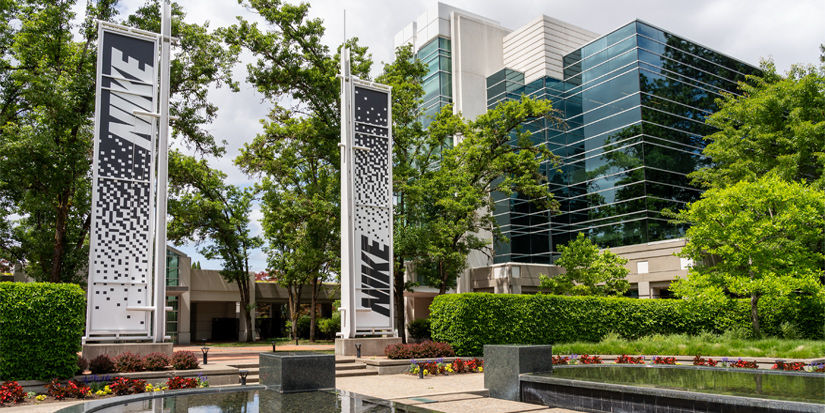
Lucky for us, when share price goes down, our yield goes up. But that’s only a good thing if the dividend is sustainable. And that’s exactly the question I’m asking myself about Nike Inc. (NKE).
The Swoosh is Back on My Radar
Shares of Nike are down 46.3% year to date bumping its dividend yield up to 4.8%, a level finally worth taking a look at.
Nike is the exclusive provider of uniforms, practice, and base-layer apparel for all 32 NFL teams through 2038. The NBA and WNBA have also renewed with Nike for uniforms, on-court gear, and fan apparel. And the company still owns the Jordan and Converse brands.
We can talk about the health of consumer spending in the economy until we’re blue in the face, but that does not affect the money that the NFL, NBA, and WNBA are spending on uniforms. I would say those commitments are some of the most stable around. It’s a solid revenue base, but the consumer spending slowdown is hitting Nike.
Last week, Nike reported its results for the first quarter of fiscal year 2027. Revenues came in at $11.2 billion, down 4% year over year. Broken down by segment:
Nike brand wholesale revenues were $6.8 billion, down 1%
Nike Direct revenues were $4.1 billion, down 8%
Converse revenues were $263 million, down 28%
Management noted that the NIKE Brand Performance portfolio continues to grow, but it’s not enough to offset the pressures being seen in NIKE Sportswear, Jordan Brand, and its sales in Greater China.
Nike is smack dab in the middle of a transformation plan.
The earnings call was full of measurable progress so far and the work that still needs to be done. Management also introduced Pace, an operating-model transformation and restructuring plan to cut costs and revive growth. It includes:
Efforts to modernize NIKE’s global supply chain
Establish a new campus in India to fuel enterprise capabilities
Realign reporting to three geographies
Reduce cost by further streamlining the organization
A strategic transformation period is a great time to buy shares. Markets are pricing in uncertainty, meaning if the transformation is successful shares could easily jump back to double their current price.
Plus, you’d be getting paid a dividend while you wait it out.
Almost a Dividend Aristocrat
The company has raised its dividend every year for the past 24 years. In fact, it usually announces its increase in November. Meaning the coveted Dividend Aristocrat title is just around the corner... that is, if it can keep paying and not cut its dividend.
We know that past performance of paying a dividend does not mean future assurance. In 2024, Walgreens Boots Alliance (WBA), 3M (MMM), and Leggett & Platt (LEG) all cut their dividends and lost their spot on the Aristocrats list. And we’ve also seen companies continue to increase their dividends just to keep that title when they should have used that money for other things.
Nike’s ability to pay its dividend is at the root of the market uncertainty.
Nike currently pays out $0.41 a quarter or $1.64 per year. Management expects adjusted diluted earnings per share for the full fiscal year to be just $1.14-$1.35. That’s a dividend payout ratio of over 100% at the current rate. Any boost to the dividend will make that coverage look even worse.
I’m not sold on the Nike turnaround story yet, but it’s definitely on my radar. If management can deliver measured progress in its next earnings report, I would be more convinced. If it can lift its full-year EPS guidance even a little bit, I think I would be ready to pull the trigger. So keep this one on your watchlist for now.
For more income, now and in the future,

Kelly Green
Kelly Green

RECENT ARTICLES
Back to the “Big Four”
October 21, 2026
A Worthwhile Exit Strategy
October 14, 2026
A Sinking Ship or A Turnaround Bet
October 7, 2026
Mailbag: Are There Dividend ETFs Out There That Are Worth It?
September 30, 2026
Burning a Hole in My Pocket
September 23, 2026
Personal Principles as An Investment Screener
September 16, 2026

Mauldin Economics Dividend Digest
There are lots of generous dividend payments waiting to be collected—if you know where to look. And many of these companies have been paying and boosting their dividends year in and year out for decades. If you want to find the yield that you deserve, sign up for Mauldin Economics Dividend Digest—industry-leading income investing research delivered to your inbox every Wednesday.
Uncover the tips and tricks to navigate the income investing landscape… to find the yield you deserve and add income to your pocket today and in the future.
By opting in you are also consenting to receive Mauldin Economics' marketing emails. You can opt-out from these at any time. Privacy Policy
NKE is a never hold for me.
I stopped buying Nike shoes because their quality was so bad.
Chasing an abstract, i.e., yield, is no reason to waste time with a loser. I don't care how much dividend is offered by a sinking ship. Your radar is too finely tuned to be occupied with this company that squandered their product quality reputation some time ago. Please adjust your usually excellent vision to a HEALTHY, i.e., inherently stable and sustainable, company. Keep up the good work.
What you fail to mention are the multiple woke marketing blunders (Kaepernick/Mulvaney) offending their base, and blundering through marketing and distribution of their new Caitlin Clark shoe (because she thinks men shouldn't play women's sports). The CEO recently announced they're "returning to sports" which is a telling comment acknowledging their prior focus on tribal virtue signaling caused their problems. Nike may be a "buy" opportunity, but I don't trust a company who ignored their focus, which isn't to drive societal change, but to provide high quality and affordable sports gear.