
A Sticky Last Mile

“Alice laughed. 'There's no use trying,' she said. 'One can't believe impossible things.'”
“'I daresay you haven't had much practice,' said the Queen. 'When I was your age, I always did it for half-an-hour a day. Why, sometimes I've believed as many as six impossible things before breakfast.'”
―Lewis Carroll
This week we find our own six impossible things in economics. Sigh.
Progress toward a goal usually isn’t linear. The first 50% isn’t too bad, the next 40% is harder, and the last 10% consumes most of the effort and resources. Business strategists call this the “last mile” problem… and it applies to inflation, too.
As I said last week inflation is Going, Not Gone. Two years ago, CPI was rising at a 9.1% annual rate and looked set to go even higher. It didn’t, and now is approaching 3%. That’s remarkable progress… but also not enough progress.
I’ve said this a few times and will keep saying it because I really want it to sink in. Learn to juggle these two thoughts in your mind because they’re both correct. Inflation is a) better than it was and b) still too high.
In my view, even the Fed’s 2% target is too high. Per Peter Boockvar, “Q2 GDP growth was 2.8%, above the estimate of 2%. Three tenths of this upside was due to a lower than expected price deflator of 2.3% vs. the estimate of 2.6%. Core PCE though of 2.9% was two tenths higher than expected.”
2.3% sounds almost like 2%. 2.9% doesn’t. Which way do you want to spin it?
I explained last week how this is mostly due to housing inflation, which might not fall as much as we would like (unless you are a housing real estate investor and then you want higher rents).
Today I want to go deeper on that point, and touch briefly on the timing of Fed cuts and interest rates. The last mile will be a long, tough slog.
Sticky Shelter
Jim Bianco of Bianco Research is one of my go-to sources on inflation and interest rates. He was talking about this “last mile” inflation problem long before anyone else I know. He was also early to point out how it’s all about housing. Here’s Jim from an interview back in February. What he said then is still pertinent today.
“… Any meaningful declines from here on out need to come from services ex-energy, and when you break down the main contributors to services inflation, the overwhelming majority boils down to shelter prices. That number is still up 5‒6% on a 12-month basis. A lot of people say housing inflation will come down considerably. But I think that’s wrong, which means inflation will remain elevated.
“You have to look at it cumulatively: Shelter—owners’ equivalent rent and rents of primary residence—are a third of headline CPI. Looking back, according to the CPI, housing inflation is up about 20% since 2021. But if you look at market measures such as the Zillow Rent index or the Case-Shiller Home Price index, they’re up like 30%. This suggests the shelter component in the CPI is understating the advance in home prices over the last three years. This doesn’t mean that the number can’t come down. But it won’t come down as fast as everybody thinks, because it still has more catch-up to do to close that gap to market measures. So housing inflation is going to stay sticky, and that’s going to keep services inflation up.”
Note that word “sticky.” Stickiness has this annoying way of spreading. Touch something sticky and it jumps to your fingers and then whatever you touch next. In this case, sticky inflation means sticky interest rates. Here’s Jim again.
“In a world where investors are wondering if the Fed will cut interest rates four, five, or six times this year, sticky inflation is going to kill that. It will just take all the talk about rate cuts off the table. The Fed can do whatever they want, as long as inflation goes back to 2%. They can cut rates to zero, they can do QE. But if inflation does not go back to 2%, it narrows their options. So inflation is truly the linchpin.”
The problem here, as Jim explains, is that the “neutral” federal funds rate will stay elevated along with inflation. The neutral rate is typically thought to be the inflation rate plus 50‒100 basis points. If inflation drops to 2%, the Fed has room to cut as much as 300 points from the current 5.5%.
If inflation stays in the 2.5‒3.5% range, as seems more likely, the neutral rate has a 4-handle. We could get a few cuts at some point in time, but how many is a few? Sigh. It’s data dependent. As of now, they have room to cut maybe 100 points, at most. This will remain the case until housing inflation breaks significantly lower. Which, as I explained last week, will probably take a long time. Barring a recession…
Diluting Inflation
Last week my friend Doug Kass flagged an article by David Stockman, who you may remember (if you’re old enough) as Reagan’s OMB Director. He left that job in frustration that neither Congress nor the public really wanted to get the debt under control. He seems to have become uber-hawkish on inflation and highly critical of the Fed, a bit like me.
Stockman shows several different inflation measures since 2017 which, considered together, show the most essential consumer prices rose about 4.0% annually over this 7½ year period. Much of that is since 2022, of course. But looking only at “trimmed mean” CPI (which omits the fastest- and slowest-growing categories), it has been 2% or higher for this entire period, averaging 3.7%.
He looks at this and, contrary to most everyone else, concludes the Fed needs to fight inflation harder and longer. Then he makes a really interesting point. Remember the talk (before COVID) about letting the economy “run hot” long enough to get inflation back up to the Fed’s 2% target? Stockman thinks we need to do that in the opposite direction: push inflation well below 2% in order to get the averages back down.
Here's Stockman:
“To be sure, the 2.00% annual inflation ‘goal’ itself is nonsense. Yet when you overshoot even that arbitrary pro-inflation target by nearly 100%, why in the world is the Fed claiming that victory over inflation is at hand, and that the next round of rate-cutting and monetary stimulus is fixing to commence?
“If nothing else, you’d think that the paint-by-the-numbers monetary central planners at the Fed would at least deign to give America’s battered savers and wage earners an extended breather from inflation risk for several more quarters or even years. That is, by keeping its foot on the monetary brakes the Fed could preclude another burst of inflation—even as the most recent outbreak was being absorbed by savers, wage earners and entrepreneurs.
“Indeed, after six years of elevated inflation, the case for diluting the inflation trend with a period of low or no inflation is overwhelming. For instance, if the trimmed mean CPI were to run at exactly 2.00% per annum for the next three years, the index rise since March 2018 would still average +3.25% per annum; and even at 1.0% annually for another three years, the cumulative gain since March 2018 would be +2.81% per annum.”
I get his point. I don’t know how the Fed would do this, though. As I’ve noted, the inflation we have now is mostly in housing, and the Fed has no good way to push housing prices lower. I suppose they could raise rates enough to intentionally ignite a recession, but that would produce other problems.
We really are in a box. As Bianco explains, the Fed doesn’t have much room to cut rates. Nor, as Stockman demonstrates, can it raise rates high enough for long enough to bring long-term inflation averages to its own target over a longer period of time.
Reaching 2% inflation and sustaining 2% inflation are two different things. They might do the former. The latter is, sadly, probably off the table, barring some economic collapse scenario.
Or is it?
Sustainable Paths
The Federal Reserve isn’t the only institution whose decisions affect inflation. Fiscal policy matters, too. Congress’s tax and spending choices have macroeconomic consequences which, unfortunately, are often apparent only in hindsight.
Lacy Hunt has been preaching steadfastly for years that rising government debt suppresses economic growth and is thus deflationary. This happens because the “fiscal multiplier” effect gets smaller as more and more spending goes to service the debt.
You keep seeing numbers in much of the media that suggest the national debt is $1.7 trillion. But the national debt has risen by close to $2.5 trillion in the last four quarters. As Treasury rolls over its debt to new issues yielding 4% or higher, interest expenses rise. Right now, with the average rate slightly over 3%, Treasury’s interest is running over $1 trillion a year. This will rise over time, even with some rate cuts and yield curve normalization. Interest will be a bigger expense than national defense. Aaarrgggh.
I think Lacy is right this is ultimately deflationary. But at the same time, spending on a vast enough scale can still have at least a short-term inflationary effect. That is certainly what we’ve seen since 2020 with the various COVID programs and then the Biden administration’s infrastructure and social spending. Give enough cash to enough people and their spending will push price levels higher, particularly when productive capacity is constrained. It adds to the debt, but those effects come later.
Now, remember what I said about juggling competing thoughts. Here’s another one: Any given monetary or fiscal policy choice can be both inflationary and deflationary. The difference lies in when each effect happens. Policies intended as stimulative policies (lower taxes, higher spending) can be inflationary at first, then deflationary later.
My friend David Bahnsen tried to unpack this in a recent letter called The Inflation Conundrum, which I highly suggest you read in full (five minutes?). Here is his opening.
“You may have heard of several schools of thought about inflation. Differing opinions on what generally causes inflation, differing opinions on what caused the 2022 inflation, and differing opinions on what to expect from inflation going forward leave ample opportunities for a mixed bag of perspectives.
“One school of thought that I have [by necessity] tirelessly disputed for a long time is the belief that excessive government spending and easy monetary policy is, necessarily, inflationary. This is not because I support excessive government spending and distortive monetary policy but rather because I oppose excessive government spending and distortive monetary policy. The school of thought that has believed this has unintentionally proclaimed that the government can ‘heat up the economy’ with levers they firmly control and ‘cool it down’ by moving those same levers the other way. Sorry, but this is not true, and it has never been, and the testimony of history is abundantly clear (see: Japan, United States, EU, UK). My Japanification thesis runs counter to the view that all fiscal and monetary thesis is inflationary, though I certainly concur that policymakers wish it were!”
(I read David’s brief market analysis and some thoughtful and brief economic insights every day. A few minutes and I am caught up and am not glued to a screen. You can get it for free by subscribing here. A sign-up screen will show up shortly.)
Now, it is certainly true the economy is far too complex for the government to control with any precision. They don’t have such buttons to push. But fiscal and monetary policy decisions definitely have effects. They are never neutral. They override the choices of individual consumers and businesses in order to achieve goals different from what a free market would deliver. The goals may be good but achieving them always has a cost.
Right now, a complex mixture of policies is producing a complex set of effects. We have inflation, mostly concentrated in housing, and either disinflation or deflation in other goods and services. The net result, if your spending matches the CPI basket, is something around 3% annualized price inflation. Your income might or might not be inflating at the same rate. If it’s not, you are slowly but surely falling behind.
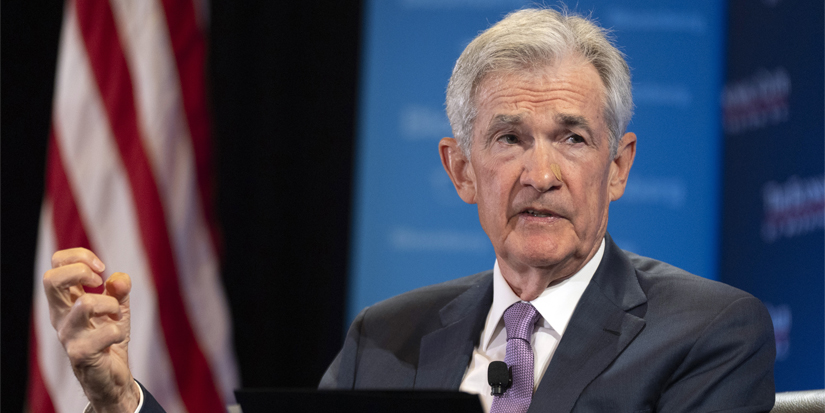
Jerome Powell and the FOMC members know this. They say they will cut rates when inflation (as they measure it) is on a “sustainable path” to their 2% target. Maybe that’s what they will decide next week, but I doubt it.
Further, Michael Lebowitz writes this week (in a report we sent in full to Over My Shoulder readers) that fiscal policy and not Fed policy will be the main driver of interest rates in the future, as the cost of the debt is drowning out the ability of the Fed to use normal monetary policy:
“As debt issued years ago with low interest rates matures and new debt with higher interest rates replaces it, the interest expense will keep rising. For context, if we assume the government's average interest rate is 4.75%, likely close to their weighted average rate on recent debt issuance, the interest expense will rise to $1.65 trillion, not including new debt. $1.65 trillion is over $300 billion above the government's next largest expenditure, Social Security. Furthermore, it is double defense spending for 2023. The annual federal deficit has only been above $1.65 trillion twice (2020 and 2021) since its founding in 1776.
“While the situation may sound gloomy, lower interest rates solve the problem. If interest rates return to the levels existing before 2022, the interest expense could easily fall below $700 billion, about half of the cost than if rates remain at current levels. Therefore, interest rates will have to be kept in check by the Fed.”
But wait! If the Fed accommodates the US government with lower-than-appropriate rates won’t that bring back inflation? Or worse, inflationary stagflation?
Yes, now you get it. Once again, you have to balance two opposite ideas at the same time.
The market expects a rate cut in September. But the market expected six rates cuts last December. The Fed has lots of impossible things to balance. The minutes from this week’s meeting should be interesting.
My friend Ed Easterling of Crestmont Research saw my letter last week and wrote to remind me of the coming yearly comparisons. Headline CPI actually declined last October-December—which is why Wall Street got so excited about rate cuts, then disappointed when inflation rose again in the first quarter. That period means this year’s Q4 CPI readings will be measured from a lower base. This “base effect” will mean a bias to higher annual rates.
The FOMC members surely know this. They understand it’s a short-term distortion. Nevertheless, they are conscious of how their decisions are perceived and the effect on market and consumer expectations.
Is the FOMC going to cut rates in September and/or November, knowing that inflation will probably pop higher soon afterward? Again, there will be a good explanation, but it will look like they cut too soon early next year. The resulting criticism may tie their hands later. That may sound like a stretch but trust me, they think of these things. At least, I hope they do.
A few months ago, Torsten Sløk made a stir by predicting no rate cuts this year. From what I see, he’s probably right. Housing inflation is unlikely to show substantial movement, and unless it does then it’s ridiculous to say the inflation target is coming into view.
For inflation, the last mile is the toughest. It may seem like “just” a mile considering where we were, but it is still a long way to go. So close and yet…
New York, Fishing, and Thoughts on What “Old” Means
I will be in New York August 10‒12 for meetings and dinners on a wide range of topics. Then the end of the month finds Shane and I fishing with 30 friends and readers at the West Coast Fishing Club on an island in far Northwest British Columbia.
Some of the public conversation has been around the topic of some people being “too old” for this or that job. I would suggest that age isn’t just a number. Some people get old in their 60s, both physically and mentally. We all know people in their 80s who run circles around us. My doctor and close friend, Dr. Mike Roizen, is an Energizer Bunny at 78, logging 10,000 steps in a normal 12-hour day, multiple medical columns a week, heavy research, multiple businesses, and still sees 17 patients in a day once a week.
We will soon be launching a letter here at Mauldin Economics on longevity and bio hacks that will keep you running longer. There are well-researched new therapies that may stave off early-stage dementia and Alzheimer's, increase your ability to build muscle mass, get better sleep, and so on.
I believe in perhaps five years—10 years for sure—age 85 will be the new 50‒60 for some of us. Maybe even better. This whole “you're too old” conversation will likely disappear. That doesn't mean we shouldn't make room for new generations, but maybe we don't need to kick experience to the curb too quickly. In the midst of all the other turmoil that we are seeing, this one will play out in the background, but it will be real. I saw that Elon Musk the other day said living longer or living forever would result in stagnation for humanity. Pardon me for not volunteering to shuffle off this mortal coil any sooner than I have to. I am just having too damn much fun. Be careful when you tell someone they are too old.
My daughter Tiffani and granddaughter Lively are here in Puerto Rico with me. Sitting outside at dinner the other night, the manager came by and commented on how hot it was. Tiffani had just left Texas where it was over 100. It was a mere 91 for a high that day here in Puerto Rico (normal here). She thought it was pleasant.
And with that, I will hit the send button. Have a great week!
Your looking forward to seeing friends in New York analyst,

John Mauldin
P.S. If you like my letters, you'll love reading Over My Shoulder with serious economic analysis from my global network, at a surprisingly affordable price. Click here to learn more.
Read important disclosures here.
YOUR USE OF THESE MATERIALS IS SUBJECT TO THE TERMS OF THESE DISCLOSURES.
Put Mauldin Economics to work in your portfolio. Your financial journey is unique, and so are your needs. That's why we suggest the following options to suit your preferences:
-
John’s curated thoughts: John Mauldin and editor Patrick Watson share the best research notes and reports of the week, along with a summary of key takeaways. In a world awash with information, John and Patrick help you find the most important insights of the week, from our network of economists and analysts. Read by over 7,500 members. See the full details here.
-
Invest in longevity: Transformative Age delivers proven ways to extend your healthy lifespan, and helps you invest in the world’s most cutting-edge health and biotech companies. See more here.
-
Macro investing: Our flagship investment research service is led by Mauldin Economics partner Ed D’Agostino. His thematic approach to investing gives you a portfolio that will benefit from the economy’s most exciting trends—before they are well known. Go here to learn more about Macro Advantage.

Recent Articles
AI: Where Will the Money Come From?
October 23, 2026
When Will AI Meet Cash Flow Reality?
October 16, 2026
The Biggest Problems We Face Today
October 9, 2026
Economic Desiderata
October 2, 2026
Reversing Financial Repression
September 25, 2026
Fed Policy: As Good As It Gets
September 18, 2026

Thoughts from the Frontline
Follow John Mauldin as he uncovers the truth behind, and beyond, the financial headlines. This in-depth weekly dispatch helps you understand what's happening in the economy and navigate the markets with confidence.
Let the master guide you through this new decade of living dangerously
John Mauldin's Thoughts from the Frontline
Free in your inbox every Saturday
By opting in you are also consenting to receive Mauldin Economics' marketing emails. You can opt-out from these at any time. Privacy Policy