
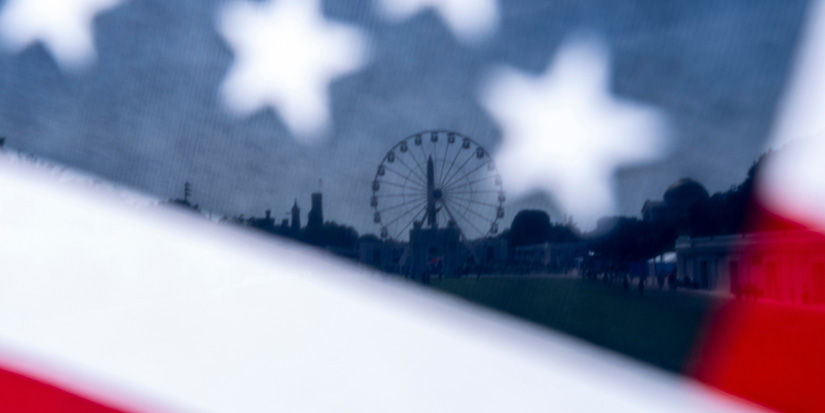
The Great American Sleepover

This letter is going to be a little different, and much shorter. But on July 4 I hope it makes you feel good!
Costco, Barbeque and Ranch Dressing
This Is Why America Will Come Together After the Next Crisis
July 4, Puerto Rico and How to Feel Good about America
This letter is going to be a little different, and much shorter. But on July 4 I hope it makes you feel good!
Regular readers know I spend most of my writing time worrying — in a constructive, analytical way, I hope — about what I think is a coming national and economic crisis, about debt trajectories, monetary policy missteps, and the various macro landmines that litter the path ahead. As well as arguing that we are still in a Muddle Through world and that things aren’t really that bad. That is my job, and I take it seriously.
I interact with a lot of readers. One of the questions I get is how do you believe the country will come together after the time of crisis that you’re describing might happen? It’s a good question because as we look around it doesn’t seem like there’s a lot of willingness to cooperate with each other. But history and similar events suggest that we will come to a better place, after a very bumpy ride.
But this week, the Fourth of July, the 250th birthday of the greatest experiment in self-governance the world has ever seen, I want to do something different. I want to celebrate. And I want to use a lens I genuinely did not expect to be reaching for: the reactions of soccer fans from around the world who came to the United States for the 2026 FIFA World Cup and discovered, to their own astonishment, that they loved it.
Let me tell you what they found. And why it should make all of us optimistic for the future.
I want to tell you about Lawrence, Kansas.
You may not know Lawrence. It sits along the Kansas River about forty miles west of Kansas City, home to the University of Kansas, some fine barbecue, and roughly 100,000 people who tend to go about their lives without attracting much international attention.
This summer, the Algerian national soccer team set up its World Cup training base in Lawrence. And the town of Lawrence, unprompted, unscripted, without any directive from FIFA or the State Department, carved the Algerian national flag into the grass of a public space and unveiled it as a welcome gift.
If you want to understand what has been happening in this country this summer, on America’s 250th birthday, the image of a Kansas town carving a foreign nation’s flag into a lawn and saying, ‘Welcome, we’re glad you’re here,’ is the one I would hang on the wall.
The Reverse Tourist Gaze
Researchers at Northeastern University have a phrase for what has been flooding social media this summer: the ‘reverse tourist gaze.’ John Wihbey, professor of media and communications technology at Northeastern, explained it this way:
“We get this kind of ‘reverse tourist gaze’ through the eyes of people who haven’t seen American culture up close. The big trucks, the Waffle Houses, the stadium infrastructure, the kind of supersized nature of American infrastructure and cultural life. It takes an outsider to come show us how it’s different than other cultures and the rest of the world.”
Source: Northeastern Global News
He is onto something important. We tend to become blind to the remarkable things in our own lives. Americans drive past Buc-ee’s without a second thought. We have been to a Bass Pro Shop. We know what Texas barbecue is supposed to taste like. We forgot, long ago, to be amazed.
Then a few million visitors arrived from around the world, and they picked up their phones, and the amazement poured out of them.
These visitors did not arrive expecting to love us. According to Pew Research, positive favorability ratings for the United States are at or near their lowest since 2002 in many of the countries that sent teams to this World Cup. In many cases, they arrived expecting something close to the opposite.
What they found instead broke their expectations in the best possible way. This was from a Scottish visitor:
“The America we are experiencing right now is the America we were promised growing up. We were expecting to be met by ICE agents, aggressive police, and the political climate we all see on the news, and that could not be further from the truth of what we’ve actually experienced here. Honestly, every single person we’ve come across has been out of this world.”
Source: yahoo! sports
Read that again. ‘The America we were promised growing up.’ This person grew up somewhere in Scotland, watching American movies, absorbing an image of this country that the news cycle had largely buried. Then they came here and discovered that the image they had carried around since childhood, the open, friendly, generous America, was real. They just had to show up to find it.
Prof. Deana Rohlinger from Florida State University wrote:
“Social scientists have known for decades that when people from different groups interact under positive conditions, stereotypes often break down. The World Cup is one of the largest examples imaginable. Part of why this resonates is that it pushes back against a story we’ve been telling ourselves for years. Then outsiders, people with no reason to flatter us, arrive expecting one thing and encounter another. Their reactions interrupt the narrative. They provide a more generous, and probably more accurate, reflection of who we are.”
Source: Florida State University News
Texas Delivers, As Usual
I will confess a certain parochial satisfaction in noting that Texas has carried a disproportionate share of the viral load this summer. This should surprise precisely no one.
There are literally tens of thousands of social media posts about the US. The Texas installments alone could fill a travel memoir. A Japanese fan documented his first bite of monster Texas barbecue beef rib. As did the Norwegians, Scots, and others. And yes, a great big Texas barbecue beef rib is a religious experience. Another Japanese visitor traveled to Fort Worth and was amazed by the western character, the cowboy hats, the historic stockyards, the streets that look, in his words, like a real-life Western movie. Dutch fans went full cowboy at the Fort Worth Stockyards. An Irish visitor sat down at a Texas Roadhouse and emerged a changed man. And a South African traveler walked into a Buc-ee’s and was rendered, by all accounts, temporarily speechless.
“You can explain Buc-ee’s. You can show photos of Buc-ee’s. But nothing really prepares someone for Buc-ee’s.”
I will note for international readers who may be unfamiliar: Buc-ee’s is a chain of Texas roadside travel centers that are, by European standards, roughly the size of a small shopping mall. They sell beaver-branded merchandise, fresh brisket, kolaches, fudge, baby clothes, and an amount of beef jerky that would alarm most nutritionists. They are magnificent when you are on a road trip.
Funniest comment about Buc-ee’s? One tourist looking at 120 gas pumps wondered if we were planning to fuel a squadron of planes. For those of us who have wandered around various countries in Europe trying to find a gas station, you can understand their amazement.
Norwegian fans toured a Bass Pro Shop with what FOX 26 described as genuine theme-park energy. I understand this completely. I first visited a Bass Pro Shop 28 years ago in Grapevine, Texas. Some of these are over 500,000 square feet. It is, in its own way, a temple to the American relationship with the outdoors, simultaneously overwhelming and inspiring.
Costco, Barbeque and Ranch Dressing
Something interesting is happening with all these viral videos, and Northeastern’s Professor Wihbey put his finger on it precisely. The same algorithms that normally funnel people toward outrage and political infighting are — this summer, at least — promoting something else entirely:
“Algorithms tend to uprank and promote high-emotion content. It’s often pointed out as a negative, insofar as a lot of the high-emotion content is political infighting or name-calling or scandal. The endearing examples of World Cup camaraderie are going viral because of their emotional qualities as well, but it’s a celebratory form of high-emotion, and that’s cool to see.”
Source: Northeastern Global News
The same machinery that can make us miserable is, at this particular moment, making us feel good about ourselves. I will take it.
Consider what is going viral: a Scottish fan at Fenway Park singing with Red Sox fans. Japanese tourists riding mechanical bulls in Texas. European visitors turning an ordinary American sports bar into a full-blown international celebration complete with chants that echoed down the block. A group of Scottish supporters who discovered John Denver’s ‘Take Me Home, Country Roads’ and turned it into an international anthem, belting every word with a passion that would have made John Denver proud. Thousands of attendees in some indoor monster stadium singing “Sweet Caroline” at the top of their lungs.
And then there is ranch dressing. I am not making this up. A single post on X praising the addictive delights of American ranch dressing was viewed more than ten million times. The appetite — if you will forgive the pun — was so intense that the TSA felt compelled to issue a public reminder: 'Pack it in your CHECKED BAG on the way home.'
This Is Why America Will Come Together After the Next Crisis
Yes, I get that college-educated voters are actively electing socialists/anarchists who want to abolish the police and army and open the borders. There will be a number of them in the next Congress. That socialist virus seems to be spreading way too rapidly.
But if you go back to the 1930s you will find actual communists were making their way into the mainstream. Socialism wasn’t seen as a negative word in many circles. But that changed so fast.
The Civil War? Economic collapses? Bank panics? The Great Recession? Pandemics? Yes, all of that has happened in the past. And the Republic survived and prospered.
And the people that were at one point at odds with each other came together and moved forward. They picked up and moved on. And the country grew and prospered. Admittedly, not evenly. As William Gibson said, “The future is here. It’s just not evenly distributed.” And that will likely always be the case, as it has been throughout human history. And as uneven as the distribution has been, there is no country with more prosperous people.
I do believe we will have a crisis, but just as in every past crisis I believe that we will come together and power through it. And America will be stronger and better afterwards.
Happy birthday, America. Two hundred and fifty years. Still the greatest experiment in human liberty the world has ever attempted, still capable of surprising people with our warmth, still making the world drive nine hours across Texas and loving every mile of it.
You’re doing something right.
You’re still the America we were promised growing up.
July 4, Puerto Rico and How to Feel Good about America
Wednesday, I had to go to the doctor to get a thorn that had embedded in my foot cut out. The shot to numb the area was quite painful, although after that it was fine. But there was a mess up in the scheduling and I ended up waiting for two hours. The best two hours of the month. As I was researching this article I decided to go on TikTok to look at the social media postings for myself.
I spent almost 2 hours watching and listening to one tourist after another extolling the virtues of America and talking about how friendly the people were, the size of our big-box stores, Texas barbecue, how big the country was, the vastness of the West and more. You should do that this weekend. And simply ask for postings from tourists visiting the US. And then start scrolling.
First, it will make you smile and then pretty soon you see the world from a completely different standpoint. The tourists from around the world eating a 1-pound beef rib barbecue and having what looked like a religious experience. Someone in some small rural town invited a young British tourist to tour the local high school football and basketball arenas. This was in a town of 3,000 people. The basketball arena could hold half the town. There was an entire wall of just the trophies from the high school. The football stadium could hold almost everyone. He was clearly having a hard time wrapping his head around the concept of a small town supporting their high school that much.
God help him if he got taken to Allen, Texas, where they spent $80 million on their football stadium.
Seriously, just go to TikTok and do it. I will confess that I had never been on TikTok, but this made me feel good.
Shane and I wish you a wonderful July 4. You have a great week!
Your grateful to be an American analyst,

John Mauldin
P.S. If you like my letters, you'll love reading Over My Shoulder with serious economic analysis from my global network, at a surprisingly affordable price. Click here to learn more.
Read important disclosures here.
YOUR USE OF THESE MATERIALS IS SUBJECT TO THE TERMS OF THESE DISCLOSURES.
Put Mauldin Economics to work in your portfolio. Your financial journey is unique, and so are your needs. That's why we suggest the following options to suit your preferences:
-
John’s curated thoughts: John Mauldin and editor Patrick Watson share the best research notes and reports of the week, along with a summary of key takeaways. In a world awash with information, John and Patrick help you find the most important insights of the week, from our network of economists and analysts. Read by over 7,500 members. See the full details here.
-
Invest in longevity: Transformative Age delivers proven ways to extend your healthy lifespan, and helps you invest in the world’s most cutting-edge health and biotech companies. See more here.
-
Macro investing: Our flagship investment research service is led by Mauldin Economics partner Ed D’Agostino. His thematic approach to investing gives you a portfolio that will benefit from the economy’s most exciting trends—before they are well known. Go here to learn more about Macro Advantage.

Recent Articles
AI: Where Will the Money Come From?
October 23, 2026
When Will AI Meet Cash Flow Reality?
October 16, 2026
The Biggest Problems We Face Today
October 9, 2026
Economic Desiderata
October 2, 2026
Reversing Financial Repression
September 25, 2026
Fed Policy: As Good As It Gets
September 18, 2026

Thoughts from the Frontline
Follow John Mauldin as he uncovers the truth behind, and beyond, the financial headlines. This in-depth weekly dispatch helps you understand what's happening in the economy and navigate the markets with confidence.
Let the master guide you through this new decade of living dangerously
John Mauldin's Thoughts from the Frontline
Free in your inbox every Saturday
By opting in you are also consenting to receive Mauldin Economics' marketing emails. You can opt-out from these at any time. Privacy Policy
On my many trips to North America I have aquired great respect for the US people along with a significant distrust in their Government and what they term Democracy by the masses.
Maybe if each of us trusted our own judgment and innate common sense rather than looking to the MSM, social media/influencers (who breathlessly and in an attempt to gain attention for self-validation) for an explanation of reality, we’d be more aware of our individual and collective good fortune.
Life isn’t perfect—but thanks to our forefathers wisdom—it is better here than anywhere else at any time in human history.
Thanks , I needed that!!!
The most biased and narrow minded John Maudlin post I have read in 15 years. Looks like Fox news wrote his post. 99% of democrats do not want to abolish the police, the army or have fully open borders. All the democrats that I know do not support far left policies, or wokism, or communism or marxism as the WSJ likes to infer. The vast majority of democrats as I read them want a system that is not run by a capitalist ethicless mafia or tax exempt Robber Barrons.
Wow. An entire article extolling the virtues of our country's greatness and how the country will one day come together again. Only to be destroyed in closing paragraphs with divisive mis-information (socialists do not want to abolish police or army or have open borders). This kind of dialog is exactly why it's going to be so hard for this country to come together again.
John - how exactly are you going to come together with someone you identify as a virus? This shows you are the problem, not the solution.
You should be ashamed.
I have subscribed to this newsletter since 2010, and this issue is, hands down, the best one yet.
I have the same optimism that is expressed here. Anyone who knows our history knows we have had far more fractious periods, not even counting the Civil War, and we have always found our way back to sanity. I think of the 1824 and 1876 elections. I think especially of the 1960s which make today look like a walk in the park.
Sometimes it really does take outsiders, whether on the personal or the national level, to marvel at the "better angels of our nature".
John. Since we both live in resort towns you might feel this also. Sometimes I am really surprised that so many people want to come here. Especially in the summer when I just want to stay inside with the AC on high.
But I think we all get jaded. I live on a beach. Visitors may be seeing the beach for the first time. We live in the US. The WC fans may be seeing it for the first time. So when we see traffic or homeless or dirt, they see the Waffle House or the Flintstone sized rib that we take for granted.
We need to remember that the grass on our side of the fence is green too
I'm saddened by you equating Socialist Democrats with anarchists (and I am neither). The goals of anarchists and Socialist Democrats are dramatically different from each other and equating them is wildly inaccurate. Democratic Socialists to not want to abolish the police nor the military, and while some of their members to want to shift funding away from increasingly militarized police to other forms of community services it is not a part of their platform. This sort of hyperbole is beneath you.
Mr. Mauldin,
Thank you for your comments. I have been a reader and investor as long as, I think, you have been in business.
I appreciate your brevity, insight and perspective. Much applause to you for all aspects of your work (too numerous for me to mention).
It is a shame that some people, e.g. Eddie, like numerous politicians, frequently use vulgarity in their comments to express a lack of intelligence.
Greetings from a long time virtual friend (reader) from Lawrence, Ks. Yes, Lawrence, our community has history of egalitarianism having been founded by abolitionists to bring Kansas into the Union as a Free State.
I am retiring at the end of August (age 77). I was hoping to not retire before my mid-seventies. About fifty years ago one of my research papers (for an MBA) argued for increasing the elgibality for Social Security to early or mid-seventies, to account for the increased life expectancies of our citizens then (1976) and in the future (now). There are other adjustments that will be required to "save" Social Security but adjusting the age(s) that trigger benefits must certinaly be one of them. Remember, demographics Is "the future that has already happened".
Not sure why I shared the above, but just wanted to send a note to a "real" Economist from an old (broken down) economics major.
Happy 4th, and sorry about your foot!
Michael Carlisle