
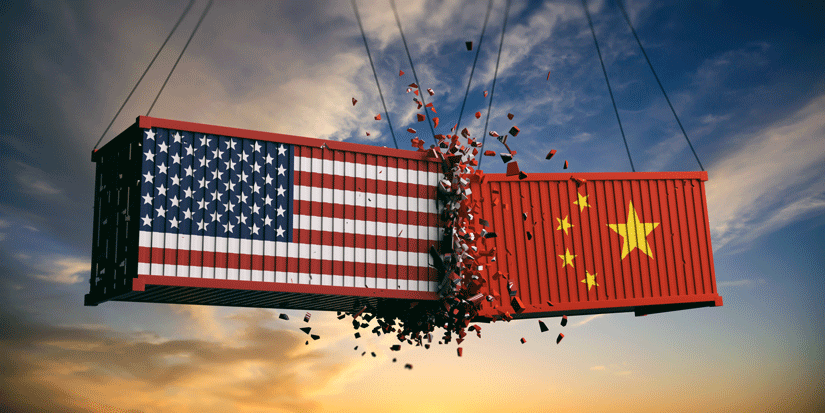
No Winners in a US-China Trade War

Add paragraph text. Click “Edit Text” to update the font, size and more. To change and reuse text themes, go to Site Styles.
In 1972, Richard Nixon flew to Beijing expecting a multipolar world and accidentally got a unipolar one.
On May 14, Donald Trump flies to Beijing attempting to build a bipolar one. History suggests he may have just as little say in the matter, but the attempt itself will reshape the next decade of global trade, security, and markets.
The Situation
US President Donald Trump is set to travel to Beijing to meet with Chinese President Xi Jinping on May 14–15. The meeting is the first in-person dialogue since an October 2025 truce in the US-China trade war. It is also the first of what sources have rumored to be several meetings between the two leaders in 2026.
The meeting was initially set for March 31–April 2 but was delayed by the United States. President Trump’s stated reason for the delay was not wanting to leave the US during the peak of its war against Iran, but Treasury Secretary Scott Bessent’s lengthy talks with Vice Premier He Lifeng in Paris shortly before suggest the deal simply wasn’t ironed out. Top leaders don’t meet until their junior staffs have settled the details, and all signs point to the upcoming proceeding as planned.
The US and China are the world’s largest and most important economies. They are also the authors and prime beneficiaries of the current era of globalization.
Why the Trump-Xi Summit Is So Pivotal
Since former US President Richard Nixon landed in Beijing in 1972 and redefined US-China relations, no countries have done as well as these two. Since 1972, the US has generated more than $23 trillion in additional GDP, while China lifted 800 million people out of extreme poverty, accounting for three-quarters of all global poverty reduction in the period. In 1990, China accounted for just 1.6% of global GDP; today it accounts for nearly 18%, meaning the two together now represent ~44% of the world economy, up from ~28% when globalization began in earnest.
A dollar invested in the S&P 500 the year Nixon landed in Beijing is worth over $270 today. China, which had negligible industrial capacity in 1972, now produces more manufactured goods than the next nine countries combined.
This is not to say that the fruits of globalization were enjoyed equally within either economy. The CCP’s cultural genocide of the Uighurs and the slow-motion death of the US industrial heartland are the receipts: ruthless consolidation in China, hollowed-out communities, and rising inequality in America. But this was the deal both sides made. The US told itself fairy tales about economic liberalization leading to a more democratic China; in fact, both populations simply got significantly richer than the rest of the world. And to quote the bard, therein lies the rub—in a US-China trade war, neither can win against the other. Victory in a US-China trade war is a competition about who can lose the least. The true winners are the countries that can stay out of the trade war, a difficult feat in a global economy so dominated by Washington and Beijing.
It’s easy to assign President Trump’s first term as the starting gun of the US-China trade conflict, since he ran on being tough on China back in 2015. But the fight began in 2009 when the Obama administration slapped a 35% tariff on tires from China. Geopolitical forces were already well at work before Trump and Xi came to power. Trump sped things up, but his pressure was always in service of “the art of the deal.”
Then the pandemic hit. You don’t need to be a conspiracy theorist to see that Beijing’s stubbornness made it much harder for the world to control the virus. The pandemic threw US-China relations off course and likely helped Biden win in 2020—and Biden had no interest in making a deal with China. Instead, he doubled down on Trump 1.0’s tough talk. Trump 2.0 prefers to pick up where he left off. His administration has threatened, cajoled, and tariffed China to no end, but it was clear even on the campaign trail that President Trump does not ultimately want to fight with China; he wants to deal with China.
In the then-candidate’s own words in August 2024: “If they want to build a plant in Michigan, in Ohio, in South Carolina, they can—using American workers, they can.” This is one of President Trump’s most maverick policy choices. The US national security establishment and the rest of the “swamp” are China hawks. They see China as the next great peer competition to US power in the world… and the most serious threat the US has ever faced. (In terms of sheer size, power, and wealth, they are correct.) Moreover, the hawks aim to use Trump’s threats, which Trump needs as leverage in his negotiations, to realize their own goals in blocking the rise of Chinese power.
China would also rather avoid a fight—the US is its single-largest export market, and exports make up roughly 20% of China’s GDP. When Trump 2.0 tariffs hit in 2025, bilateral trade fell 29%, yet the US remained China’s top export destination. China produces ~28% of global manufactured goods but can’t absorb them domestically, making the US the key buyer keeping its factories running. Still, China is ready to fight if needed, knowing a nationalist dictatorship can weather economic pain better than a liberal democracy.
Which is why, even while the US and China have been negotiating, China rolled out new trade rules that lay the legal groundwork for punishing foreign companies that seek to shift their sourcing away from China. Over the weekend, China even flat out told five domestic refiners linked to Iranian oil trade to ignore explicit US sanctions based on a 2021 Chinese law.
All of this makes the upcoming Trump-Xi summit pivotal.
Three Scenarios Over the Next Decade
At the macro level, there are three primary scenarios for where the world goes over the next 10 years.
Scenario 1 is a bipolar world, with the US and China dominating global politics, trade, and security. This can express itself in one of two ways:
A Cold War 2.0-style conflict, with individual nations forced to choose between rival blocs
A more benign “G-2” arrangement, where the US and China ignore their differences and cooperate as master and apprentice, Sith-lord style, to replace the US-led liberal international order
Trump has used the “G-2” language occasionally in the last year, and this scenario would arguably be best for the largest number of people.
Scenario 2 is a return to unipolarity—either US dominance reasserted or China displacing it—which would likely require regime collapse or serious instability on the losing side.
Scenario 3 is multipolarity, where the US-China competition continues despite President Trump’s dealmaking efforts. Both remain formidable and wealthy—but less so than they could have been. Their competition opens space for Brazil, Turkey, India, and perhaps the EU to carve out their own spheres of influence.

To his credit, Trump is pushing back against the worser angels of our nature. He’s attempting to turn the tide of a US-China rivalry back toward peaceful, stable, even mutually enriching competition, and away from the fever dreams of World War III in the Taiwan Strait peddled by the US national security establishment and the mainstream media. But he is up against forces far more powerful than his position: 77% of Americans hold an unfavorable view of Beijing.
In a multipolar world, it is a good idea to be bullish on the countries and markets that will benefit. In a bipolar world, it makes more sense to concentrate bullishness on the G-2. When it comes to applying geopolitics to investing, this question is everything. If the answer to this question changes—whatever your answer is—your entire model must change. Everything flows from it.
It is worth noting that when Nixon decided to make a deal with China in 1972, he did not see the coming unipolar age of American dominance on the horizon. He believed the world was moving in a multipolar direction and wanted the US strong enough to balance against the Soviets and any future challengers. Policymakers’ intentions often mean little against the impersonal forces that govern geopolitics: Nixon went to Beijing preparing for a multipolar world and accidentally got a unipolar one. Trump is going to Beijing to build a bipolar one. History suggests he may have just as little say in the matter.
I’ve been in the multipolar camp since 2019 and will be watching the summit for any signal that Trump can trump history.
Map/Chart of the Week
Two weeks ago, for a consumer goods and supply chain risk audience, I built this map by screening countries against four criteria: high fertility rate, accelerating GDP-per-capita growth, low current GDP-per-capita base, and cheap electricity—each measured relative to global averages.
The result is an interesting and counter-intuitive map of areas posed for outperformance over next two to five years in global markets.

Blind Spot
What’s not on people’s radar but should be…
Japan’s Ministry of Finance spent an estimated $34.5 billion buying yen on April 30 after the currency breached 160 against the dollar. It was the first intervention since July 2024, and Finance Minister Katayama’s “final warning” language before pulling the trigger suggests it won’t be the last. The yen briefly snapped back to 155 before drifting weaker again.
This is the central tension of Prime Minister Takaichi’s economic agenda. She wants cheap government borrowing to fund a defense and industrial buildup, a stable yen to protect household purchasing power, and growth. She cannot have all three. The tension is institutional as well as economic: Takaichi needs the Bank of Japan to keep rates low enough to fund her ambitions, but the BOJ has been inching toward normalization, and the finance ministry worries more about the yen weakening than Takaichi’s agenda progressing.
As I wrote in February, the most likely outcome is that Takaichi accepts yen depreciation and bets that nominal wage growth can outrun it. So far, that bet is losing. Real wages fell every month in 2025, the fourth consecutive year of decline. Nominal wages rose 2.3%, but consumer prices rose 3.7%, eating the gains.
The Hormuz crisis makes this worse. Japan imports nearly all its energy, and a weak yen plus $120+ oil is terrible for household budgets. Last week’s intervention shows how narrow Takaichi’s path is. Her Meiji 2.0 vision—rearmament, industrial sovereignty, a Japan that punches its weight again—depends on convincing the public to endure short-term pain for long-term revival. But every month of negative real wages erodes that faith a little more. Currency interventions buy time but not much else, and not much of it. Takaichi’s government has a lot of work to do if it is to succeed.
Reader Question

Finally…
What I’m watching: NBA Playoffs!
What I’m reading: Breakneck: China’s Quest to Engineer the Future, Dan Wang
What I’m listening to: “Warp Speed for Everything,” The Jacob Shapiro Podcast (a fantastic conversation with author and analyst Dror Poleg exploring how AI is reshaping work, value, and the economy). Check it out here.

Jacob Shapiro
Read important disclosures here.
YOUR USE OF THESE MATERIALS IS SUBJECT TO THE TERMS OF THESE DISCLOSURES.
Permanlink:
Put Mauldin Economics to work in your portfolio. Your financial journey is unique, and so are your needs. That's why we suggest the following options to suit your preferences:
-
John’s curated thoughts: John Mauldin and editor Patrick Watson share the best research notes and reports of the week, along with a summary of key takeaways. In a world awash with information, John and Patrick help you find the most important insights of the week, from our network of economists and analysts. Read by over 7,500 members. See the full details here.
-
Invest in longevity: Transformative Age delivers proven ways to extend your healthy lifespan, and helps you invest in the world’s most cutting-edge health and biotech companies. See more here.
-
Macro investing: Our flagship investment research service is led by Mauldin Economics partner Ed D’Agostino. His thematic approach to investing gives you a portfolio that will benefit from the economy’s most exciting trends—before they are well known. Go here to learn more about Macro Advantage.
Recent Articles
The War on Grain
October 22, 2026
Singing the Songs of Low-Priced Bonds
October 15, 2026
Brazil’s Turn to the Right
October 8, 2026
China Is Building What Nature Gifted the US
October 1, 2026
Trading Russia for Canada
September 24, 2026
Can Anyone Bring the Houthis to Heel?
September 17, 2026

New from Jacob Shapiro × Mauldin Economics…
The World Isn't Ending
Geopolitics, translated for investors
The headlines say the world is going to hell in a handbasket. The reality is that it’s just being rearranged —and that there is opportunity amid the chaos. Join Jacob Shapiro every Thursday as he translates complex global power shifts into actionable intelligence for your portfolio.
Join thousands of investors who refuse to watch the world from a fetal position.
By opting in you are also consenting to receive Mauldin Economics' marketing emails. You can opt-out from these at any time. Privacy Policy
Timely article...thank you. I was just watching a NYT interview with Ray Dalio on his view of the future: he concluded by saying that much will be determined by how we treat each other, domestically and internationally. Unfortunately with so many of our 'leaders' following a win-lose doctrine there is little hope in the short to medium term of a truly cooperative and compassionate way ahead.
It's why I see Scenario 3 as the likely outcome: trust in our current leaders is eroding to a point where their hold on power is unsustainable and irreversible, and a multipolar world will emerge. How we get to this point, and what it will look like, is still very uncertain.