
Inflation Doesn’t Cooperate

There is so much going on, it is hard to know where to begin. CPI just came out, the Republican administration put on offer some very nonconservative spending proposals, Treasury Secretary Scott Bessent makes some rather (how to say this?) problematic statements. The FOMC meets next week. The data is all over the place.
Where Do Republicans Go From Here?
There is so much going on, it is hard to know where to begin. CPI just came out, the Republican administration put on offer some very nonconservative spending proposals, Treasury Secretary Scott Bessent makes some rather (how to say this?) problematic statements. The FOMC meets next week. The data is all over the place. I had a long and epic dinner in New York with David Bahnsen, Rene Aninao, and Brian Syztel which has my mind buzzing with ideas and new concepts.
But first, let me take you back to the early morning in Grapevine, Texas on September 11, Twenty-five years ago. Our phones began ringing with friends telling us to turn on the TV. We saw the tragedy. I was managing a fund and my brokers were on Wall Street. I simply had no perspective up until that point. I called him and heard the horror firsthand.
At the time, it was the most impacting moment of my life. Not unlike Pearl Harbor was for my father. You knew everything would change, just not how or why or to what. My father captained an ocean-going tug for the Army. He pushed the first barge into Tokyo Bay which carried MacArthur’s furniture. The Japanese were decisively defeated and are now our allies.
We must never forget 9/11, and we must never forget who triggered it. It is not a state actor that can be defeated and it is not World War II. But the dangers are still there. Never forget.
Inflation Doesn’t Cooperate
Trigger warning: some of the letter below will be critical of some the latest proposals and actions from the Trump administration. I get that the proposals from many of the Democrats are far worse. But that doesn’t justify a departure from conservative principles. Jumping in:
The Consumer Price Index for August showed that headline inflation rose 0.4% as expected, but it is still a hot number. 3.4% year-over-year inflation is a long way from the already too high 2% target. Energy was of course a large factor, and is up 4% over the month and 27% year-over-year. Housing prices are still somewhat overstated but getting closer to current reality. Note that housing prices change with a 12-month lag and so can distort the inflation figures on both the up and down side depending on the trend.
The Producer Price Index this week was annualized 5.4%. Below is from the BLS chart on the PPI. I cut-and-pasted just the monthly annual number and the core number. You can see the full data at the link below. The average for the last six months has been well over 5%. That feeds directly into CPI pressures. This is a trend that is not the Fed’s or our friend.

Further, shipping rates over both land and sea are spiking. Diesel fuel is getting really high. That all filters into the price of everything physical that has to be shipped.
This morning, we see 85-86% chance that the Fed will hike rates at the FOMC meeting next week. As I noted in previous letters, Chairman Kevin Warsh simply did not have the votes to raise rates that the last meeting. I am sure there are a lot of conversations going on among FOMC members and the Chair, and his Jackson Hole speech certainly improved his chances of getting a few more members to vote with him.
Here’s the problem. The midterms are in less than two months. I don’t think the chairman will want to raise rates with an 8 to 4 vote. You want to see some consensus here. Can he get nine votes or even 10? I hope so. But if he can’t raise rates this next meeting, it almost certainly means that he will not raise rates at the October 27-28 meeting which is only six days before the general election. Talk about being between the rock and a hard place.
My view is if they do not raise rates, long-term rates will go up even more. It will really call into question whether the Chairman is serious about inflation, no matter how much he keeps talking the talk. As Thomas Sowell told us, we should not judge a policy by its intentions but by its actions and results. The Federal Reserve is still expanding the balance sheet. At a minimum they can stop that. Warsh has to get in front of this, or it could get out of hand.
I expect a rate hike, and I believe (hope?) that long rates will come back down. The markets are justifiably nervous about inflation, and with proposals from the Republican administration which would only increase the deficits, they have reason to be nervous. The Fed needs to establish its bona fides.
The housing market is in the doldrums. At 6.9% 30-year mortgage rates, it is tough for a family to buy a new home. We are at a 10-year high in the supply of single-family homes. And while home prices are beginning to slip in most markets, the drop is not significant in terms of making it easier for families to buy their first home. Raising rates on the short end may ironically have the side benefit of reducing mortgage costs somewhat.

I Am the House Now
Treasury Secretary Scott Bessent said this week, talking about supporting the Japanese yen, “I am the house now.” And indeed, the yen did actually rise a few percentage points after their initial intervention and supposedly future interventions coordinated with the Bank of Japan. Below is the last 30 days of trading, and you can see where the yen is up 3.5% against the dollar over the last 30 days. And it has stayed down. but….

That move has been criticized most famously by Scott’s friend and mentor Stan Druckenmiller in a Wall Street Journal op-ed (which you should read), but a lot of us have been critical, noting that currency interventions are typically only temporary. It takes a fundamental shift in government policies and actual economic trading to change the trend.
Japan is running huge deficits and their economy is not that strong. There is a reason their currency weakened by over 50% from its all-time high. Now, can a coordinated effort between the US Treasury Department and the Bank of Japan make a temporary difference? That can last for months? Yes. And I think that’s what’s happening. Bessent doesn’t want the appearance of the Japanese not investing in the US treasury market before the midterms. The Bank of Japan is signaling they are going to raise rates which will help marginally, but they’re going to have to do more than on that front. And the Japanese government is still running large deficits which in the past has been almost entirely financed by the Bank of Japan. This is obviously inflationary, even with the very low inflation of Japan.
Bessent knows better. He was there when Soros and Druckenmiller faced down the Bank of England. He knows the history of currency interventions. But he is not a hedge fund now, he is the Secretary of the Treasury and he is trying to do what he can for different purposes. So he talks a good game but long-term it will not work. Japan has its own internal issues that need to be solved in order to maintain the valuation of their currency.
And while I am piling on Scott Bessent, let’s point out that his buying of long-term bonds in order to bring down they interest rate on the long end was spectacularly unsuccessful. First, $4 billion is spitting into the wind. If you really want to do something, you have to bring it in much larger size. And that creates a problem. It is essentially shifting chairs on the deck of the Titanic. Messing with the bond market is a magnitude more difficult and far less likely to succeed than trying to intervene in the yen market. The problem is not the bond market, it is the incompetence of Congress and its inability to control spending.
When Congress decides to reduce the deficit to below nominal GDP, long term rates will drop dramatically. Until then? Not so much. And buying long-term bonds and replacing them with short-term bonds is highly problematic. It is not good financial management, as it actually costs the country money long-term.
My friend Peter Boockvar did the math for us this morning. Quoting:
“I did a bit of back of the envelope math with regards to the Treasury bond buyback. I guessed at one of the bonds they might have bought back a piece of and it was originally a 30 yr bond, issued on February 15th 2016 and currently trading at $.65 on the dollar and has a coupon of 2.5%. The size of the issue was $40 billion.
“Let’s just say the $5b buyback was all of this issue, Treasury was able to reduce US debt by about $2.77b (buying $7.7b of notional bonds for $.65 on the dollar). Great! But while the 2.5% coupon on the $7.7b of debt reduction would save $192.5mm of annual interest expense, look at the cost of replacing that low cost debt. Treasury needs to issue $5b of short term bills to pay for the buyback. Let’s use the current 1 yr T-bill interest rate of 4.25% and to raise $5b of bills, interest expense would be $212.5 million annualized.
“So, we’ve given up the certainty of a bond with still 20 years of maturity at a coupon of just 2.5% and replaced it with a more than 4% rate on short term bills whose financing use of the short end is highly uncertain as to cost in the coming years.
“Why were the offers to Treasury on this buyback less than historically? Maybe many didn’t want to take a mark to market 35% loss on their long term bonds I’m guessing.
“I’ll take another of Stan Druckenmiller’s WSJ quote, 'This wasn’t liquidity management, it was price management.' And to repeat again, no lunch is free on Wall Street.
"US Treasury bond maturing on 2/15/46"

Where Do Republicans Go From Here?
I was on the Texas state executive committee for the Republican Party for almost 20 years from the early 80s to the early 2000’s. I was chair of many state committees, and held the gavel at some point at every convention from the late 80s on. I can go on, but the point is that I was clearly in the Republican camp. (I should note that a young version of me voted for McGovern and Carter.)
The Democrats dominated Texas state politics in the 60s and 70s, but that began to change in the 80s. It became a regular occurring event where Democratic political officials and sometimes entire counties would switch to the Republican Party. The rationale was always along the lines of:
“I didn’t leave the Democratic Party. The Democratic Party left me.” I should note that Democrats of my youth in Texas were largely conservative and had been for a century. The move leftward by the Democratic Party made them highly uncomfortable.
I have always been economically conservative and somewhat socially moderate, even more so today. I look at the Republican Party today and I don’t see many economic conservatives in Congress, except for the lip service kind. I get why the Senate is difficult, as the filibuster rule keeps a lot of conservative measures from passing. And I don’t want to get rid of the filibuster.
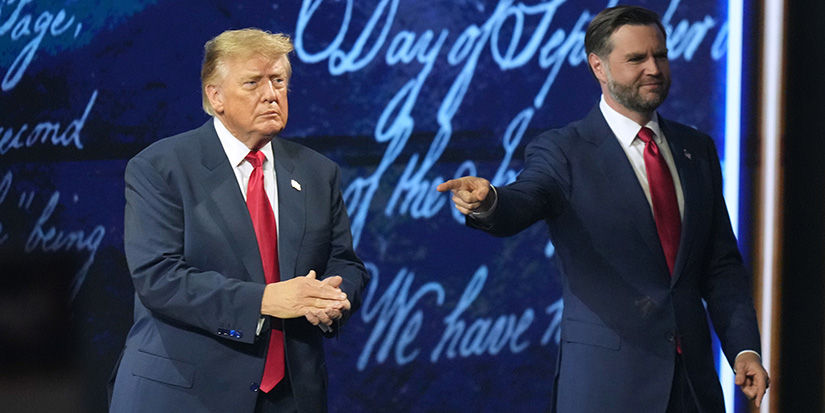
But the last few months have really got me puzzled. When the president says that he will give a bribe of $5,000 to every American if they give him a Republican House and Senate, which would cost an estimated $1.3 trillion, further destroy any budget credibility of the Republican Party and would add (my back of the napkin guess) at least 1% to inflation, meaning that rates would have to go even higher for longer, what do you do? That is not a Republican Party that I am familiar with. Reagan was popular, but not a populist. So was Bush, at least in his first term. There is zero chance such a proposal could make it through the Senate, and I would give pretty large odds that it could not pass the House
And then Vice President J. D. Vance proposes we repurpose money allocated for single mothers for daycare into a $9,000 per child welfare subsidy for stay-at-home moms for the family makes less than $76,000. In the name of supporting family values. Who can be against family values? And then employees of the theoretically conservative Heritage Foundation argue the proposal would be revenue neutral and profamily? What in the wide, wide world of Republican sports is going on?
I’m not going to go back in great detail, but essentially the money would come from the Child Care and Development Fund, a $12-billion block grant created in the 1990s to help low-income parents pay for care while working or finishing school. 30% of that money comes from Social Security. The authorization for the remaining 70% expired in 2020. Each year since then, Congress has renewed the funding.
If a Republican-controlled Congress wanted to reduce spending on daycare for single moms, in theory they could just do so. That has never been proposed. What this proposal would do is to shift money from single moms to stay at home moms.
“The CCDF currently covers about 1.3 million children and 870,000 families. Four in five recipient families are headed by a single working parent, usually a mother. The new rule would add no new money to the fund, exclude unmarried couples and send checks to households rather than day-care providers.” (source: Contributor: JD Vance's convoluted scheme to pay stay-at-home parents - Los Angeles Times)
Does anybody in their right mind believe this doesn’t create another welfare constituency? And further, do you really think that there is any vote to cut off single working mothers from daycare access? All this means is there would have to be new monies allocated and the deficit will be further increased. Who doesn’t like free money?
(For a thorough and well-reasoned analysis of this proposal, I suggest you listen to David Bahnsen’s podcast at Capital Record here (produced by the National Review)
I feel like a Texas Democrat in the 1980s. Where is my party? Except that for me, and I suspect a lot of people, there is no other party to call home.
Proposals like these, while they do pander to some portion of the base, are not pointing us in the direction of reducing deficits. It disheartens those who are fiscally conservative, which is (was?) a big portion of the party.
Paul Krugman has on more than one occasion said that the deficits and debt don’t matter. So far, he’s been right. That is beginning to change. And like every country in history, debts and deficits don’t matter until they actually do. And when they do, it is typically in a rather vicious and unwelcome fashion. Stay tuned.
Cleveland, DC and More
Shane and I will be in Cleveland October 10 for Mike and Nancy Roizen’s 80th birthday party (Mike turned 80 a few months ago). Then I will be in DC November 10 and 11th for an Inner Circle meeting. Those members attending will get the distinct pleasure of meeting with David Bahnsen and Rene Aninao and some other very special guests. They will get a little flavor of what those dinners I mentioned above are like.
My friend and fellow Mauldin Economics writer, Jared Dillian, has a new book out this week called The Awesome Portfolio. It is essentially about a much-simplified portfolio allocation process, one that reduces a great deal of stress and is very conservative. It is actually as much about investor psychology as it is about portfolio allocation. Jared is good on investor psychology. Highly recommended.
He noted in his latest blog the immense satisfaction that he got from seeing his book on a Barnes & Noble shelf. I can so relate. I used to go to bookstores in every city I visited. When I saw my book on a shelf, it did bring a certain level of thrill/satisfaction. And I always offer to the manager to sign the book. They would put a little sticker on it saying “autographed book.” Which actually meant that they couldn’t send the book back even if it didn’t sell. Just saying…
New York was very crowded. Hotel rooms were the highest prices I have ever experienced. I had lunch with Ed D’Agostino who came in from Connecticut. On his way in he checked to see what hotel rates were as he thought he might spend the night. There were barely any rooms. There was one at the Ritz Carlton for $25,000 plus outrageous prices at other hotels. At lunch he pulled up his phone to show me that search, and somebody took that $25,000 suite at the Ritz. Restaurants were full. I know billionaires may be leaving, but it’s not looking that way on the streets today.
And with that, I will hit the send button. You have a great week. And don’t forget to follow me on Twitter. And just for the record, there was no AI used in the writing of this letter.
Your wondering where we are going analyst,

John Mauldin
P.S. If you like my letters, you'll love reading Over My Shoulder with serious economic analysis from my global network, at a surprisingly affordable price. Click here to learn more.
Read important disclosures here.
YOUR USE OF THESE MATERIALS IS SUBJECT TO THE TERMS OF THESE DISCLOSURES.
Put Mauldin Economics to work in your portfolio. Your financial journey is unique, and so are your needs. That's why we suggest the following options to suit your preferences:
-
John’s curated thoughts: John Mauldin and editor Patrick Watson share the best research notes and reports of the week, along with a summary of key takeaways. In a world awash with information, John and Patrick help you find the most important insights of the week, from our network of economists and analysts. Read by over 7,500 members. See the full details here.
-
Invest in longevity: Transformative Age delivers proven ways to extend your healthy lifespan, and helps you invest in the world’s most cutting-edge health and biotech companies. See more here.
-
Macro investing: Our flagship investment research service is led by Mauldin Economics partner Ed D’Agostino. His thematic approach to investing gives you a portfolio that will benefit from the economy’s most exciting trends—before they are well known. Go here to learn more about Macro Advantage.

Recent Articles
AI: Where Will the Money Come From?
October 23, 2026
When Will AI Meet Cash Flow Reality?
October 16, 2026
The Biggest Problems We Face Today
October 9, 2026
Economic Desiderata
October 2, 2026
Reversing Financial Repression
September 25, 2026
Fed Policy: As Good As It Gets
September 18, 2026

Thoughts from the Frontline
Follow John Mauldin as he uncovers the truth behind, and beyond, the financial headlines. This in-depth weekly dispatch helps you understand what's happening in the economy and navigate the markets with confidence.
Let the master guide you through this new decade of living dangerously
John Mauldin's Thoughts from the Frontline
Free in your inbox every Saturday
By opting in you are also consenting to receive Mauldin Economics' marketing emails. You can opt-out from these at any time. Privacy Policy
I wish at some point someone would describe what this fiscal conservative response entails. Put some details on it, describe the benefits in the short term and the long term. Then describe the problems with this approach both in the short term and the long term. Define the sort of people who will be winners if implemented and who will be the losers. Take the politics out of it, don't put your opinions in it. Include only evidence that has been shown to be true in the past and define what current differences may change those outcomes this time. Take any religion and other moral views you hold out of it too, unless those moral views are universally held.
Where is it?
John,
Thank you. Your clear eyed, and now 'homeless' comments ring clear to many of us.
Dan
Regarding the US 30 year bond interest rate. Is it possible that the interest rate is the result of supply and demand as Torsten Slok explains in The Daily Spark article from September 12, 2026?
https://www.apollo.com/wealth/insights-news/insights/daily-spark/from-a-savings-glut-to-a-savings-shortage
Regarding the exchange rate of the Japanese Yen. The cumulative inflation in the US since 1998 is roughly 100%. The cumulative inflation in Japan since 1998 is roughly 15%. If one currency has a higher inflation than the other then the value of the currency with the higher inflation should decline compared to the currency with the low inflation. The Purchasing power parity of the Japanese Yen to the USD is about 93 Yen per USD. Yet the exchange rate is around 160 Yen per USD. Since 2012 and more steeply since 2020 the USD has gotten stronger compared to the Japanese Yen rather than weaker. That is strange. Can it be explained by the carry trade and the interest rate differential? Can it be explained with the USD being the reserve currency, shielding the USD from inflation-based devaluation? The decline of the JPY compared to the USD must have something to do with the Japanese economy, because other currencies e.g. the Euro did not decline compared to the USD. Are there other Japanese economy related factors at play besides the carry trade? The government debt? But the Japanese government debt has actually declined since 2020. What is going on? How can it be explained?
Update:
Regarding the Yen. This Reuters article sums up the situation well. It seems the Yen weakness boils down to carry trade, trade imbalance, JP pension money outflows and private investment outflows. In other words, the Yen weakness is due to interest rate differential, lack of busines opportunities in Japan, being dependend on imports and no longer exporting a lot. https://www.reuters.com/world/asia-pacific/yen-rally-faces-moment-truth-boj-risks-disappointing-markets-2026-09-15/
As a fellow fiscal conservative and social moderate, I couldn't agree with you more John. Neither party is interested in cutting spending or trying to solve any long term problems. Instead, politicians of all stripes focus on largely trumped up trivia - it's the billionaires, or the Muslims, or those "horrible" LBTQ people, and so forth. A big part of the problem is that while Congress as a whole gets very low marks for responsibility, accountability, and ethics, Americans overwhelmingly think their personal representatives in Washington are much more honest, etc,etc than the other 534 elected leaders. I worry about the K shaped economy, when policies are slanted toward making the upward leg easier (the leg I'm in, BTW) on the backs of those in the lower leg. Well on our way to creating a permanent underclass, which historically has never ended well.
So, soapboxes aside, where do we go from here? How do we get away from the tyranny of a two party system, one of which is going in the wrong direction and the other doesn't know where it is going?
Are we really going to wait for the bond vigilantes to fix this problem for us?
Great essay, but I would ask in response to, “there is no other party to call home…”, why is it necessary to call either major party home? And, in fact, perhaps it’s healthier at this point to stop supporting both? The more truly independent voters that exist, the less power the dysfunctional forces can wield and the less defeatist we will collectively be about potential opportunities for change. It’s so much easier and liberating to live by principles than by group identities. Plus it supports better outcomes. Count me out of team loyalty to anyone or anything that’s trying to box me in.
Great letter, John, thanks. I enjoyed the range of comments made.
Reading your letter and the commends is always enjoyable every week. It brings thoughts and ready my mind for the coming weeks of financial world. You seldom go political. But when you do, I find it also wonderful to know how you and your readers think, which teach me so much.
When considering policies of a government, I am usually staying with figures and facts, which help people to navigate thru slogans trying to distort normal thoughts. But when talking about party and voting, I find it very difficult to based the choice on a few single policies, especially in this very complex and informative world. Almost any focus on any policy will give you false impressions of right and wrong doings, since human are bad on processing so many details fairly. At these circumstances, I usual stand a step back from the frontline and watch the whole big picture. John, I suggest you do the same.
First you must put on a "wise" filter glasses, then you step back and see the picture of this country, ignoring much of the hard details. Is the party leading the country going roughly right? Will the other party navigate the country better? At that point, I don't care about political promises, cold detail facts, political tagging, populist or not, authoritarian or not, etc. Calculating on all the details will give you a 50-50 voting all the time (of course, because billions are being campaigned to create this impression, it is very natural we see this.) This 50-50 feeling is an artificially created false senses from the details, and cannot be trusted. We need that big picture glasses, wear it and read the marcos of this country.
I know you have wisdom filter with you that can think Collectively. All successful entrepreneurs know this. They navigate their companies "ship" full of different details and cold facts -- some winning some losing -- to muddle thru any rough sea and to arrive at their desired shores. I mean, a good choice is to avoid mischief and on the arrival, but is not made out of every single details. Some would say Collective Judgement. Voting a party is the same thing, I suppose. What do you think, John?
I hope that everyone understands your comment, “deficits don’t matter until they do”. Well they do now and hopefully it’s not going to be too painful. Although I think it might be.
You wrote, "But the last few months have really got me puzzled". Really, John? How many more years of trump nonsense do you need. You are "puzzled". Really? Trump cares about Trump. That's it.
Looking at the WSJ graph in the attached link why would the Fed raise. Core continues a downward slide as does Overall although the latter is more volatile. A hike won't stop the war or result in lower energy prices unless it has a significant negative impact on the economy.
How Inflation Has Trended Since 2015