
Why DeepSeek Is Bullish for the World

“There are decades when nothing happens, and weeks when decades happen,” says a quote from Vladimir Lenin, who may have copied it from someone else. Regardless of origin, it is true and will be even more true as technology and even government changes faster. We may have just lived through such a week for the financial markets—and maybe for the whole global economy.
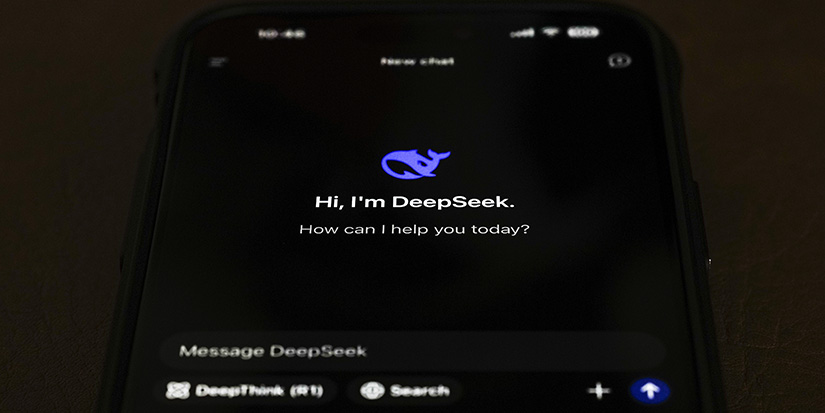
I’m talking, of course, about the Chinese-made DeepSeek artificial intelligence model, which emerged last week and seems to deliver results comparable to the far more expensive systems US companies are working on. Everyone is still debating the implications. While it may be bad news for US tech companies that have been throwing hundreds of billions of dollars at ever more expensive AI systems, it is unambiguously very good for the world.
Historical analogies nearly always fail, but here’s one that may at least rhyme: On March 14, 2000, then-President Bill Clinton and then-PM Tony Blair of the UK said research into the human genome’s sequence should be made freely available to all. Biotechnology stocks immediately plunged. Other segments held up for a while, but the great Nasdaq bull market arguably ended that day.
What was the trigger? The biotech industry of that time had planned to profit by using proprietary genetic data to make expensive drugs. The data would be the “wide moat” protecting them from competition. When Clinton and Blair signaled this might not be so easy, those stocks lost a lot of their appeal, as did stocks in general a few months later. Valuation matters.
Similarly, today’s US tech giants are all-in on artificial intelligence. Their wide moat is (or was) that these systems require highly advanced and very expensive microchips which the US government had helpfully decreed ineligible for export to China.
This produced a rosy outlook: US companies like Nvidia (NVDA) would profit from making those chips, which other US companies would buy and use to develop AI applications in vast new US data centers. The main worry was getting enough electricity to power it all. China, it was thought, would be hobbled for lack of the necessary chips, and thus present little competition.
DeepSeek just poked a massive hole in that happy narrative. More broadly, it tells us something important about China and where the world economy is going.
My best guess is all this will be bad news for the US stock market but good news—and possibly great news—for humanity. I’ll explain why in a minute. But first, we need to understand what just happened.
“An Unambiguous Innovation”
When the topic involves China and technology, one of my go-to sources is Gavekal Research. They know how the Chinese economy works and are really good at explaining it in ways Westerners can understand.
Louis Gave knew DeepSeek was a gamechanger as soon as he saw it. Last Sunday night, as US investors were just starting to see the news, he posted a report calling this Another Sputnik Moment (Over My Shoulder members can follow that link to read it).
(Explanation for the youngsters: The USSR’s 1957 launch of Sputnik, the first Earth satellite, wasn’t just a scientific achievement. Terrified Americans suddenly knew the Soviet Union was flying right over their heads. This marked the moment when the Cold War became real. Louis Gave isn’t prone to overstatement, so his use of that term made me sit up in my chair.)
Gavekal’s Beijing-based tech analyst Tilly Zhang followed up with a deeper explanation. This is a good, short summary of the hoopla, so I’ll just quote Tilly verbatim.
“DeepSeek stunned the AI industry with the release of two new models: V3 in December 2024 and R1 in January 2025. These perform roughly as well as OpenAI’s leading models on tasks such as math and coding. But the most striking aspect is the cost: DeepSeek said training the V3 model required 2,048 of Nvidia’s H800 chips—a downgraded last-generation chip designed to comply with US export controls on China—at a cost of US$5.6mn. By contrast, OpenAI has said it spent more than US$100mn to train ChatGPT-4.
“DeepSeek’s achievements may not be quite as impressive as headlines imply. For starters, the new models have shortcomings. One of the key reasons they perform well despite limited access to advanced chips is due to their ‘Mixture of Experts’ approach. This means available computing power is concentrated on a few ‘expert’ tasks, while less-critical tasks may be undertrained. The models thus excel in certain areas, but their overall performance is less consistent than some rivals. For instance, one Chinese AI expert has noted that one of the models performs well on math and coding tests, but correctly answered only about half of some other classic AI test questions. In short, the models are specialists adapted to become generalists.
“The US$5.6mn price tag should also not be taken too literally. One reason DeepSeek’s costs are low is that the company’s offerings have so far focused only on text-based large-language models, while some US rivals offer multimodal models that can handle images and videos, making direct cost comparisons misleading. Another is that the company can piggyback on the costly earlier advances made and lessons learned by US AI firms. Finally, the much-cited cost figure doesn’t account for prior research and development spending. DeepSeek’s parent company reportedly had an initial research and development budget of around RMB3bn, as well as a stockpile of about 10,000 of Nvidia’s advanced A100 chips, meaning the actual cost of development was almost certainly much higher.
“Nonetheless, the company achieved an unambiguous innovation in software architecture that allowed it to deliver strong performance on many tasks at a low cost. That reflects a broader strategy among Chinese technology firms in response to US export controls: using software to get more out of less-advanced hardware. A 2023 review of Tencent’s Hunyuan AI model by the Berkeley AI Research Lab, for instance, concluded that ‘[s]oftware advancements are making old hardware increasingly useful.’”
How do they do this with a lesser version of Nvidia’s GPU? Limited access to the hardware as well as limited capital forced the developers to be extraordinarily creative. It is highly likely that the results cost a great deal more than $5.6 million, but even 10 times more still makes it extraordinarily cheap.
The twist you need to understand is that DeepSeek isn’t exactly better than OpenAI and other US-developed systems. But it seems to come close, and at a fraction of the cost, thanks to clever software design. Let’s look at that cost. Newsletter writer Ed Zitron had an insightful take called Deep Impact. (Over My Shoulder readers already saw this, too!)
“DeepSeek's models—V3 and R1—are more efficient (and as a result cheaper to run), and can be accessed via its API at prices that are astronomically cheaper than OpenAI's. DeepSeek-Chat—running DeepSeek's GPT-4o competitive V3 model—costs $0.07 per 1 million input tokens (as in commands given to the model) and $1.10 per 1 million output tokens (as in the resulting output from the model), a dramatic price drop from the $2.50 per 1 million input tokens and $10 per 1 million output tokens that OpenAI charges for GPT-4o. DeepSeek-Reasoner—its ‘reasoning’ model—costs $0.55 per 1 million input tokens, and $2.19 per 1 million output tokens compared to OpenAI's o1 model, which costs $15 per 1 million input tokens and $60 per 1 million output tokens.
“Now, there's a very obvious ‘but’ here. We do not know where DeepSeek is hosting its models, who has access to that data, or where that data is coming from or going. We don't even know who funds DeepSeek, other than that it’s connected to High-Flyer, the hedge fund that it split from in 2023.”
Conventional wisdom had been that Chinese companies excel in hardware but don’t have Silicon Valley’s programming talent, even though China has been excelling in software for a long time. And they are literally training more than 10 times the software engineers the US is. That’s why people assumed the export ban on Nvidia’s most advanced chips would prevent China from catching up. If DeepSeek (and presumably others) are finding ways around this barrier, it’s a true game-changer.
11-Foot Ladders
Suspicions abound that DeepSeek is really a Chinese government operation. Louis Gave thinks DeepSeek is what it appears to be: a quant hedge fund using its own resources to build a technology platform it thought would be useful. In China, government-funded projects go through universities or the large companies over which the government has deeper control.
On Gavekal’s private site, Louis responded to a subscriber who thought it was all a “Chinese communist propaganda psyop.”
“I must say that it is always surprising to me how so many people, when one highlights something positive about China, immediately fall back on ‘you are a victim, or a willing participant, in Chinese propaganda.’ To me, it's like a historian saying, ‘The Tiger II tank was a superior tank to the Sherman, more mobile and yet more resistant’ and being accused of being a Nazi for making that statement.
“Sometimes, facts are just facts. And in this case, the facts are that China released a new LLM model that has just blown a gaping hole in the AI bull market narrative.
“I do think that if Oxford University, or the Ecole Polytechnique had released this, there would be a lot less anger, and a lot less cope… The fact that it is China somehow adds a lot of emotions and accusations.
“But the fact that it is China is also perhaps not surprising. First, because China now produces so many engineers. Second, because the rule of technology is that when governments put up 10-foot walls, people come up with 11-foot ladders.
“I think China just showed us an 11-foot ladder. One that is triggering a collapse in the very idea of tech moats.”
That last line (my emphasis, by the way) is the key point here. The US tech giants are giant in part because they have dug so many “moats” to stall competition. These range from aggressive intellectual property protection to buying out smaller companies before they become competitors, as well as inducing the government to protect them from potential foreign rivals.
If those moats start getting drained, it will eventually become impossible for these companies to sustain the handsome profits that sustain their ever-growing stock prices—a big problem if you are unselectively long in any of the popular large-cap stock indexes.
But otherwise, it’s a sign the world is getting better. Yes, better.
Competition Works
Compared to some of today’s younger business leaders, I am remarkably old-fashioned. I actually believe in free enterprise. I think everyone wins when human ingenuity is unleashed to seek profits by providing useful goods and services that people want to buy. I don’t fear competition; I welcome it. Competition makes me look for new and better ways to help people, ultimately helping myself as well.
All this applies globally, too. When ideas flow freely, they meet and mingle (to use Matt Ridley’s memorable phrase, “ideas have sex and produce more ideas”) and produce new innovations. The cycle then repeats, making life better.
If, as it appears, DeepSeek has found more cost-effective ways to provide the benefits of AI, we should all welcome it. This will bring us closer to the many benefits AI technology promises. The faster AI decodes giant datasets of medical data, for instance, the faster we can get highly effective, targeted drugs that cure deadly cancers and other illnesses. And that’s just the beginning.
It is true some companies are heavily invested in different methods that may never show any payback. That’s sad… but capitalism means not every risk generates a return. This is Schumpeter’s “creative destruction” at work.
Now, is it a problem if this key technology comes from our top international rival? Maybe, but not necessarily. Hostility is a choice. We can choose to cooperate, too. International trade helps maintain peaceful relations.
John Tamny, editor of RealClearMarkets, had a great note comparing the DeepSeek situation to the 1980s/1990s US dependence on energy imports.
“The rest of the world largely supplied the oil consumed stateside, but not at the expense of growth. In fact, the US economy soared as Americans outsourced the extraction of a crucial commodity to others, all so that they could focus on advances well beyond the ability of others around the world to achieve. In other words, cheap oil imports helped ignite a US technology boom that continues to this day.
“The imports didn’t harm us simply because work divided is never harmful. Quite the opposite, actually. It’s a reminder that comparative advantage is not situationally good. It’s always good. In truth, it’s always brilliant.
“The rise of DeepSeek and other globally produced AI advances have the potential to author a Golden Age of American economic creativity as outsourced automation of work and thought enable heretofore unseen human advance. And in tying the economies of China and the US even closer together, they’ll be a catalyst for peace too.”
Let a Hundred AI Flowers Bloom
Perhaps the most important thing DeepSeek did was make the software truly “open source.” You can go grab it and jumpstart your own AI company. In fact, they released a paper telling people precisely how they did it—in detail. And unlike OpenAI, which is ostensibly open-source, but they had some of the same results, DeepSeek shows the full Monty.
Oracle co-founder Larry Ellison once said that the “entry price” to get meaningfully involved in developing artificial intelligence would be $100 billion. The “moat” that US tech had for artificial intelligence was that it was so expensive. That moat is now a puddle.
Venture capitalists further down the food chain can either work with DeepSeek or recreate their own version, specifically looking at individual applications and not some general all-knowing piece of software, for a fraction of a billion dollars, let alone $100 billion.
My complaint about artificial intelligence has been we were promised real AI back in the mid-1980s. Only now, 40 years later, are we starting to see some real use cases. I have friends that are really making AI a big part of their business.
I believe we will start seeing specific applications literally blossom all over in so many areas that will impact us. Yes, we will still need large AI for large problems, but most of the applications that will show up in our daily lives won’t need to process protein folding.
This is not about China. I applaud the creativity of the DeepSeek developers and especially their ability to drive down costs. I am amazed they made it truly open-source and revealed everything.
I and others have maintained that eventually AI will be a commodity. And just like the world would be massively better if some scientist figured out how to make $10 oil from garbage, even though it would devastate energy stocks, the world would be better off with cheap artificial intelligence, especially if it used only 10% of the power. To think that the US could maintain control over AI is like thinking we could maintain control over energy because we found oil in Pennsylvania. AI will be everywhere and cheap.
Combined with the other new technologies that will change the way we manufacture chips and power AI, what DeepSeek just did is massively bullish for humanity.
We should focus less on where AI tools come from and think more about what we will do with them. I’m confident that blending this technology with American ingenuity will produce more breakthroughs in the years to come. Those breakthroughs, in turn, will help not just Americans but Chinese people, too… unless national leaders decide they shouldn’t.
We have some important choices ahead. If we make the right ones, this really will have been a week when decades happened.
Here are some additional links for your late-night reading:
Ben Thompson: DeepSeek FAQ
Dave’s Garage (video): DeepSeek R1 Explained by a Retired Microsoft Engineer
Timothy B. Lee: I don’t believe DeepSeek crashed Nvidia’s stock
Bloomberg: Steve Cohen Says DeepSeek Is ‘Bullish’ Development for AI Theme
West Palm Beach, Dallas, and DC
I will be in West Palm Beach on March 13 for a dinner with David Bahnsen and his team at The Bahnsen Group for their clients and higher-net-worth prospects. If you’re interested, mark it in your calendar and I will get you details within a week or so.
Sometime in late March, I will be in Dallas and then in the DC area where we will be opening a clinic specializing in therapeutic plasma exchange, in addition to the one here in Dorado. Plus West Palm Beach and other locations coming quickly. I should actually write about the anatomy of a startup because it has been so fascinating as well as challenging. But not until I finish my book.
I had dinner last Sunday night in Columbia, Maryland, with Dr. Mike Roizen and Dr. Robert Redfield who was the CDC director under Trump 1. Both gentlemen are very wired in to what is happening on healthcare in the new administration. It’s actually very encouraging. Redfield is impressive.
Mark your calendars for May 12–19 as we will host the best-ever Strategic Investment Conference, once again virtual. The lineup is extraordinarily solid. Seriously, the best ever.
It’s time to hit the send button, so I wish you a great week and follow me on X!
Your finding more reasons to be bullish on humanity analyst,

John Mauldin
P.S. If you like my letters, you'll love reading Over My Shoulder with serious economic analysis from my global network, at a surprisingly affordable price. Click here to learn more.
Read important disclosures here.
YOUR USE OF THESE MATERIALS IS SUBJECT TO THE TERMS OF THESE DISCLOSURES.
Permanlink:
Put Mauldin Economics to work in your portfolio. Your financial journey is unique, and so are your needs. That's why we suggest the following options to suit your preferences:
-
John’s curated thoughts: John Mauldin and editor Patrick Watson share the best research notes and reports of the week, along with a summary of key takeaways. In a world awash with information, John and Patrick help you find the most important insights of the week, from our network of economists and analysts. Read by over 7,500 members. See the full details here.
-
Invest in longevity: Transformative Age delivers proven ways to extend your healthy lifespan, and helps you invest in the world’s most cutting-edge health and biotech companies. See more here.
-
Macro investing: Our flagship investment research service is led by Mauldin Economics partner Ed D’Agostino. His thematic approach to investing gives you a portfolio that will benefit from the economy’s most exciting trends—before they are well known. Go here to learn more about Macro Advantage.

Recent Articles
AI: Where Will the Money Come From?
October 23, 2026
When Will AI Meet Cash Flow Reality?
October 16, 2026
The Biggest Problems We Face Today
October 9, 2026
Economic Desiderata
October 2, 2026
Reversing Financial Repression
September 25, 2026
Fed Policy: As Good As It Gets
September 18, 2026

Thoughts from the Frontline
Follow John Mauldin as he uncovers the truth behind, and beyond, the financial headlines. This in-depth weekly dispatch helps you understand what's happening in the economy and navigate the markets with confidence.
Let the master guide you through this new decade of living dangerously
John Mauldin's Thoughts from the Frontline
Free in your inbox every Saturday
By opting in you are also consenting to receive Mauldin Economics' marketing emails. You can opt-out from these at any time. Privacy Policy