

Thoughts from the Frontline
Follow John Mauldin as he uncovers the truth behind, and beyond, the financial headlines. This in-depth weekly dispatch helps you understand what's happening in the economy and navigate the markets with confidence.
Let John guide you through this decade of disruption
John Mauldin's Thoughts from the Frontline
Free in your inbox every Saturday
By opting in you are also consenting to receive Mauldin Economics' marketing emails. You can opt-out from these at any time. Privacy Policy
Latest Articles

August 31, 2012
The Consequences of Easy Monetary Policy
"No very deep knowledge of economics is usually needed for grasping the immediate effects of a measure; but the task of economics is to foretell the remoter effects, and so to allow us to avoid such acts as attempt to remedy a present ill by sowing the seeds of a much greater ill for the future." – Ludwig von Mises We heard from Bernanke today with his Jackson Hole speech. Not quite the fireworks of his speech ten years ago, but it does offer us a chance to contrast his thinking with that of another Federal Reserve official who just published a paper on the Dallas Federal Reserve website. Bernanke laid out the rationalization for his policy of ever more quantitative easing. But how effective is it? And are there unintended consequences we should be aware of? Why is it that the markets seem to positively salivate over the prospect of additional QE? Quickly, I will be doing an inaugural "Fireside Chat" with Barry Ritholtz on Tuesday, September 11 at 1 PM Eastern. This webinar will be hosted by my friends at Altegris Investments and will be available to accredited investors and financial professionals. If you have already registered with the Mauldin Circle (and are in the US), you will shortly be receiving an invitation to attend. If you have not, I invite you to go to www.mauldincircle.com and register today, so you can hear Barry and me discuss the latest news and, of course, touch on the election and what it means for investors. Now, let's delve into quantitative easing.

August 24, 2012
Boomers Are Breaking the Deal
There is something missing from this thing we are calling a recovery. For most in the US it does not feel like a recovery, and for good reason: the jobs aren’t there. But for some groups it is a recovery, and more. And that reveals an even bigger problem. Today, in a summer-shortened Thoughts from the Frontline, we look at the trends in employment as well as take note of a signpost we passed on the way to finding out that we can’t pay for all the future entitlements we have been promised. It’s a short letter but hopefully thought-provoking. At the end, I note a webinar and a few speeches I’ll be giving in the near future.

August 17, 2012
How Change Happens
"To trace something unknown back to something known is alleviating, soothing, gratifying and gives moreover a feeling of power. Danger, disquiet, anxiety attend the unknown – the first instinct is to eliminate these distressing states. First principle: any explanation is better than none… The cause-creating drive is thus conditioned and excited by the feeling of fear …" – Friedrich Nietzsche "Any explanation is better than none." And the simpler, it seems, in the investment game, the better. "The markets went up because oil went down," we are told. Then the next day the opposite relationship occurs, and there is another reason for the movement of the markets. But we all intuitively know that things are far more complicated than that. As Nietzsche noted, dealing with the unknown can be disturbing, so we look for the simple explanation. "Ah," we tell ourselves, "I know why that happened." With an explanation firmly in mind, we now feel we know something. And the behavioral psychologists note that this state actually releases chemicals in our brain that make us feel good. We literally become addicted to the simple explanation. The fact that what we "know" (the explanation for the unknowable) is irrelevant or even wrong is not important for the chemical release. And thus we look eagerly for reasons. And that is also why some people get so angry when you challenge their beliefs. You are literally taking away the source of their good feeling, like drugs from a junkie or a boyfriend from a teenage girl. Thus we reason that the NASDAQ bubble happened because of Greenspan. Or that it was a collective mania. Or any number of things. Just as the proverbial butterfly flapping its wings in the Amazon triggers a storm in Europe, we may conclude that a borrower in Las Vegas triggered the subprime crash. Crazy? Maybe not. Today we will look at what complexity theory tells us about the reasons for phenomena as apparently diverse as earthquakes and the movement of markets. Then we’ll look at how New Zealand, Fed policy, gold, oil, and that lone investor in St. Louis are all tied together in a critical state. Of course, how critical and which state are the issues. This is an encore appearance of the letter that is clearly the most popular one I have ever written, updated with a few thoughts from recent times (it was also part of a chapter in Endgame). Numerous reviewers have stated that this one letter should be read every year. As you read, or reread, I’ll be enjoying a week off. I have gone off to a secret location to relax and get away, all by my lonesome, which is something I have really not done for years. It will be interesting to see if I can adjust to all the peace and quiet, but so far I am coping quite well. And now, let’s think about ubiquity.

August 10, 2012
And Then There Is Disaster C
They say that breaking up is hard to do. Now I know, I know that it's true Don't say that this is the end. Instead of breaking up I wish that we were making up again. – Neil Sedaka, 1962 I have contended for some time that Europe is faced with two choices: Disaster A, which is the break-up of the eurozone, or Disaster B, which is the creation of a fiscal union, which keeps the euro more or less intact. Over the last few months I have come to realize that there is indeed a third option, which now looks increasingly possible. This is rather sad, as the third option is just an even worse Disaster C. Each choice carries with it its own unique set of problems, but the outcome of any of the choices will be that the people of Europe face a serious recession, if not a depression. This will impact global growth for more than a short time and, depending on the choice, could plunge the world into a crisis as bad as or worse than the recent credit crisis. In today’s letter we look at all three choices, meanwhile musing on how we arrived at the bottom of such a deep hole, shovels flailing.

August 3, 2012
Time to Row, or Sail?
Note to readers: Due to internet connection problems from the Shadow Fed fishing camp in Maine, important information that John wanted to include in this week's letter did not get out in time for the original deadline, and so we are reposting the letter. A few weeks ago, Ed Easterling and I updated the work we published almost ten years ago about secular bear and bull markets in chapters 5 and 6 of Bull's Eye Investing. This week I am in Maine at the annual Shadow Fed fishing trip (for those of us whose invitation to Jackson Hole keeps getting lost in the mail). Ed has graciously agreed to do another piece with me on the earnings, or business, cycle, which is different in timing than the secular stock market cycle but is part of the total warp and woof of the markets. When you combine them, you get a much clearer picture of the markets. Earnings are a topic of great debate. At any given time, you can hear someone on TV talking about how "cheap" the market is, while the person on the next channel goes on about how expensive the market is. Today we look at the cycle of earnings, rather than a specific point in time. Let me give you a little preview. In terms of time, this earnings cycle is already longer than average, and in terms of magnitude it is projected to go to all-time highs. Which makes one want to think about whether current projections are realistic. So let's jump right in. (Note: This letter sets the Thoughts from the Frontline record for the number of charts, so it will print longer than usual, but the number of words is about average.) But let me note that this week is the start of the 13th year of Thoughts from the Frontline. I started in August of 2000, talking about how the US would be in recession in 2001, analyzing the yield curve, which was beginning to seriously invert and which was also the signal for the recession call for 2007. I began with about 2,000 email addresses, gathered from readers of a previous print letter for another publisher and the readers of my first best-seller; and for whatever reason the list began to grow, and within a few years my entire business model changed, thanks to you, the readers and friends of this letter. The list has now grown to around 1 million of my closest friends and is posted on more websites than I ever imagined it would be. Who knew, 13 years ago, that this thing called the internet would be so cool? I am very grateful for your support. I started Thoughts from the Frontline as a free service and hope to continue writing it for free for many years, as long are there are a few close friends who will still read my musings. My writing and thinking have evolved over the years, but I still sit down each Friday, wherever I am, and write about what I found interesting in all the reading I did the past week. I still find it exhilarating to hit the send button at the end of the process, every Friday night, and I relish the connection I feel with and the feedback I get from my readers. And so, with an appreciative heart, here is this week's letter, as we kick off another year. And what a year it promises to be!

July 27, 2012
Gambling in the House?
Rick: How can you close me up? On what grounds? Captain Renault: I'm shocked, shocked to find that gambling is going on in here! – From the classic scene in Casablanca, made in 1942 The latest scandal du jour seems to be about what is now called LIBORgate. But is it a scandal or is it really just business as usual? And if we don’t know which it is, what does that say about how we organize the financial world, in which $300-800 trillion, give or take, is based on LIBOR? This is actually just the second verse of the old song about derivatives, which is a much larger market. Which of course is a problem that was not solved by Dodd-Frank and that has the potential to once again create true havoc with the markets, whereas LIBOR can only cost a few billion here and there. (Sarcasm intended.) The problem is the lack of transparency. Why would banks want to reveal how much profit they are making? The last thing they want is transparency. This week I offer a different take on LIBOR, one which may annoy a few readers, but which I hope provokes some thinking about how we should organize our financial world.

July 20, 2012
The Lion in the Grass
The Seen and the Unseen "In the economic sphere an act, a habit, an institution, a law produces not only one effect, but a series of effects. Of these effects, the first alone is immediate; it appears simultaneously with its cause; it is seen. The other effects emerge only subsequently; they are not seen; we are fortunate if we foresee them. "There is only one difference between a bad economist and a good one: the bad economist confines himself to the visible effect; the good economist takes into account both the effect that can be seen and those effects that must be foreseen. "Yet this difference is tremendous; for it almost always happens that when the immediate consequence is favorable, the later consequences are disastrous, and vice versa. Whence it follows that the bad economist pursues a small present good that will be followed by a great evil to come, while the good economist pursues a great good to come, at the risk of a small present evil." - From an essay by Frédéric Bastiat in 1850, "That Which Is Seen and That Which Is Unseen"

July 13, 2012
The Beginning of the Endgame
"Come, Watson, come! The game is afoot. Not a word! Into your clothes and come!" – Sherlock Holmes About this time two years ago I began to seriously work with Jonathan Tepper on our book Endgame: The End of the Debt Supercycle and How It Changed Everything. It came out the following March. I remember vividly that in November of that year, as crisis after crisis hit Europe, and the first of about 20 summit meetings which were supposed to solve the crisis was convened, that Jonathan and I worried that the book would not be out in time to actually catch the Endgame before it happened (at least in Europe). Ah, such naiveté from your humble analysts. While we predicted (in general) pretty much everything that has happened so far, from Greece to Spain to Italy, the problems with "austerity" in times of crisis, the even larger eventual problems of postponing the day of reckoning, etc., we now must stand back and shake our heads in awe and wonder at the ability of European leaders to kick the can down the road. Given the serious nature of the problems, it is amazing (to us at least) that they have been able to keep the wheels from coming off. In the face of the powerful centrifugal forces that should have torn Europe apart, we must pause and give serious thought to why they have not done so already. (In the book, we also discussed at length the problems in Japan and the US and looked at several other problematical countries, but we were not worried that those events would preempt our publishing deadline. Those problems are still in our future, but coming at us ever faster as times gallops on.) For the last year I have been writing that it is not clear that Europe (with the probable exception of Greece) will in fact break up. The forces that would see a strong fiscal union are quite powerful. In today's letter, I will try to bring you up to date on some insights I have had in the 18 months since we did the final book edits.
July 6, 2012
Into the Matrix
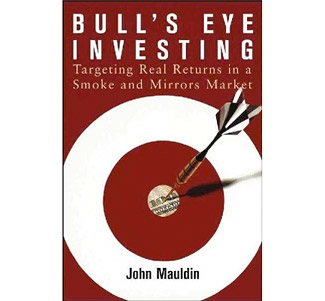
(Bull's Eye Investing Ten Years Later, cont.) What does the current environment of earnings and valuations tell us about the prospects for the US stock markets in general over the next 3-5-7-10 years? This week we have part two of "Bull's Eye Investing Ten Years Later," which we started last week. These two letters have been co-authored with Ed Easterling of Crestmont Research. We take a look at research we did almost ten years ago as part of my book Bull's Eye Investing, updating the data and asking,"Are we there yet? When will we get to the end of the secular bear market?" We will start with a few paragraphs from last week's letter and then move right along.
June 29, 2012
Bull’s Eye Investing (Almost) Ten Years Later
It's been almost a decade since I co-authored with Ed Easterling of Crestmont Research some research in this letter that later became chapters five and six of Bull's Eye Investing. Although the ten-year anniversary of the book is actually 2013, the current vulnerabilities in the markets encouraged us to revisit the material a bit early, to prepare you for what lies ahead. Reflecting back to yesteryear gives us the opportunity to assess the accuracy of our insights. I am in Tuscany at the moment, watching the sun set over the Tuscan hills; so I will thank Ed for doing the heavy lifting in this letter while I get to relax, although there is so much going on and I am such a junkie that I am forced to get my current-events fix every day. I must say, the news certainly provides some very pure adrenaline rushes. But more on that at the end. For now we take the longer view of the stock market that I first wrote about at the end of the last century, and to which Ed added some real meat in early 2003. But first, I am pleased to be able to announce the release of the rest of the videos of the 2012 Strategic Investment Conference, co-sponsored by my partner, Altegris, which we held last month. David Rosenberg (and many attendees!) said this was the best conference ever, featuring a world-class lineup of economic and financial leaders. Our very enthusiastic attendees created a roomful of energy that the speakers seemed to feed off of, and everyone brought their "A" game. It really was quite special. And now we have the videos. Those of you who are members of my special program for accredited investors, called the Mauldin Circle, can access the conference videos by going to the "My Information" section at the bottom of your personal home page, when you log into www.altegris.com. I can't think of a better way to sharpen your investment outlook than to partake of the insights of some of the best minds in the world, including Dr. Lacy Hunt, Niall Ferguson, David Rosenberg, Jeffrey Gundlach, Mohamed El-Erian ... not to mention your humble analyst. In order to view the videos, you must be a member of the Mauldin Circle. This program has replaced our Accredited Investor Newsletter Program. My partner Altegris and I have worked hard to enhance the program, which now includes access to webinars, conferences, special events, videos, accredited newsletters, and presentations featuring alternative-investment managers and other thought leaders and influencers. The good news is that this program is completely free. The only restriction is that, because of securities regulations, you have to register and be vetted by one of my trusted partners, which in the United States is Altegris, before you can be added to the subscriber roster. This will be a quite painless process (I promise). Once you register, an Altegris representative will call you to provide access to the videos, presentations, and summaries from the speakers featured at our 2012 Strategic Investment Conference. Click here to initiate your membership in our exclusive Mauldin Experience Program. After you have talked with the Altegris representative, you'll be able to view the first set of five videos, featuring Dr. Lacy Hunt, Jeffrey Gundlach, Niall Ferguson, David Rosenberg, and Mohamed El-Erian, as well as the final set featuring Dr. Brock, our two all-star panels (one with Marc Faber), and yours truly. I think you will find the presentations particularly relevant this week. And now, let's think about secular bear markets.

June 22, 2012
Daddy’s Home
I have often said that when someone is appointed to be a member of the Federal Reserve, they are taken into a back room and given a complete DNA change. They simply are not like you and me once they step out of that room, with the exception of Fisher and Lacker and a few colleagues who seem to be able to resist the infection. This week we will look at the recent action of the Fed and use that as a springboard to think about how effective Fed policy can be in an age of deleveraging. And if there is time, we simply must look at Europe. I started this letter in Texas and will finish it this morning in Spain. But first, and quickly, most of you are aware of my annual Strategic Investment Conference, co-sponsored with my partner, Altegris, which we held last month. This year's David Rosenberg (and many attendees!) said this was the best conference ever, featuring a lineup of world-class economic and financial leaders. Our very enthusiastic attendees created a room full of energy that the speakers seemed to feed off of, and everyone brought their "A" game. It really was quite special. And now we have the videos. For those of you who are members of my special program for accredited investors, called the Mauldin Circle, you can access the conference videos by going to the "My Information" section at the bottom of your personal home page, when you log into www.altegris.com. I can't think of a better way to sharpen your investment outlook than to partake of some of the best minds in the world, including Dr. Lacy Hunt, Niall Ferguson, David Rosenberg, Jeffrey Gundlach, Mohamed El-Erian … and even your humble analyst. In order to view the videos, you must be a member of the Mauldin Circle. This program has replaced our Accredited Investor Newsletter Program. My partner Altegris and I have worked hard to enhance the program, which now includes access to webinars, conferences, special events, videos, accredited newsletters, and presentations featuring alternative investment managers and other thought leaders and influencers. The good news is that this program is completely free. The only restriction is that, because of securities regulations, you have to register and be vetted by one of my trusted partners, which in the United States is Altegris, before you can be added to the subscriber roster. This will be a quite painless process (I promise). Once you register, an Altegris representative will call you to provide access to the videos, presentations, and summaries from selected speakers featured at our 2012 Strategic Investment Conference. Click here to initiate your membership in our exclusive Mauldin Experience Program. After you have talked with the Altegris representative, you'll be able to view the first set of five videos, featuring Dr. Lacy Hunt, Jeffrey Gundlach, Niall Ferguson, David Rosenberg, and Mohamed El-Erian. We will have the rest of the conference lineup for you in a few weeks. And now, let's scrutinize the Fed.
June 15, 2012
The Bang! Moment is Here
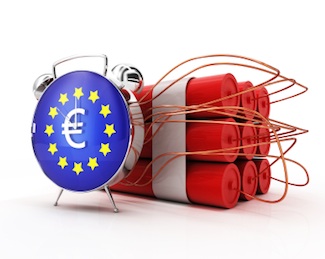
"Perhaps more than anything else, failure to recognize the precariousness and fickleness of confidence – especially in cases in which large short-term debts need to be rolled over continuously – is the key factor that gives rise to the this-time-is-different syndrome. Highly indebted governments, banks, or corporations can seem to be merrily rolling along for an extended period, when bang – confidence collapses, lenders disappear, and a crisis hits. "Economic theory tells us that it is precisely the fickle nature of confidence, including its dependence on the public's expectation of future events, which makes it so difficult to predict the timing of debt crises. High debt levels lead, in many mathematical economics models, to "multiple equilibria" in which the debt level might be sustained – or might not be. Economists do not have a terribly good idea of what kinds of events shift confidence and of how to concretely assess confidence vulnerability. What one does see, again and again, in the history of financial crises is that when an accident is waiting to happen, it eventually does. When countries become too deeply indebted, they are headed for trouble. When debt-fueled asset price explosions seem too good to be true, they probably are. But the exact timing can be very difficult to guess, and a crisis that seems imminent can sometimes take years to ignite." – From This Time Is Different, by Carmen Reinhart and Ken Rogoff We know that money is simply flying out of Greek banks. A number of them are clearly insolvent, yet they are meeting demands for withdrawals. Where is the cash coming from? The answer is in the form of yet another acronym from Europe, called the ELA. Is there a limit to this largesse? And politicians are becoming rather snarky (short-tempered, critical, testy, irritable, freaked-out – you fill in the word) with each other. This is what happens when crisis-weary politicians face yet another Greek tragedy, but this time perhaps it will hit even closer to home. Is there anyone left anywhere who has not grown tired of reading about Greece? I am tired of writing about them, yet if we are to understand the sturm und drang, the storm and stress, of Europe, we must begin there. Because, unlike Las Vegas, what happens in Greece most definitely does not stay in Greece.
- Page 60
Free Financial Newsletter
Thoughts from the Frontline explores developments overlooked by mainstream news and analyzes challenges and opportunities on the horizon.
The newsletter began as John’s way of sharing his thoughts with a few associates. Two decades later, it is one of the most widely read investment newsletters in the world. From his warning of an impending recession in 2000, to a polemic on the Obamacare “death spiral” in 2016, John has blazed his own trail as one of the most respected macroeconomic minds in the field.
"Central bankers, businessmen, and investors continually try to beat History to a pulp, but History always wins the final rounds."
John Mauldin, Thoughts from the Frontline, 2001.



John Mauldin
Editor, Thoughts from the Frontline
When investors, financial professionals, and discerning citizens need a big-picture view of what's going on in the economy, they turn to John Mauldin.
And for good reason. John has dedicated more than 30 years to keeping people informed about financial risk.