

Thoughts from the Frontline
Follow John Mauldin as he uncovers the truth behind, and beyond, the financial headlines. This in-depth weekly dispatch helps you understand what's happening in the economy and navigate the markets with confidence.
Let John guide you through this decade of disruption
John Mauldin's Thoughts from the Frontline
Free in your inbox every Saturday
By opting in you are also consenting to receive Mauldin Economics' marketing emails. You can opt-out from these at any time. Privacy Policy
Latest Articles

May 31, 2013
Central Bankers Gone Wild
When Jonathan Tepper and I wrote Endgame some two years ago, the focus was on Europe, but we clearly detailed how Japan would be the true source of global volatility and instability in just a few years. “A Bug in Search of a Windshield” was the title of the chapter on Japan. This year, I wrote in my forecast issue that 2013 would be “The Year of the Windshield.” For the last two weeks we have focused on the problems facing Japan, and such is the importance of Japan to the world economy that this week we will once again turn to the Land of the Rising Sun. I will try to summarize the situation facing the Japanese. This is critical to understand, because they are determined to share their problems with the world, and we will have no choice but to deal with them. Japan is going to affect your economy and your investments, no matter where you live; Japan is that important. In bullet-point fashion, let’s summarize the dilemma that faces Abe-san, Kuroda-san, and the other leaders of Japan. Japan is saddled with a yawning fiscal deficit that, if it were closed too quickly, would plunge the country into immediate and deep recession. The yen would strengthen, and Japan's exports would once again be damaged. Such is the paradoxical outcome if you suddenly decide to live within your means when you have been on a spending binge. The Japanese deficit is close to 10% of GDP. For my US readers, think about what would happen next year if the government cut $1.6 trillion from our budget. Japan has a GDP that is now close to 500 trillion yen (give or take a few tens of trillions). Their most recent budget calls for Y92.6 trillion in spending, almost evenly divided between Y43.1 trillion financed from tax revenues and Y42.9 trillion from the issuance of new bonds, adding to Japan's massive public-sector debt that already totals nearly Y1 quadrillion. Say that with a straight face: 1 quadrillion. And this massive debt is not a recent phenomenon: it has been accumulating for many years. Tax revenues have been going down for decades, as the country has been mired in no-growth deflation for 24 years. Revenues are now down to where they were in 1985. By way of comparison, US tax revenues in 1985 were $734 billion (or $1,174 billion in constant 2005 dollars). Last year, US revenues were $2,450 – that is, more than double the 1985 total. (taxpolicycenter.org) The following chart is courtesy of my friend and Japan expert Kyle Bass at Hayman Capital Management. If this were a stock, would you be a buyer? Japanese ten-year interest rates exploded from just above 30 basis points to over 1% at one point in the past month. The Bank of Japan (BOJ) intervened, but rates closed today at 0.85%. Note that they are still down from the 1.3% where they stood two years ago. It costs the Japanese government 24% of its revenues just to pay the interest on its debt at current rates. According to my friend Grant Williams (author of Things That Make You Go Hmmm...), if rates rise to just 2.2%, then it will take 80% of revenues to pay the interest. Even at the low current rates, the explosion in Japanese debt has meant that interest rate expense has risen from Y7 trillion to over Y10 trillion. Note in the chart below (also from Kyle) that the Japanese government is now issuing more in bonds than it pays in interest. Somewhere, Charles Ponzi is smiling. Just for fun, here is a picture of Mr. Ponzi writing a check (courtesy of Geert Noels). For 20-plus years, Japanese nominal GDP has barely risen. If your nominal GDP stagnates and you are running large deficits every year, then your debt-to-GDP ratio rises. For Japan, the ration will be a staggering, never-before-seen 245% this year. The only way you can lower the rate of debt-to-GDP expansion – and perhaps convince investors to continue to buy your bonds – is to increase your nominal GDP while slowly lowering your deficit over time until the increase in your debt is less than the nominal growth of your economy. After years of running trade surpluses, Japan is now running a trade deficit. Basic economic accounting tells us that for Japan to get to its goal of sustainability, it absolutely must have a trade surplus. And as deep a hole as Japan is in, it needs seriously large trade surpluses. Like back in the good old days of only a few years ago. Not to mention that the country's current account surplus is down by over half from its peak in 2007 and back to where it was 20 years ago. The trend is ugly. There are only two ways to get nominal growth. You can get real growth or you can create inflation. There are not many things that you can get Hayek and Keynes and every other economist to agree on, but this one thing is the universal answer to your fiscal problems: Growth, with a capital G. That is the remedy put forth by every economist and every politician : “We need to grow our way out of the crisis.” But there are two problems as Japan tries to get to growth. Problem #1: Your nation is aging, and internal consumer spending is not going to be a source of real growth. You have to talk like that can happen, but you know it is just not all that realistic. You have been trying for 20 years to get your country to spend, and people are just not up to it. What you really need is for your export base to get with the program and massively increase its sales to the rest of the world. In fact, that is your only real option. And one of the easiest ways to do that is to drive down the value of your currency, especially against the currencies of competitor nations. That boost in exports can help relieve your chronic excess productive capacity and maybe, possibly, hopefully, engender a labor shortage and drive up the cost of labor, which will help stimulate inflation. Problem #2: You are mired in deflation and have been for 20 years. Since there is no natural source of inflation in Japan – a nation of savers and an increasingly elderly population –you have to create inflation by increasing the prices of your imports. And the way to increase those prices is to drive down the value of your currency, especially against the dollar and the euro. Hmmm, we see a possible strategy emerging here. But if you set out to decrease the value of your currency, you violate all sorts of central banker and G7 codes and rules. Given the scale at which you need to operate, you would start a currency war, and no major central bank could possibly be associated with something so distasteful. That is a touchy problem, but fortunately for you there is a solution: you can engage in quantitative easing in order to stimulate your economy. That is certainly within the rules, as the central banks of every other major member of the club (the Fed, ECB, and Bank of England) have been doing it for years.< How can anyone object to a policy that simply targets inflation? The fact that such a pursuit happens to drive down the value of your currency is merely a by-product of the necessary pursuit of mild, 2% inflation, which is the only way for your country to get out of its slump. The other big players all have 2% inflation targets; you are just aligning Japan's course with their own stated policies. And besides, even with the huge size of your announced quantitative easing, you can point out that you are way behind the growth of the monetary base of the Fed, the ECB, and the BoE. That brings us to a major dilemma, which Kyle Bass calls the Rational Investor Paradox. If you are an investor or fiduciary in Japan and you now believe the Bank of Japan is quite serious about creating inflation, do you continue to hold Japanese government bonds (JGBs)? Any serious analyst would assume that interest rates will climb to at least the rate of inflation, assuming you believe that Japan can create inflation. And especially if they pursue a policy that is going to lower the purchasing power of the yen, why would you, a rational investor, want to hold long-term Japanese bonds? Why wouldn't you sell as soon as Kuroda announced the “shock and awe” policy? (It certainly left me in shock and awe! And intellectually, I knew it had to be coming!) And that is exactly what happened the day after Kuroda announced his policy. The BoJ had to step in a few days later and start buying bonds in significant quantities to hold the rate down. Your problem is compounded by the fact that the natural buyers of your bonds for the last 20 years have been the retirement plans of your workers. But your country is rapidly getting older, and now those pension plans and individual savers are starting to cash in those bonds in order to meet pension obligations and to live in retirement. Your major pension plans are now sellers (on net) of JGBs. Mrs. Watanabe is not going to be a buyer of bonds in retirement. She will want to sell in order to buy rice and help out her grandkids. She will need to pay for rising energy and healthcare expenses and other basic needs. In short, you are rapidly running out of buyers “at the margin,” which is where markets are made. Now, to the crux of the problem. You cannot allow interest rates to rise much more than they already have. That way lies fiscal disaster. Yet the buyers of Japanese bonds are starting to get nervous and to leave the market, which is a rational consequence of your drive for inflation, which you absolutely must have if Abenomics is to have a snowball’s chance in Hades of working. That means there is only one real source of bond buying power left: The Bank of Japan. The Bank of Japan is on its way to becoming the market for Japanese bonds. It is eventually going to have to “hit the bid” on every bond that is issued by the government, because if the current policy is maintained it will drive all buyers from the market, leaving just sellers. The pension systems will not necessarily exit their JGBs, but they will let them roll off as they need to raise cash to meet their pension obligations. International buying of your bonds will also slow to a trickle. The Bank of Japan is going to have to print – sorry, Kuroda-san, I mean pursue quantitative easing – to a far greater extent than it has announced in order to keep up with the demands that will be heaped upon it. We are talking about numbers that will stagger the imagination. This will be bigger than Carl Sagan’s "billions and billions." It will not be long before the word quadrillion starts to be used more frequently. Kyle Bass remarked during the webinar that he, Jon Sundt, and I just recorded that if you started counting and called out one number every second, it would take 33 million years to get to a quadrillion. A quadrillion is a thousand trillion, or a million billion or a billion million. We humans simply have no way to grasp the enormity of such a number. Nor can we understand the implications when such fantastic numbers must be applied to the world’s money supply.

May 24, 2013
The Mother of All Painted-In Corners
Alice laughed: "There's no use trying," she said; "one can't believe impossible things." "I daresay you haven't had much practice," said the Queen. "When I was younger, I always did it for half an hour a day. Why, sometimes I've believed as many as six impossible things before breakfast." – Alice in Wonderland, Lewis Carroll I wrote several years ago that Japan is a bug in search of a windshield. And in January I wrote that 2013 is the Year of the Windshield. The recent volatility in Japanese markets is breathtaking but characteristic of what one should come to expect from a country that is on the brink of fiscal and economic disaster. I don't mean to be trite, from a global perspective; Japan is not Greece: Japan is the third-largest economy in the world. Its biggest banks are on a par with those of the US. It is a global power in trade and trade finance. Its currency has reserve status. It has two of the world’s six largest corporations and 71 of the largest 500, surpassed only by the US and comfortably ahead of China, with 46. Even with the rest of Asia's big companies combined with China's, the total barely surpasses Japan's (CNN). In short, when Japan embarks on a very risky fiscal and monetary strategy, it delivers a serious impact on the rest of the world. And doubly so because global growth is now driven by Asia. Japan has fired the first real shot in what future historians will record as the most significant global currency war since the 1930s and the first in a world dominated by true fiat money. At the risk of glossing over details, I am going to try and summarize the problems of Japan in a single letter. First, a summary of the summary: Japan has painted itself into the mother all corners. There will be no clean or easy exit. There is going to be massive economic pain as they the Japanese try and find a way out of their problems, and sadly, the pain will not be confined to Japan. This will be the true test of the theories of neo-Keynesianism writ large. Japan is going to print and monetize and spend more than almost any observer can currently imagine. You like what Paul Krugman prescribes? You think he makes sense? You (we all!) are going to be participants in a real-world experiment on how that works out. (Note: This letter will print longer than usual as there are a lot of graphs.) But first, I want to mention a very special event, that is of great relevance to this discussion, and that will be coming your way in just a couple weeks. I'm going to get together in New York with five of the most powerful investing minds in the world – Kyle Bass, Mohamed El-Erian, John Hussman, Barry Ritholtz, and David Rosenberg – and we're going to totally take apart the New Normal environment in which we all find ourselves and then rethink and rebuild it in a way that will help you not only survive it but profit from it. Investing In the New Normal will feature a full hour of our unfiltered conversation and uncensored analysis. It will come to a computer screen near you on Tuesday, June 11, and you will want to be there! The event is free, and you can register here. Seriously, a full hour with those five guys. How cool is that? I will make sure you get a few powerful take-aways that will impact your thinking and your investing. And now, let’s take a look at that hard windshield and that big bug.

May 17, 2013
All Japan, All the Time
The evils of this deluge of paper money are not to be removed until our citizens are generally and radically instructed in their cause and consequences, and silence by their authority the interested clamors and sophistry of speculating, shaving, and banking institutions. Till then we must be content to return, quo ad hoc, to the savage state, to recur to barter in the exchange of our property, for want of a stable, common measure of value, that now in use being less fixed than the beads and wampum of the Indian, and to deliver up our citizens, their property and their labor, passive victims to the swindling tricks of bankers and mountebankers. –Thomas Jefferson, in a letter to John Adams, 21 March 1819 I am definitely bullish. The budget deficit is shrinking massively. Guys who are short, they better have a shovel to get out of the grave. –David Tepper, Appaloosa Management LP, CNBC, 14 May 2013 Never have investors reached so high in price for so low a return. Never have investors stooped so low for so much risk. –Bill Gross, PIMCO, 14 May 2013 We can rightly declare victory on the housing front and (reduce) our purchases, with the aim of eliminating them entirely as the year wears on. I believe the efficacy of continued purchases is questionable. –Richard Fisher, president of the Dallas Federal Reserve Bank, National Association for Business Economics, 16 May 2013 It will take further gains to convince me that the "substantial improvement" test for ending our asset purchases has been met…. We could reduce somewhat the pace of our securities purchases, perhaps as early as this summer. Then, if all goes as hoped, we could end the purchase program sometime late this year. –John Williams, president of the Federal Reserve Bank of San Francisco, Reuters, 16 May 2013 The balance of risks of prolonged very low interest rates and unconventional policies is shifting. The costs are growing in relation to the benefits. –BIS, Reuters, FT Alphaville, 16 May 2013 Jefferson was lamenting the woeful state of the dollar 200 years ago because the country was beset by fiscal problems, not because someone in the government wanted to ruin the value of the currency. Today, however, we find ourselves in a situation where it is the national policy of multiple countries, including the United States, to reduce the value of their currencies. My friend Mohamed El-Erian chided me on stage at our recent conference not to say “currency wars” but to use the more polite term “currency tensions.” But no matter what you call it, there are clearly governments whose intent is to pursue a mercantilist trade policy to the detriment of their trade partners by manipulating the value of their currencies. I predicted in Endgame that the latter half of this decade would see the most serious currency wars since the end of WWII. The opening shots have been fired. This will not be just a continuation of the currency skirmishes we have seen in recent decades. No, the real artillery is being brought to the front. And as in any war, it is best not to have your valuable personal possessions anywhere near the field of conflict. But which way to run? Who are the good guys to run to? Are there any good guys at all? Maybe the better question to ask is, who will win? Will there be any winners? Do you really want to look like Rocky Balboa after his first winning fight? This week we again focus on Japan. Their stock market has been on a tear, and their economy grew 3.5% last quarter. Is Abenomics really the answer to all their problems? Is it just a matter of turning the monetary dial a little higher and voila, there is growth? Why doesn’t everyone try that? And what would happen if they did? But first, since we are talking about Japan, let me remind readers about a very special webinar with one of my personal-favorite money managers, Kyle Bass of Hayman Capital Management, LP, based here in Dallas. On May 29, I will be calling in from Brussels to team up with Jon Sundt of Altegris Investments to talk with Kyle about his thoughts on all things economic, but in particular his latest views on what is happening in Japan. He will have just returned from Asia and will be full of new facts and ideas (as he always is). Kyle has always positioned his fund to take advantage of what he sees as potential risks in global markets (the subprime crisis, Europe, etc.), and now he has really laser-honed in on Japan. Given that I think (as I will make the case today) that Japan is now the center of monetary experimentation (and potential fiscal earthquakes), we must pay close attention. If you are a qualified purchaser or a licensed investment adviser qualified to make private placement recommendations, please join my partners at Altegris for this webinar event on Wednesday, May 29, at 12:00 noon EDT/9 a.m. PDT. If you are not yet a Mauldin Circle member, be sure to register here for this lively and candid discussion. Upon qualification by my partners at Altegris, you will receive an email invitation. Existing Mauldin Circle members will automatically receive an invitation. I apologize for limiting this discussion to qualified purchasers and investment advisers, but we must follow the rules and regulations. I look forward to having you at this exclusive event. (In this regard, I am president and a registered representative of Millennium Wave Securities, LLC, member FINRA.) And now let’s focus on Japan.

May 10, 2013
Skills, Education, and Employment
"The large shortfall of employment relative to its maximum level has imposed huge burdens on all too many American households and represents a substantial social cost. In addition, prolonged economic weakness could harm the economy's productive potential for years to come. The long-term unemployed can see their skills erode, making these workers less attractive to employers. If these jobless workers were to become less employable, the natural rate of unemployment might rise or, to the extent that they leave the labor force, we could see a persistently lower rate of labor force participation." - Janet L. Yellen, Vice-Chair, US Federal Reserve, March 4, 2013 It is graduation time, and this morning finds me swimming in a sea of fresh young faces as a young friend graduates, along with a thousand classmates. But to what? I concluded my final formal education efforts in late 1974, in the midst of a stagflationary recession, so it was not the best of times to be looking for work. It turned out that I had a far different future ahead of me than I envisioned then. But I would trade places with any of those kids who graduated today, as my vision of the next 40 years is actually very optimistic. With all the advances in healthcare, technology, and communications that have come and will come, they will get to embrace a world full of opportunity; and yet, this generation is starting out with more than just a minor economic handicap. This week's letter will explore changes in the work marketplace, changes that generated quite a lot of discussion at last week's Strategic Investment Conference. At the end of the letter I will also provide a link for qualified investors to listen in on a webinar conversation between Kyle Bass and me on another of the main topics last week: Japan. This is one you'll want to tune in to. (Warning: this letter will read fast but print long, as there are more than the usual number of charts and graphs, though the word count is actually shorter than usual.) And a quick note up front on Japan. As of the last two weeks, Japanese investors are now net buyers of foreign bonds, and the yen has broken through 100 to the dollar. I think what is happening in Japan is going to be the nexus of a global flow of cash that will be unlike any we have ever seen. Attention MUST be paid. It is windshield time.

May 2, 2013
The QE Sandpile
Sell in May and go away? What about "risk off?" And ever more QE? Today's letter is a quick note and a reprise of a popular letter from yesteryear (with a bit of new slant), as I am at my conference in Carlsbad. But first, I thought I would shoot you a few quick, interesting notes that crossed my desk in the last week. It is almost a ritual for me to mention at this time of year the old investment saw, "Sell in May and go away." It has been surprisingly good advice in most years. My good friend Art Cashin is a curator (and prodigious progenitor) of investment wisdom. He offers these two insights from his research: Tomorrow is the beginning of May, so a "Sell in May" review is in order. To avoid reinventing the wheel, let me plagiarize the veteran Jim Brown's synopsis yesterday. Sell in May? We are at that time of year when investors have to decide if they want to take profits and move to cash for the summer or risk losing those profits in the next correction. The Stock Trader's Almanac has made the "Sell in May and go away" trade one of the most visible trends in the market. Because the markets normally decline in the summer, they came up with the best six-month trading system. If you had invested $10,000 in the Dow in 1950 and only kept the money in stocks from November through April, you would have had $684,073 as of the end of 2011. If you reversed the strategy and invested for the May-October period, you would have lost $1,024 over the same 61-year period. That is a pretty telling statistic, and the cycle rarely fails to produce. And Art followed up the next day with: Mark Hulbert suggests it may be a much older multi-national phenomenon. The "sell in May" pattern also exists in other countries besides the US. Ben Jacobsen, a finance professor at Massey University in New Zealand, reached that conclusion after studying all available historical evidence from each of 108 separate stock markets around the world. For example, his statistical tests detected the seasonal pattern in the United Kingdom stock market as far back as 1694. Jacobsen, in an interview, emphasized that the Halloween Indicator isn't merely the product of a shameless, after-the-fact data-mining exercise. He said that he found an article as long ago as 1935 – in the Financial Times – in which the "sell in May" pattern is referred to as something that was already well-known and followed. Even though the pattern nearly 80 years ago already had a solid historical foundation, Jacobsen notes, since then the difference between the average returns in winter and summer has become even bigger. This is a crucial point, he argues, since the all-too-usual tendency is for patterns to begin to evaporate once investors become aware of them and try to exploit them." China's PMI came in this week at barely above 50 and has been clearly falling for the last year. Despite what you read, China's economic growth is slowing, which is NOT good for commodity metals and products (different from the "softs" like grains, cattle, etc.). GaveKal argues that the commodity price fall that we have been seeing of late is possibly structural in nature. Yet the bond market rises, gold is rising, stocks are rising. (Clearly, the market did not listen to my friend Nouriel Roubini this morning – Dr. Doom indeed! After his speech, no one at this conference can call me pessimistic. Although he prefers the term realistic.) Seemingly everything is levitating. "Where is risk off?" I ask aloud back in the green room as I write this. Paul McCulley quips to me, "Never get in a …… contest with a man who buys ink by the barrel." The clear implication is that this levitation is all central bank-induced. The Fed, Japan, and the ECB are all in full gear, and England is only waiting for Mark Carney to arrive from Canada with the North American printing technology employed so well by his friend Ben Bernanke. The question I am asking at the conference is, "What will happen when quantitative easing has to end? What does that look like?" I will report next week on what I am learning here, but right now let's return to what has proven to be the most popular piece I have written over the last 13 years. And as you read it, think not just of sand piles but of the analogous pile of electrons of quantitative easing as it mounts up toward criticality. Friedrich Nietzsche knew just how the troubling unknown grips our imaginations and compels us to look for answers: "To trace something unknown back to something known is alleviating, soothing, gratifying, and gives moreover a feeling of power. Danger, disquiet, anxiety attend the unknown – the first instinct is to eliminate these distressing states. First principle: any explanation is better than none…. The cause-creating drive is thus conditioned and excited by the feeling of fear…." –Friedrich Nietzsche "Any explanation is better than none." And the simpler, it seems in the investment game, the better. "The markets went up because oil went down," we are told. Then the next day the opposite relationship occurs. Then there is another reason for the movement of the markets. But we all intuitively know that things are far more complicated than that. As Nietzsche notes, dealing with the unknown can be disturbing, so we look for the simple explanation. "Ah," we tell ourselves, "I know why that happened." With an explanation firmly in hand, we now feel we know something. And the behavioral psychologists note that this state actually releases chemicals in our brain that make us feel good. We literally become addicted to the simple explanation. The fact that what we "know" (the explanation for the unknowable) is irrelevant or even wrong is not important to the chemical release. And so we look for reasons. That is why some people get so angry when you challenge their beliefs. You are literally taking away the source of their good feeling, like drugs from a junkie or a boyfriend from a teenage girl. Thus we may reason that the NASDAQ bubble happened because of Greenspan. Or was a collective mania. Or was due to any number of things – pick your favorite belief. My favorite: just as the proverbial butterfly flapping its wings in the Amazon triggers a storm in Europe, maybe a borrower in Las Vegas triggered the subprime crash. Crazy? Maybe not. Today we will look at what complexity theory tells us about the reasons for earthquakes, disasters, and the movements of markets. Then we'll look at how New Zealand, Fed policy, gold, oil, and an investor in St. Louis can all be tied together in a critical state. Of course, how critical and what state are the questions here.

April 26, 2013
The Cashless Society
But Mousie, thou art [not alone], In proving foresight may be vain: The best-laid schemes o' mice an' men Gang aft agley, An' lea'e us nought but grief an' pain, For promis'd joy! Robert Burns, To a Mouse, on Turning Her Up in Her Nest with the Plough It is a common trope in science fiction novels. Economic transactions are handled seamlessly with a wave of a card or a physically imbedded chip, and whatever the author imagines money to be is transferred, far removed from the archaic confines of ancient physical monies. If you Google "cashless society" you get about 600,000 references in under a second, and 20 pages into the references there are still articles on a future world where physical cash is no longer needed. Some see it as a sign of the "end times," some as a capitalist plot, some as a frightening vision of socialists and ever-bigger governments, and some as a logical step in the evolution of a technologically driven international commerce. And some of the "cashless society" references are showcase articles for the latest innovation that turns your phone or smart card into a functional wallet. I can attest it is quite possible to go for days without needing actual cash (as long as there are no kids around). The Bitcoin phenomenon (28 million sources on Google!) is a libertarian enthusiast's dream of not just a cashless society but a society with no need for fiat money and central banks. Today we'll look at research suggesting that cashless future might be farther off than we either fear or hope. Not only is a cashless society farther away than some think, we are actually seeing an increase in the use of cash all over the world (and this is not just a US phenomenon). We will look at some interesting factoids that in themselves make for thought-provoking discussions, but when we couple them with research on the rise of the unreported economy (aka the underground economy) and the number of people who get some form of government assistance, we may find problematic consequences resulting from hidden incentives that work in unintended ways.
April 19, 2013
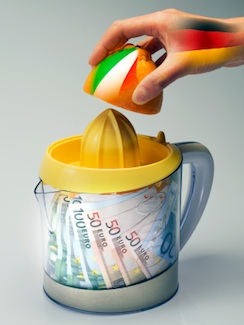
Austerity Is a Consequence, Not a Punishment
Two seemingly different questions and comments from readers and friends crossed my path the last few days, but I saw a definite connection between them. The first question was, Why do we pursue austerity when it seems not to work? And then many readers wrote to ask this week, What do I think about the real problems that are surfacing in the Rogoff and Reinhart assertion that debt above a ratio of 90% debt to GDP seems to slow economic growth by 1% (especially since I have quoted that data more than a few times)? We’ll deal with each question separately and then see if we can connect the dots. The first question comes from correspondence I have had with Ms. Aga Barberini, who works in the investment world in Milan, Italy. She came there from Poland some 20 years ago. The first part of her note contains the question on austerity, but I’ll pass along more of her letter, as I think it will give us all some insight into the seeming chaos that voters are facing in choosing a path for Italy. (And I hope my editors leave some of the charming grammar in her letter. You can almost hear the musical tones of her Italian English.) I am worried for Italy, too. When I came here 20 years ago Italy was beautiful and rich; it was very good for a girl from Eastern Europe. Nowadays a lot of Italians go to Poland and settle down. I guess it’s going to get worse, the austerity will be tighter. Please tell me why should we go ahead with austerity when IMF last month came out saying that for every point of tax lifting in Italy we lose 2.5 points of GDP? First they said that the tax lifting would produce only 0.5 points of GDP slip, now they say they were wrong. The political chaos is lasting. My husband says, why don't we vote for the comedian in June (as it is almost sure we are going to vote again soon)? Sure, Grillo is right in a lot of things and would clean the politics a lot. (By the way, did you know that the oldest bank in the world, Monte dei Paschi di Siena’s mess is reaching 20 billion euros? They took away the money doing ... the bank transfers ;-) The Banka d'Italia didn't see; CONSOB, the Italian SEC, didn't see...). But how can a serious person vote for the comedian? But I say sometimes the one who is good for the revolution isn't necessarily good to rule the country. Do you remember the guy called Lech Walesa? Thanks to him the communism [in Poland] was fallen – we all agree. Polish people were so thankful to him that we appointed him for the first democratic president. Than we found that he didn't have enough background to rule the country and enough culture to represent us on the international stage. I will vote Berlusconi again. I can't stand communists even if they call themselves “the left.” (Sidebar: I was in Siena last summer and visited the ancestral home of the bank mentioned above, the world’s oldest, founded in 1472. I marveled that any bank could last so long. At the Palio last summer we met one of the senior managers of the bank. It turns out that it was local politicians who ran the board of the bank, and now the authorities are saying management hid the problems from them.) So let me try to answer you, Aga. Austerity has come to have a rather bad name of late. The complaint is that it just doesn’t work. Which is somewhat like complaining that the roof is leaking because someone else hassn’t fixed it. If by “working” we mean that austerity is supposed to produce growth, then of course it doesn’t work. By definition, austerity means you are reducing a fiscal deficit, and doing so will reduce growth in the short term. That begs the question, why would you want to do that? Don’t we want growth? Let’s look at why a country might need to endure austerity. “Austerity” is now the name we give to the situation where a government has to limit its spending during an economic downturn or recession. The governments of the developed world amassed huge sovereign debts in the course of what is known as the Debt Supercycle. As interest rates fell, borrowing to finance consumption and spending became easy. But now that decades-long supercycle has ended. One way of looking at the problem of swollen sovereign debt is to say that it goes back to Keynes (although one cannot actually blame the current problems on his economic theory). Keynes argued (roughly) that when there is a normal business-cycle recession a government should spend money to counterbalance the private-economy slowdown. That means that the government should borrow money and run fiscal deficits to help boost spending and the economy. According to his theory, this would make the recession not as deep and help bring the economy back to recovery sooner. This was tried after World War II in numerous countries in the developed world, and it seemed to work. "We are all Keynesians now" is a famous phrase uttered by Milton Friedman and attributed to US President Richard Nixon. It is popularly associated with the reluctant embrace of Keynesian economics in a time of financial crisis, by individuals such as Nixon, who had formerly favored less interventionist policies. (The phrase was first attributed to Milton Friedman in the December 31, 1965, edition of Time magazine. In the February 4, 1966, edition, Friedman wrote a letter clarifying that his original statement was, "In one sense, we are all Keynesians now; in another, nobody is any longer a Keynesian.") (Wikipedia) The problem that arose was that most countries rarely followed through on the second part of Keynes’s prescription, which was to pay back the debt when times were good. Rather, the debt just continued to accumulate. But, because interest rates were dropping, the size and cost of the debt became less of an issue.

April 12, 2013
Assume a Perfect World
An engineer, a chemist, and an economist are stranded on a deserted island. They are starving, when miraculously they find a box filled with canned food. What to do? They consider the problem, bringing their collective lifetimes of study and discipline to the task. Being the practical, straightforward sort, the engineer suggests that they simply find a rock and hit the cans until they break open. “No, no!” cry the chemist and economist, “we would spill too much food and the birds would get it!” After a bit of thought, the chemist recommends that they start a fire and heat the cans. The pressure in the cans will force them open and the food will conveniently already be heated. But the engineer and economist object, pointing out correctly that the cans would likely explode and splatter the food all over the beach. The economist, after carefully studying the cans and reading the labels, starts scrawling a series of equations in the sand, which eventually cover the entire beach. After much pondering, he excitedly announces, “I’ve got it! I’ve got it!” as he points to the final equation. They ask him to explain, with their visions of finally getting a meal causing them to regard the economist with a new sense of respect. The economist clears his throat and begins, “First, assume a can opener …” I am not sure how old that joke is, but it dates to about the time when economists discovered mathematics and models, which is to say, about the time when economists developed physics envy and decided they would like to be regarded as scientists rather than philosophers. This week we continue to look at the data and models developed by economists, with a view to understanding both their usefulness and their limitations. The specific data we will examine this week is inspired by the release of the President’s FY 2014 US budget proposal this week. While it and the House and Senate budget proposals may appear to be widely divergent, there are some underlying and quite disturbing similarities among them. Specifically, all three proposals assume away the real world. It does not matter which version you prefer; they all lack the basic precautions and hedges that those of us involved with preparing family and business budgets make sure to include in our own forecasts. While whole books could be written about the underlying assumptions in these latest budget proposals, we will examine (hopefully briefly) just a few of the more glaringly problematic ones.
April 5, 2013
The Theology of Inflation
We begin this week with a simple pop quiz. Is inflation good or bad? Answer quickly. I’m sorry – your answer is wrong. Or rather, we can’t know if your answer is right or wrong because we are not sure what is meant by the question. We may think we know – and we may be right – but we can’t be sure, because the word inflation has different meanings for different people in different places and different times. In fact, even the same people in the same place and time can’t agree on a precise definition. This is in part because most of us still think of economics as a science akin to physics or mathematics. Inflation is one way economists attempt to measure things. But unlike the distances between stars or atoms, or the certainty implicit in even very abstract mathematical models, our measurement of inflation is limited by and entirely dependent upon the tools we choose. In fact, the methodology we use has as much ability to determine the outcome as the actual data does. This week we begin a series on economic data with a look at inflation, but we’ll preface the series with a discussion of how economics may be more akin to philosophy or theology than the hard sciences. If you are an academic economist, you may want to move on to the next letter, unless you are capable of not taking yourself too seriously. First, a little housekeeping. You are getting this letter this week on Friday night or Saturday morning, depending on what part of the globe you inhabit. When Thoughts from the Frontline first started (in August of 2000), I wrote on Friday during the day and hit the send button in the afternoon. The list was smallish and delivery was quick. Over the years, it has taken me longer to research and write. My business life is now focused around thinking about and writing this letter, which suits me just fine. But now “writing day” often stretches late into the night and beyond, into the following morning. Friday nights became Saturday mornings and I ended up sleeping too late on Saturday to really enjoy the day. I should note that since I quit drinking about 19 months, 26 days, and 4 hours ago (but who’s counting?) it is taking me about twice as long to write the letter. Seriously. I suspect that, like many writers far more productive and interesting than I am, I was self-medicating my ADD with a little wine and scotch on writing nights. Not a lot, mind you; just enough. Whatever enough is, which is another data point that can be, well, fluid. So I decided to try writing Sunday night, and then moved to Tuesday night due to the publishing schedule of other Mauldin Economics publications. However, readers told me they prefer to read me on the weekend. It finally dawned on me (skilled analyst that I am) that there is little difference between Tuesday and Thursday nights. So the new schedule will be that I will write on Thursday night, reflect and edit on Friday, and make sure the letter gets to you overnight for your weekend reading pleasure. Thanks for your patience as I wandered through the week in order to get back to sending the letter on the weekend when you always wanted it anyway.

March 26, 2013
You Can’t Be Serious
I admit to being surprised by Cyprus. Oh, not the banking crisis or the sovereign debt crisis or the fact that its banks were eight times larger than the country itself or even the fact that the banks were bloated with Greek debt that had been written down. I wrote about all that a long time ago. What surprised me was that all the above was apparently a surprise to European leaders. While there is much to not like about what European leaders have done since the onset of their crisis some five years ago, they have demonstrated a prodigious ability to kick, poke, and massage the can down the road, to defuse crisis after crisis, and to indefinitely postpone the inevitable. They have demonstrated a remarkable ability to spend taxpayers’ and others’ money in order to keep Europe and the euro more or less in one piece. At every step they have been keenly intent on maintaining trust in the system. That they have been successful in keeping a majority of citizens in favor of the Eurozone and the euro, even in countries forced to endure serious austerity, must be recognized. However, the shock in Cyprus reveals an absolute lack of preparedness in dealing with a problem that had festered for several years. By now it should be no surprise to anyone that sovereign nations can default, that banks can go bankrupt under the weight of defaulted sovereign debt, and that banks can be too large for some countries to bail out. That a clear and consistent response to Cyprus should have been worked out in the halls of Brussels and the ECB seems so, well, reasonable. Clearly, the large depositors in Cypriot banks, the majority of whom were Russian (according to Financial Times reports) thought the Eurozone had a plan. In fact, the apparent assumption, bordering on religious faith, that Eurozone leaders would not allow depositors in Cypriot banks to lose one euro, is almost touching. This snafu is going to have repercussions that spread far beyond this tiny island nation. Let’s look at a few of the implications.

March 19, 2013
Will the Real Unemployed Please Raise Your Hands?
This week’s letter will be a very short part of a book I am writing with Bill Dunkelberg (the Chief Economist of the National Federation of Independent Businesses) on the future of employment. It has taken longer to write than I initially anticipated, for a host of reasons, chief among which is that the future is not as obvious as I originally thought. Diving into the data has brought a few surprises. It doesn’t help that I have (probably to the frustration of Dunk, although he is way too polite to say it) changed the focus from “merely” what we need to do to create jobs (which is still an important part of the book) to what kinds of jobs will the future bring and who will get them. But to understand the future of employment, we have to be able to measure what we mean when we say employment. And the data that we all too often think of as hard and fast is anything but. Is unemployment in the eye of the beholder? We know what we mean when we say our brother-in-law is unemployed. But does the government data mean the same thing? The answer is “maybe, sometimes, and it depends.” I selected this part of the book not only because it is toward the beginning but also as a result of a conversation I had this week that got me to thinking about data and its usefulness. It is in this context that we will look at unemployment data. But first, a quick comment on why this letter is not about Cyprus, which seems to be the topic du jour. I wrote four weeks ago, after my visit to Athens, that Cyprus would be a problem and to pay attention.

March 12, 2013
Argentina on Sale
When I was younger, so much younger than today, I never needed anybody's help in any way. But now these days are gone, I'm not so self assured, Now I find I've changed my mind and opened up the doors. – John Lennon, the Beatles (From Cafayate, Argentina) There are some who worry whether the path that Argentina has taken to monetary ruin on multiple occasions (and that it seems intent on taking again) is one that the US may also find itself on. That worry has crossed my mind a few times, I must confess. Today we will look at Argentina more in depth. From a monetary perspective, it deserves attention. And once again there will be opportunity. Let me jump right to the conclusion: Just as Spain is not Greece, because each chose a unique route to economic malaise, the US is not Argentina. We are perfectly capable of avoiding Argentina’s problems while cooking up ones that are all our own. But there are some worrisome and potentially instructive issues in Argentina.
- Page 57
Free Financial Newsletter
Thoughts from the Frontline explores developments overlooked by mainstream news and analyzes challenges and opportunities on the horizon.
The newsletter began as John’s way of sharing his thoughts with a few associates. Two decades later, it is one of the most widely read investment newsletters in the world. From his warning of an impending recession in 2000, to a polemic on the Obamacare “death spiral” in 2016, John has blazed his own trail as one of the most respected macroeconomic minds in the field.
"Central bankers, businessmen, and investors continually try to beat History to a pulp, but History always wins the final rounds."
John Mauldin, Thoughts from the Frontline, 2001.



John Mauldin
Editor, Thoughts from the Frontline
When investors, financial professionals, and discerning citizens need a big-picture view of what's going on in the economy, they turn to John Mauldin.
And for good reason. John has dedicated more than 30 years to keeping people informed about financial risk.