Thoughts From the Frontline, Bond Market

7 posts tagged with “Bond Market”.

Who’s Afraid of a Big, Bad Bailout?

September 26, 2008

"A tournament, a tournament, a tournament of lies.
Offer me solutions, offer me alternatives and I decline.
It's the end of the world as we know it and I feel fine.
(It's time I had some time alone.)"

- Lyrics from R.E.M., 1987

Flying last Tuesday, overnight from Cape Town in South Africa to London, I read in the Financial Times that Republican Congressman Joe Barton of Texas was quoted as saying (this is from memory, so it is not exact) that he had difficulty voting for a bailout plan when none of his constituents could understand the need to bail out Wall Street, didn't understand the problem, and were against spending $700 billion of taxpayer money to solve a crisis for a bunch of (rich) people who took a lot of risk and created the crisis. That is a sentiment that many of the Republican members of the House share.

As it happens, I know Joe. My office is in his congressional district. I sat on the Executive Committee for the Texas Republican Party representing much of the same district for eight years. This week, Thoughts from the Frontline will be an open letter to Joe, and through him to Congress, telling him what the real financial problem is and how it affects his district, helping explain the problem to his constituents , and explaining why he has to hold his nose with one hand and vote for a bailout with the other.

Just for the record, Joe has been in Congress for 24 years. He is the ranking Republican on the Energy and Commerce Committee, which is one of the three most important committees and is usually considered in the top five of Republican House leadership. He is quite conservative and has been a very good and effective congressman. I have known Joe for a long time and consider him a friend. He has been my Congressman at times, depending on where they draw the line. I called his senior aide and asked him how the phone calls were going. It is at least ten to one against supporting this bill, and that is probably typical of the phones all across this country. People are angry, and with real justification. And watching the debates, it reminds us that one should never look at how sausages and laws are made. It is a very messy process.

I think what follows is as good a way as any to explain the crisis we are facing this weekend. This letter will print out a little longer, because there are a lot of charts, but the word length is about the same. Let's jump right in.


Whatever Happened to Decoupling?

August 15, 2008

The old mantra was that if the United States sneezed, the rest of the world would catch a cold, as the US was seen as the main driver of world growth. That was then. Economists and analysts began to argue that China and the developing markets were starting to provide a consumer base for the world. And Europe's new and growing markets would be able to stave off problems from abroad and stay on their own growth path. The world, we were assured last year, would not suffer from problems in the US economy.

Today, we look at evidence that this might not quite be the case. And if it is not, those who look for diversification in global markets may be disappointed. Also, I quickly look back at my January forecasts and feel it may be time for a mid-course correction. It seems I may have been a little too optimistic. It should make for an interesting letter.

But first, a quick commercial. I spent two days at the Caves Valley Golf Club outside of Baltimore with good friend and business partner Steve Blumenthal, the president of CGM. He has developed a platform of money managers who can take direct accounts, and I recommend that readers interested in outside money management take a look at them. Normally, to take a look at the managers, we have you sign up to get a "pass" to take a peek behind the curtain. We decided we would change that policy, at least for this week. If you would like to look at a manager I think quite highly of, you can click on this link to see a few details about him. http://www.cmgfunds.net/sys/docs/118/ARS%20Scotia_new.pdf (Remember, past performance is not indicative of future results.) If you would like to talk with Steve or his team about this manager or the others that are on the platform, simply click on the following link, fill out the form, and they will call you. http://www.cmgfunds.net/public/mauldin_questionnaire.asp


The Return of the Muddle Through Economy

November 4, 2006

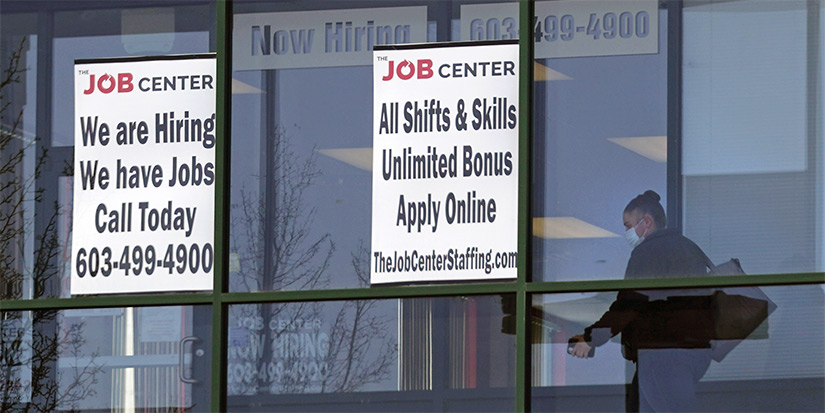
With each new slice of economic data the past few weeks, the bond market decided that the economy was getting softer and the potential for the Fed to start cutting rates was growing. Rates have been drifting down for the past few weeks. And then came today's unemployment numbers. The unemployment rate dropped to 4.4%. The bond market simply threw up. Yields on the 10-year bond rose a breathtaking 12 basis points in just a few hours.

But wait a minute. Why should the bond market worry about unemployment? Employment is a lagging indicator. In fact, the last time the unemployment rate was this low was during the recession of 2001. The unemployment rate was 4.4% in April of 2001. It dropped to 4.3% in May, before it began its climb to 6.3% two years later. The National Bureau of Economic Research tells us that the official dates for the last recession were from March through November of 2001. Note that the unemployment rate was dropping for two months even as the economy was beginning a recession.

This is not an isolated event. It is quite common for the unemployment rate to fall even as a recession is beginning. That is what we mean when we say lagging indicator.


The Visible Slowdown - A New Trend?

September 23, 2006

Yesterday the Philadelphia Fed Business Economic Survey came in at the lowest level since the recession in 2001. Some argue that it is just one month's worth of data, and "...besides, it is Philadelphia. Those numbers are always quirky." And why pay attention to the Conference Board's Index of Leading Economic Indicators? The bond market has its own opinions, and they are different than that of the stock market. With all of this as backdrop, we will then think about why we should be optimistic. Things are going to get better. All it takes is a little innovation.

The data seems to be pointing to an economic slowdown of some kind. It is getting increasingly difficult to suggest that we are in for a Goldilocks scenario where growth runs at 3%, inflation drops below 2% and housing starts to recover.

The debate is between those who say we are in for a soft landing or a hard landing. A hard landing is one in which the economy enters a recession. A soft landing is normally defined as one where the economy slows but stops somewhere north of an actual recession.


Mid-Year Forecast - More See-Saw Fed

July 15, 2005

Where will Treasury rates go? What about inflation/deflation? The dollar? The stock markets? Gold? We cover all this and more in this week's letter.

I normally do an annual forecast at the beginning of each year. In conversations with a number of clients and readers, I've come to realize it might be helpful to do a midyear forecast as well.

In January, I suggested that 2005 would be the year of the See-Saw Economy. So far, with one major exception, my forecast is in the middle of the fairway. I wrote:


Poker at the Federal Reserve

July 11, 2003

Is this a critical time in the bond market or are we simply back to where we were a few months ago before the recent madness? If it was temporary insanity, what caused it? Why is the dollar rising? Why have the Japanese sold more foreign bonds in the past few weeks than in the past few years? Who is buying those bonds? If the money supply is growing at breath-taking rates, why is gold languishing? If the economic data is so dismal then why are stocks rising, setting higher highs with each run-up?