

The Future of Public Debt
-
 John Mauldin
- |
- February 11, 2011
- |
- Comments
- |
- View PDF
 John Mauldin
The Future of Public Debt
A Bit of Background
Drastic Measures
The Future Public Debt Trajectory
Debt Projections
Phoenix, Tokyo, and London
This week I find myself in Bangkok, and I must admit to enjoying the experience a great deal, so much so that I am going to preview a portion of my coming book, Endgame, so that I can go back out and play tourist. Next week I get back to my more or less regular schedule, but I think you will enjoy this first portion of chapter six, where we look at an important paper from the Bank of International Settlements on “The Future of Public Debt.” It is not a pretty one. We are watching one of the last great bubbles begin to deflate – the bubble of government and government debt – all over the developed world. This is a serious weight that will be a drag on our growth, and it is interesting to contemplate as I sit in Bangkok, a city that is vibrant and teeming with opportunity.
Endgame will be in the bookstores in a few weeks, but let me once again ask you to not pre-order the book from Amazon or online. Pre-order books do not get into the book sales numbers (long story and more information than you want to know). I encourage you to pre-order from your local book store if you have one. Let me note that in the portion below, the pronoun we is used a lot. It is not the royal we – I do have a co-author, Jonathan Tepper, and this book has very much been a collaboration. More on some Thai thoughts at the end, but let’s jump into today’s Thoughts from the Frontline.
The Future of Public Debt
Our argument in Endgame is that while the debt supercycle is still growing on the back of increasing government debt, there is an end to that process, and we are fast approaching it. It is a world where not only will expanding government spending have to be brought under control but also it will actually have to be reduced. In this chapter, we will look at a crucial report, “The Future of Public Debt: Prospects and Implications,” by Stephen G. Cecchetti, M. S. Mohanty, and Fabrizio Zampolli, published by the Bank of International Settlements (BIS).
The BIS is often thought of as the central banker to central banks. It does not have much formal power, but it is highly influential and has an esteemed track record; after all, it was one of the few international bodies that consistently warned about the dangers of excessive leverage and extremes in credit growth.
Although the BIS is quite conservative by its nature, the material covered in this paper is startling to those who read what are normally very academic and dense journals. Specifically, it looks at fiscal policy in a number of countries and, when combined with the implications of age-related spending (public pensions and health care), determines where levels of debt in terms of GDP are going.
Throughout this chapter, we are going to quote extensively from the paper, as we let the authors’ words speak for themselves. We’ll also add some of our own color and explanation as needed. (Please note that all emphasis in bold is our editorial license and that we have chosen to retain the original paper’s British spelling of certain words.)
After we look at the BIS paper, we will also look at the issues it raises and the implications for public debt. If public debt is unsustainable and the burden on government budgets is too great, what does this mean for government bonds? The inescapable conclusion is that government bonds currently are a Ponzi scheme. Governments lack the ability to reduce debt levels meaningfully, given current commitments. Because of this, we are likely to see “financial oppression,” whereby governments will use a variety of means to force investors to buy government bonds even as governments actively work to erode their real value. It doesn’t make for pretty reading, but let’s jump right in.
A Bit of Background
But before we start, let’s explain a few of the terms the BIS will use. They can sound complicated, but they’re not that hard to understand. There is a big difference between the cyclical versus structural deficit. The total deficit is the structural plus cyclical.
Governments tax and spend every year, but in the good years, they collect more in taxes than in the bad years. In the good years, they typically spend less than in the bad years. That is because spending on unemployment insurance, for example, is something the government does to soften the effects of a downturn. At the lowest point in the business cycle, there is a high level of unemployment. This means that tax revenues are low and spending is high.
On the other hand, at the peak of the cycle, unemployment is low, and businesses are making money, so everyone pays more in taxes. The additional borrowing required at the low point of the cycle is the cyclical deficit.
The structural deficit is the deficit that remains across the business cycle, because the general level of government spending exceeds the level of taxes that are collected. This shortfall is present regardless of whether there is a recession.
Now let’s throw out another term. The primary balance of government spending is related to the structural and cyclical deficits. The primary balance is when total government expenditures, except for interest payments on the debt, equal total government revenues. The crucial wrinkle here is interest payments. If your interest rate is going up faster than the economy is growing, your total debt level will increase.
The best way to think about governments is to compare them to a household with a mortgage. A big mortgage is easier to pay down with lower monthly mortgage payments. If your mortgage payments are going up faster than your income, your debt level will only grow. For countries, it is the same. The point of no return for countries is when interest rates are rising faster than their growth rates. At that stage, there is no hope of stabilizing the deficit. This is the situation many countries in the developed world now find themselves in.
Drastic Measures
“Our projections of public debt ratios lead us to conclude that the path pursued by fiscal authorities in a number of industrial countries is unsustainable. Drastic measures are necessary to check the rapid growth of current and future liabilities of governments and reduce their adverse consequences for long-term growth and monetary stability.”
“Drastic measures” is not language you typically see in an economic paper from the Bank for International Settlements. But the picture painted in a very concise and well-written report by the BIS for 12 countries they cover is one for which the words drastic measures are well warranted.
The authors start by dealing with the growth in fiscal (government) deficits and the growth in debt. The United States has exploded from a fiscal deficit of 2.8 percent to 10.4 percent today, with only a small 1.3 percent reduction for 2011 projected. Debt will explode (the correct word!) from 62 percent of GDP to an estimated 100 percent of GDP by the end of 2011 or soon thereafter. The authors don’t mince words.
They write at the beginning of their work:
Like what you’re reading?
Get this free newsletter in your inbox every Saturday! Read our privacy policy here.
“The politics of public debt vary by country. In some, seared by unpleasant experience, there is a culture of frugality. In others, however, profligate official spending is commonplace. In recent years, consolidation has been successful on a number of occasions. But fiscal restraint tends to deliver stable debt; rarely does it produce substantial reductions. And, most critically, swings from deficits to surpluses have tended to come along with either falling nominal interest rates, rising real growth, or both. Today, interest rates are exceptionally low and the growth outlook for advanced economies is modest at best. This leads us to conclude that the question is when markets will start putting pressure on governments, not if.
“When, in the absence of fiscal actions, will investors start demanding a much higher compensation for the risk of holding the increasingly large amounts of public debt that authorities are going to issue to finance their extravagant ways? In some countries, unstable debt dynamics, in which higher debt levels lead to higher interest rates, which then lead to even higher debt levels, are already clearly on the horizon.
“It follows that the fiscal problems currently faced by industrial countries need to be tackled relatively soon and resolutely. Failure to do so will raise the chance of an unexpected and abrupt rise in government bond yields at medium and long maturities, which would put the nascent economic recovery at risk. It will also complicate the task of central banks in controlling inflation in the immediate future and might ultimately threaten the credibility of present monetary policy arrangements.
“While fiscal problems need to be tackled soon, how to do that without seriously jeopardizing the incipient economic recovery is the current key challenge for fiscal authorities.”
Remember that Rogoff and Reinhart show that when the ratio of debt to GDP rises above 90 percent, there seems to be a reduction of about 1 percent in GDP. The authors of this paper, and others, suggest that this might come from the cost of the public debt crowding out productive private investment.
Think about that for a moment. We (in the US) are on an almost certain path to a debt level of 100 percent of GDP in just a few years, especially if you include state and local debt. If trend growth has been a yearly rise of 3.5 percent in GDP, then we are reducing that growth to 2.5 percent at best. And 2.5 percent trend GDP growth will not get us back to full employment. We are locking in high unemployment for a very long time, and just when some 1 million people will soon be falling off the extended unemployment compensation rolls.
Government transfer payments of some type now make up more than 20 percent of all household income. That is set up to fall rather significantly over the year ahead unless unemployment payments are extended beyond the current 99 weeks. There seems to be little desire in Congress for such a measure. That will be a significant headwind to consumer spending.
Government debt-to-GDP for Britain will double from 47 percent in 2007 to 94 percent in 2011 and rise 10 percent a year unless serious fiscal measures are taken. Greece’s level will swell from 104 percent to 130 percent, so the United States and Britain are working hard to catch up to Greece, a dubious race indeed. Spain is set to rise from 42 percent to 74 percent and only 5 percent a year thereafter, but their economy is in recession, so GDP is shrinking and unemployment is 20 percent.
Portugal? In the next two years, 71 percent to 97 percent, and there is almost no way Portugal can grow its way out of its problems. These increases assume that we accept the data provided in government projections. Recent history argues that these projections may prove conservative.
Japan will end 2011 with a debt ratio of 204 percent and growing by 9 percent a year. They are taking almost all the savings of the country into government bonds, crowding out productive private capital. Reinhart and Rogoff, with whom you should by now be familiar, note that three years after a typical banking crisis, the absolute level of public debt is 86 percent higher, but in many cases of severe crisis, the debt could grow by as much as 300 percent. Ireland has more than tripled its debt in just five years.
The BIS paper continues:
“We doubt that the current crisis will be typical in its impact on deficits and debt. The reason is that, in many countries, employment and growth are unlikely to return to their pre-crisis levels in the foreseeable future. As a result, unemployment and other benefits will need to be paid for several years, and high levels of public investment might also have to be maintained.
“The permanent loss of potential output caused by the crisis also means that government revenues may have to be permanently lower in many countries. Between 2007 and 2009, the ratio of government revenue to GDP fell by 2–4 percentage points in Ireland, Spain, the United States, and the United Kingdom. It is difficult to know how much of this will be reversed as the recovery progresses. Experience tells us that the longer households and firms are unemployed and underemployed, as well as the longer they are cut off from credit markets, the bigger the shadow economy becomes.”
Clearly, we are looking at a watershed event in public spending in the United States, United Kingdom, and Europe. Because of the Great Financial Crisis, the usual benefit of a sharp rebound in cyclical tax receipts will not happen. It will take much longer to achieve any economic growth that could fill the public coffers.
Now, let’s skip a few sections and jump to the heart of their debt projections.
The Future Public Debt Trajectory
(There was some discussion whether we should summarize the following section or use the actual quotation. We opted to use the quotation, as the language from the normally conservative BIS is most graphic. We want the reader to understand their concerns in a direct manner. This is in many ways the heart of the crisis that is leading the developed countries to endgame. It is startling to compare this with the seeming complacency of so many of our leading political figures all over the world.)
Like what you’re reading?
Get this free newsletter in your inbox every Saturday! Read our privacy policy here.
“We now turn to a set of 30-year projections for the path of the debt/GDP ratio in a dozen major industrial economies (Austria, France, Germany, Greece, Ireland, Italy, Japan, the Netherlands, Portugal, Spain, the United Kingdom and the United States). We choose a 30-year horizon with a view to capturing the large unfunded liabilities stemming from future age-related expenditure without making overly strong assumptions about the future path of fiscal policy (which is unlikely to be constant). In our baseline case, we assume that government total revenue and non-age-related primary spending remain a constant percentage of GDP at the 2011 level as projected by the OECD.
“Using the CBO and European Commission projections for age-related spending, we then proceed to generate a path for total primary government spending and the primary balance over the next 30 years. Throughout the projection period, the real interest rate that determines the cost of funding is assumed to remain constant at its 1998–2007 average, and potential real GDP growth is set to the OECD-estimated post-crisis rate.”
Here, we feel a need to distinguish for the reader the difference between real GDP and nominal GDP. Nominal GDP is the numeric value of GDP, say, $103. If inflation is 3 percent, then real GDP would be $100. Often governments try to create inflation to flatter growth. This leads to higher prices and salaries, but they are not real; they are merely inflationary. That is why economists always look at real GDP, not nominal GDP. Reality is slightly more complicated, but that is the general idea.
That makes these estimates quite conservative, as growth rate estimates by the OECD are well on the optimistic side. If they used less optimistic projections and factored in the current euro crisis (it is our bet that when you read this in 2011, there will still be a euro crisis, and that it may be worse) and potential recessions in the coming decades (there are always recessions that never get factored into these types of projections), the numbers would be far worse. Now, back to the paper.
Debt Projections
As noted previously, this text is important to the overall intent.
“From this exercise, we are able to come to a number of conclusions. First, in our baseline scenario, conventionally computed deficits will rise precipitously. Unless the stance of fiscal policy changes, or age-related spending is cut, by 2020 the primary deficit/GDP ratio will rise to 13% in Ireland; 8–10% in Japan, Spain, the United Kingdom and the United States; [Wow! Note that they are not assuming that these issues magically go away in the United States as the current administration does using assumptions about future laws that are not realistic.] and 3–7% in Austria, Germany, Greece, the Netherlands and Portugal. Only in Italy do these policy settings keep the primary deficits relatively well contained—a consequence of the fact that the country entered the crisis with a nearly balanced budget and did not implement any real stimulus over the past several years.
“But the main point of this exercise is the impact that this will have on debt. The results [in Figure 6.1] show that, in the baseline scenario, debt/GDP ratios rise rapidly in the next decade, exceeding 300% of GDP in Japan; 200% in the United Kingdom; and 150% in Belgium, France, Ireland, Greece, Italy and the United States. And, as is clear from the slope of the line, without a change in policy, the path is unstable.
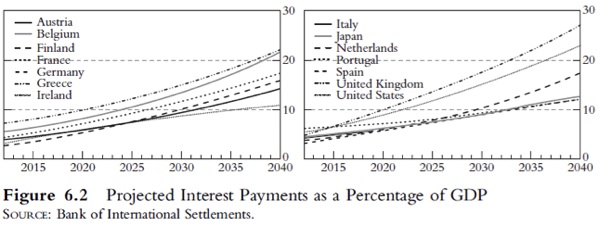
“This is confirmed by the projected interest rate paths, again in our baseline scenario. [Figure 6.1] shows the fraction absorbed by interest payments in each of these countries. From around 5% today, these numbers rise to over 10% in all cases, and as high as 27% in the United Kingdom. Seeing that the status quo is untenable, countries are embarking on fiscal consolidation plans. In the United States, the aim is to bring the total federal budget deficit down from 11% to 4% of GDP by 2015. In the United Kingdom, the consolidation plan envisages reducing budget deficits by 1.3 percentage points of GDP each year from 2010 to 2013 (see e.g. OECD [2009a]).
“To examine the long-run implications of a gradual fiscal adjustment similar to the ones being proposed, we project the debt ratio assuming that the primary balance improves by 1 percentage point of GDP in each year for five years starting in 2012. The results are presented in [Figure 6.1]. Although such an adjustment path would slow the rate of debt accumulation compared with our baseline scenario, it would leave several major industrial economies with substantial debt ratios in the next decade.
“This suggests that consolidations along the lines currently being discussed will not be sufficient to ensure that debt levels remain within reasonable bounds over the next several decades. An alternative to traditional spending cuts and revenue increases is to change the promises that are as yet unmet. Here, that means embarking on the politically treacherous task of cutting future age-related liabilities. With this possibility in mind, we construct a third scenario that combines gradual fiscal improvement with a freezing of age-related spending-to-GDP at the projected level for 2011. [Figure 6.1] shows the consequences of this draconian policy. Given its severity, the result is no surprise: what was a rising debt/GDP ratio reverses course and starts heading down in Austria, Germany and the Netherlands. In several others, the policy yields a significant slowdown in debt accumulation. Interestingly, in France, Ireland, the United Kingdom and the United States, even this policy is not sufficient to bring rising debt under control.”

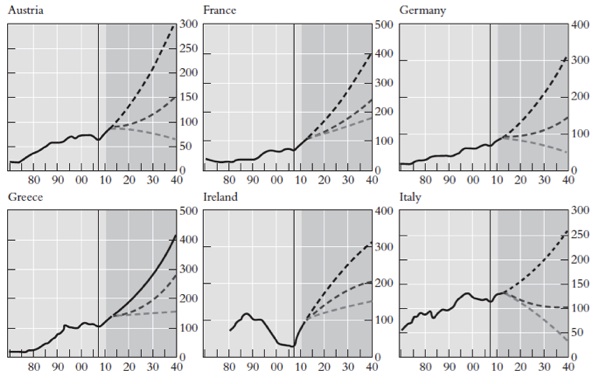
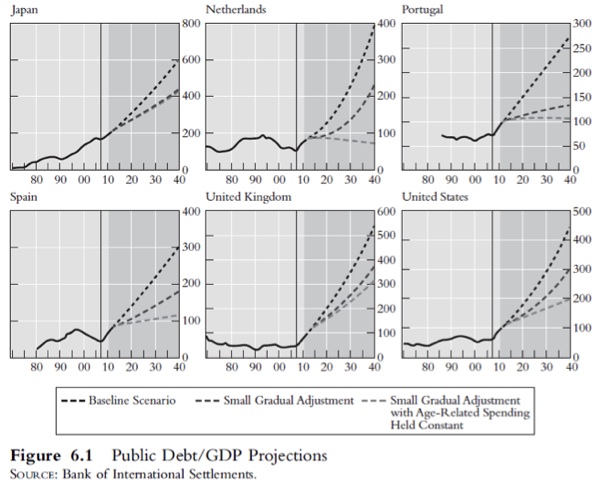
And yet, many countries, including the United States, will have to contemplate something along these lines. We simply cannot fund entitlement growth at expected levels. Note that in the United States, even by draconian cost-cutting estimates, debt-to-GDP still grows to 200 percent in 30 years. That shows you just how out of whack our entitlement programs are, and we have no prospect of reform in sight. It also means that if we—the United States—decide as a matter of national policy that we do indeed want these entitlements, it will most likely mean a substantial value added tax, as we will need vast sums to cover the costs, but with that will lead to even slower growth.
Long before interest costs rise even to 10 percent of GDP in the early 2020s, the bond market will have rebelled. (See Figure 6.2.)
Like what you’re reading?
Get this free newsletter in your inbox every Saturday! Read our privacy policy here.
This is a chart of things that cannot be. Therefore, we should be asking ourselves what is endgame if the fiscal deficits are not brought under control? Quoting again from the BIS paper:
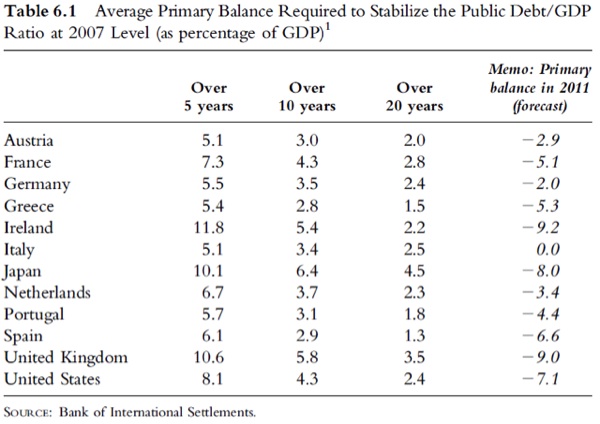
“All of this leads us to ask: what level of primary balance would be required to bring the debt/GDP ratio in each country back to its pre-crisis, 2007 level? Granted that countries which started with low levels of debt may never need to come back to this point, the question is an interesting one nevertheless. [Table 6.1] presents the average primary surplus target required to bring debt ratios down to their 2007 levels over horizons of 5, 10 and 20 years. An aggressive adjustment path to achieve this objective within five years would mean generating an average annual primary surplus of 8–12% of GDP in the United States, Japan, the United Kingdom and Ireland, and 5–7% in a number of other countries. A preference for smoothing the adjustment over a longer horizon (say, 20 years) reduces the annual surplus target at the cost of leaving governments exposed to high debt ratios in the short to medium term.”
Can you imagine the United States being able to run a budget surplus of even 2.4 percent of GDP? More than $350 billion a year? That would be a swing in the budget of almost 12 percent of GDP.
[End of excerpt]
I have taken enough of your time today, gentle reader, and it will soon be time to hit the send button. I spoke yesterday at the Foreign Correspondents Club here in Bangkok, and took a number of questions, as I did in all my presentations this week. Let me tell you, there is some skepticism as to whether the Western world in general and the US in particular can meet the challenges posed by the massive fiscal deficits. There was genuine concern that the world as a whole and their world in particular could once again be dragged into a crisis. They were looking for answers, and some assurance that we could find the way out. I have few answers, and although I am somewhat of an optimist that we will figure it out (after we are maybe forced to!), there is little in the way of assurance that the ride will not be a bumpy affair.
What answers I do have are not ones you will like, as I can assure you that I don’t like them myself. But when we are left with no good choices, we must choose among the poor ones. And that is a topic we will deal with more and more in this letter, as the choices we make (among the various nations) will determine our own personal investment and protection strategies.
Phoenix, Tokyo, and London
I will be speaking next week in Phoenix at the Phoenix Investment Conference & Silver Summit February 18-19, 2011, at the Renaissance Glendale Hotel and Spa. Attendance is free. You can register at http://www.cambridgehouse.com. The conference focuses on metals and mining, and if those are among your interests, check it out.
Then it’s on to Tokyo, where I get to have dinner with Christopher Wood of CLSA (consistently rated the #1 strategist in Asia) and then speak at their annual conference. I have long wanted to spend time with Chris (a colorful figure in our world), and this is a dinner I am really looking forward to. I am literally in and out of Tokyo in two days, but at least it is a non-stop flight from Dallas. Getting back from Bangkok is a very long, three hops, a full day indeed.
Then I will be in London and Malta for sure in the third week of March, and my guess is that somewhere along that time I will also be in New York and elsewhere to promote the new book.
I must hit the send button, as my host here in Bangkok, Tony Sagami, is downstairs; and soon Richard Duncan (the author of The Dollar Crisis and The Corruption of Capitalism) will join us. I see some fun and new sights in my near future. I am off shopping tomorrow in what they tell me is the world’s largest open air market (it seems some friends and family have this shopping list, don’t you know). It will be an interesting next few days. Have a great week!
Your not understanding one word he hears here analyst,

John Mauldin
P.S. If you like my letters, you'll love reading Over My Shoulder with serious economic analysis from my global network, at a surprisingly affordable price. Click here to learn more.
Tags
Suggested Reading...
|
|


Did someone forward this article to you?
Click here to get Thoughts from the Frontline in your inbox every Saturday.