

Tough Choices, Big Opportunities
-
 John Mauldin
- |
- October 1, 2011
- |
- Comments
- |
- View PDF
 John Mauldin
This week I am in Ireland and going from meeting to meeting with a wide variety of people. And this week's letter is a wide-ranging interview with me, conducted by that doyen of financial-world interviews, Kate Welling. She really is one of the best, and she has graciously given me permission to share the interview with you this week, while I am researching next week's letter on Ireland and Europe. I hope you enjoy reading it half as much as I did recording it.
(Sorry for the letter being late. There was a major technical difficulty. – The Editing Team)
But first, in the interest of full disclosure, I want to briefly note to my readers that I have joined the board of Galectin Therapeutics (Ticker: GALT), a small biotech company with unique potential technologies. I get asked from time to time to join a biotech corporate board, but have so far not done so, and the exception is now GALT.
Basically (to make a long story short), GALT has a deep repository of research performed in the USSR prior to the fall of the Iron Curtain, on carbohydrates. Russian and Eastern European scientists had traveled the world looking for new carbohydrates in plants, etc., and the research spanned many decades. When Russian science lost much of its funding, some of those famous scientists came to the US and brought this research, which was then quite new. In the West, we had concentrated on using proteins as drugs, ignoring by and large their lowly sugary brethren.
In an agonizingly slow process, funding found its way to this research, and some very interesting things were discovered about a particular type of carbohydrate that binds to and blocks a protein called galectin, which appears to cause cirrhosis. It seems to be found in the presence of cancer cells, and according to peer-reviewed research may be the cause of cirrhosis of all types, but specifically of the liver. Mouse and other studies suggest the blocking carbohydrate has the potential to be a cure for cirrhosis, and GALT will be in human trials next year with the very prestigious liver research group at Ludwig Institute in Brussels and plans to be in clinical trials next year for liver fibrosis. One of GALT's molecules also appears to dramatically reduce the side effects of chemotherapy for certain types of cancer treatments. (Phase-two trials indicated a unique combination of increasing median patient survival while reducing the number of severe adverse events by approximately 50%). GALT has an application pending with the government of Colombia, which suggests the possibility of use in Latin America soon).
These are wonderful things, of course, but not why I joined the board. In economics, Bastiat used to talk about "the things you can see and the things you don't see." What I "see" in GALT is what is not yet seen, and that is the treasure trove of data on carbohydrates, for which uses are so far only vague speculation. I see the potential for a lot of very interesting research, which will be very costly, but could have real impact, as their current cirrhosis drug candidates have. I should mention that the liver research is highly speculative, as there are no human trials, only mice, rats and human liver-cell culture studies. These are encouraging, to be sure; but as my doctor, Mike Roizen, constantly reminds me, to help temper my enthusiasm, "John, orange juice works in mice!"
Investing in small biotechs with "potential" is somewhat akin to investing in junior and exploratory gold mining stocks. If everything works out, the returns can be exhilarating, but the majority of them will go to zero, so you need to do a LOT of homework and have a diversified basket of them. I do that with biotechs. I love each one of my "investments," but I fully recognize that for a whole host of reasons they could go to zero. What can be a wonderful technology may not work in humans, or it can work but another company comes along and does it better and cheaper, or (more likely) they run out of money or have management problems.
GALT is a perfect example of what I look for. They have wonderful upside if the technology proves out, but will be a big disappointment if it does not. Clearly, I think there is something there, if I am willing to join the board. I also know that some of you will be tempted to "ride along." Let me say, do not, unless you go to their website, listen to their CEO, Peter Traber, explain the technology and company, read the independent research, and look at the board that chairman Jim Czirr has rounded up. GALT has had "issues" in the past, as my kids would say, and it has taken Jim some time, since he organized a take-over of the board, to get the ship headed in the direction it needed to go; but he is fanatical (almost maniacal) about it, which is of course what you must have. Dr. Traber, formerly in charge of global drug development for Glaxo, is a force in himself and relatively new as the CEO. I am very impressed with him. I really like the management team and the plans going forward. No guarantees of course that the good plans will work out the way we hope.
And if you do the research for yourself and like what you see, then be patient. Do not chase the stock price. Pat Cox of Breakthrough Technology Alert introduced me to the company and I bought a few shares, a long time ago. I intend to buy more over the next year; but as a director, I will allocate an annual amount and buy them on a regular, prearranged basis regardless of share price, and will not start to do so for some reasonable time after this announcement. So, I have a mixed bias. As a director I want to see the company shares do well, but I hope they don't get too high, for a while at least. (It's much like my monthly gold purchases: I am glad to see gold is down, as I get more of it when I buy!)
Don't buy if your time horizon is measured in less than years. If you feel the need to look at charts and current prices, then I suggest you pass. I have no idea what the stock will do in the short term, nor a timetable for reportable results. You can see the website at www.galectintherapeutics.com. You can request a copy of the independent research by emailing your request to squeglia@galectintherapeutics.com or calling the company at 617-559-0033.
Tough Choices, Big Opportunities
As noted above, I had the privilege of finally meeting Kate Welling, who writes the famous (in the financial world) Welling@Weeden letter, in which she highlights interviews and commentary from many of the financial world's luminaries. I must confess, getting time with her has been on my list of "want to's" for a very long time, and we did finally meet this summer in Maine, thanks to David Kotok. Her interviews are simply the best, but are hard for most investors to access, as they are aimed at institutional clients.
I think I have convinced her to break out of her shell and offer these great interviews to the retail world. She is working on the details, such as price, etc.; but in the meantime you can go to www.welling.weedenco.com and click on "How to Subscribe" (individual) and put in your email address, and she will get the information back to you. Check it out. Next Monday you well see another interview by her that she did with my friend Paul McCulley (formerly of Pimco), in which he talks about the same problems I do but offers a dramatically different set of solutions. We both think the other is dead wrong, but love each other anyway. Now here's my interview.
listeningin,too
The Endgame
John Mauldin Sees Opportunities Aplenty, But Hard Choices First

John Mauldin, best-selling author and omnipresent e-presence, needs no introduction, so I won't get in the way. The president of Millennium Wave Investments very generously spent some quality after-breakfast time with me on a deck on the shore of a gloriously remote Maine lake, right after S&P downgraded the U.S., and this is how the conversation went. Listen in.
KMW
So what's the next step in the end game, now that we've seen S&P downgrade the U.S.?
It's going to be a series of steps – and they are going to seem surreal. I mean, here we were last night at a gathering of some of the finest economic minds in the world, when the first word of the downgrade started leaking out. When I was told by Jim Bianco and John Silvia to stand by, Bloomberg was going to need commentary because S&P had reportedly issued the downgrade, my initial reaction was to laugh and say, "Guys, if you want me to make a fool of myself in front of a million people come up with a more credible lie." Yet in an odd sense, I am hoping that the downgrading of the U.S. government, acts as a wakeup call to our Congress and to the President to recognize that we really do have to do something. This is the whole process of the end game.
Which, it just so happens, is the title of your latest bestseller, "Endgame: The End of The Debt Supercycle and How It Changes Everything," which you wrote with Jonathan Tepper.
Well, could we have a clearer signal that this is the end of the debt super cycle? What we have done is use leverage for 70 years to finance our growth. At the beginning of the supercycle, it was giving us $5 of growth for every dollar of leverage. But towards the end, it was giving us 50 cents for every dollar of leverage – so it was not a good bet anymore. While this is hard for an author to say, the most important book of the last decade was not, in fact, mine, but Ken Rogoff and Carmine Reinhart's book, "This Time It's Different," which gave us a marvelous, marvelous framework for analyzing the crisis backed up with a data series of one financial crisis after another. What we have learned (or, really failed to learn) is that it's never different this time. There is a pattern, and the United States is no different than Greece or Ireland or Italy or Japan or any other country in history. Highly indebted governments, banks, or corporations can seem to be merrily rolling along for an extended period, when bang! – confidence collapses, lenders disappear, and a crisis hits. There's a limit to how much the bond market is going to let us borrow. As we approach that limit – and we're not there yet, we have time, thank God – we can make choices about how we want to deal with the problem. But the problem is too much debt and too high a deficit. And we have to deal with it. Our choices are only about how.
Meaning?
When I am in front of a crowd speaking about this, I frequently liken the problem to a bottle of wine. I like to take a bottle of wine out and put it in front of them, saying, "We're going to have this much pain and there is not anything we can do about it. But we can choose to take it all at once– that's probably a depression – or we can turn the bottle on its side and take only little bit at the beginning, and then as we grow over time, we can take more. Now, as we all learned in Economics 101, if we reduce government spending, that is going to reduce GDP. But the economic literature tells us that it's going to reduce GDP only for about 4 quarters, on average, so that is not a long-term effect. The problem comes in because we're going to have to reduce the deficit by about 1% of the GDP a year in the first year and then do the same the next year and then the next year. We're going to have to do it for 5 or 6 years. Now, that doesn't mean we can't have phenomenal growth in the meantime that will help us bring GDP up even as we reduce the deficit. But we are also going to have to deal, in the deleveraging process, with a couple of recessions because that's what happens. That is what the recent McKinsey Global Institute study that I mentioned in my book made very clear: This is not a normal cyclical, or business cycle recession; it was brought on by too much borrowing, and now we have to repair our balance sheets by deleveraging at the same time that the assets we bought in the boom are falling in value. What's more, empirically, a long period of deleveraging almost always follows a major financial crisis. These deleveraging periods, it's very clear, include both recessions and periods of growth, and we are talking about a five-to-seven year process.
In other words, there's no quick exit, for those looking for instant gratification?
No such luck. I was with Senator Rob Portman (R, Ohio), who was the head of the OMB [Office of Management and Budget] from 2006-2007, under President George W. Bush, just last week. I was with 10 senators, as a matter of fact, at the invitation of Sen. Portman, basically giving a seminar on this process. By the way, it was tri-partisan. There were Democrats in attendance and also Sen. Joseph Lieberman, so we had an independent! These guys were very engaged. But as you began to explain to them that we have a 57 year outlook dominated by the problems of slow growth, high unemployment, and there is nothing they can do; there is no pixie dust that they can sprinkle on these problems, it was plain that it wasn't what they wanted to hear. Hearing that, in fact, when you start dealing with the problem in a credible manner, you are going to create the very situation that your constituents don't want, isn't something that warms politician hearts.
Like what you’re reading?
Get this free newsletter in your inbox every Saturday! Read our privacy policy here.
Or what passes for hearts in those environs. I would have loved being a fly on those walls.
As you're sitting and talking with them, they're saying, "This is not fun," Several of them had already read the book. They knew. That's why they brought along colleagues. That's how you get 9 or 10 senators in a room for 90 minutes. The ones who knew had been working the floor. When they had asked me to come, I thought there would be 3 or 4 maybe at the meeting. But you do what you can. It was a sobering group. There were people in that room who were going to be named to the government's "Gang of 12," which is charged with finding budget cuts under the debt ceiling deal.
Have you noticed how Chinese terminology is seeping into political discourse?
It is, isn't it? But my point is that we're going to be lurching from crisis to crisis; my deep concern is that second half growth is going to be slow, 1% if we're lucky.
I'd say we're flirting with stall speed – or worse.
We are and the problem is that Europe – somewhere in the next six months to a year, maybe sooner, is going to have a true, true crisis. And for us to think that it is not going to visit our shores seems absurd on its face – after all, our subprime problems, which originated in Vallejo and Riverside and Nevada and Arizona and Florida, took the entire world of banking and credit down. It is all really interconnected. I use an analogy of a sand pile in my book. There was a wonderful computer experiment in the mid-'80s, used to study the stability of a simulated sand pile. They would drop one piece of electronic "sand" onto a sand pile, over and over again, and when the pile became unstable, it would show up red on the computer screen. So over time, you would get these large fingers of instability that would build up through the system. Sometimes they'd produce little small slides but sometimes the pile would build up and then you'd have a massive slide. Well, we now have so many fingers of instability among our banks and among our financial institutions around the world that this interconnectedness is going to create, I think, another crisis here in the U.S. I expect it to push us into a recession push unemployment even higher. And I expect all of that to happen right in the middle of the election year – even though, historically, you'd expect 2012 to be a good year for the economy, because that's what the presidents do.
It sure helps, if they want to get re-elected. Hence, the presidential cycle.
My point is that the end game takes away all the previous cycles, all the data. That takes me back to my meeting with Sen. Portman. I said, "Your former guys at OMB are making projections that the U.S. is going to be growing at 3.5% and that unemployment drops to 7% – by using past performance as their guide. Yet every email that I send out, every letter I write, everything I publish has a disclaimer at the bottom, saying that "past performance is not indicative of future results," because it isn't.
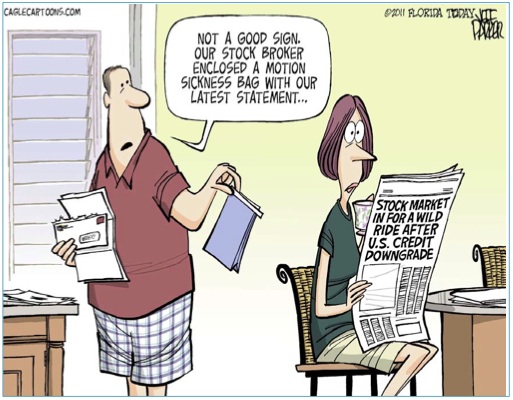
True, though nobody reads those disclaimers – and lots of folks invest like they believe in the predictive power of past performance.
Yet the single most-important thing we need to understand is that we are in the end game – and understand that you cannot use past models in the endgame. We have a lot of physics employed in the economic world these days. We want to be able to model things – and sometimes the models even work – but that doesn't necessarily mean that we have built smart models.
It's amazing how many physicists around Wall Street seem to have forgotten everything they once learned about the way complex systems can become too complex – go critical – and then fail catastrophically.
We have the potential for another banking crisis, at least equivalent to what we just went through. Because 80% of European banks are going to be insolvent; they are all more leveraged than our banks. They weren't required to put up any capital against their holdings of sovereign debt because everybody knew the sovereigns are sovereign and cannot default. Well, they were wrong. So now we're in this crazy situation where our banks have loaned them money and their banks have lent money to ours, and we've all sold each other credit default swaps – and Dodd-Frank didn't solve the central issues. We still have banks that are too big to fail, we did not put most credit default swaps on an exchange – because, God knows, that would have hurt the banks' profits –
In my opinion they're an innovation that should be banned in most instances.
Well, I disagree. I'm actually in the school that says we don't have too many derivatives – we don't have enough. Derivatives are a good thing, but they need to be on an exchange. A futures contract is a derivative – but it's on an exchange and so you know your counterparty is going to keep their end of the bargain.
It's also tied to a physical, not merely some third or fourth degree paper construct created to facilitate financial speculation.
Like what you’re reading?
Get this free newsletter in your inbox every Saturday! Read our privacy policy here.
I believe you can have markets for pure speculation. But what I want to know is who the counterparty is. If the counterparty is AIG, then it's no longer speculation. You put the public purse at risk and it is utterly absurd to give Goldman Sachs $10 billion of public money because they bought protection from AIG. If you buy protection from a private party, it is up to you to know who the private party is and it's up to you to have done your homework. It is not up to the public to come in and say, "Oh, Goldman Sachs, you poor boy, you didn't know what you were doing," and bail you out.
But AIG was a "triple A" credit.
No excuses. The upshot is that as a society, we're in a situation of being forced to embrace austerity; it's a word you don't want to use. But being forced to gradually reduce the deficit and deleverage changes the underlying tectonic plates of the economy. Businesses are just going to have to shift, individuals are going to have to shift. I was talking to one of our Maine fishing guides last night; he was asking what does all this mean for me? He said, "I'm a small businessman. I thought if I came through this last recession, I might be okay." But I had to sit there and tell him that, "You're probably going to have to survive another five years of this." Then he said, "I don't want to work for another 5 years." I looked at him and said, "You're probably going to have to." That's just the reality, more and more– not just in the U.S., but around the world. My throwaway line in "Endgame" is, "Japan is a bug in search of a windshield." Japan is going to hit the wall sometime within the next few years – and unlike Greece, Japan makes a difference.
It's still the third largest economy in the world–
So going back to my meeting with the senators, I said, "Guys, the real problem you guys are going to have is not getting the deficit under control. You can figure out a glide path – just like taking a plane in, you find your glide path and take it down slowly. You can figure it out. Your real problem is going to be that every major economy in the world tries to take your currency down.
You see competitive devaluations?
The euro, if it exists in two years, is going to be a lot cheaper. I said in 2002, when the euro was at 88 cents, that it was going to a buck-fifty and all the way back to a buck in 12-15 years. You could see this coming. The pound is going to parity. The yen, when they start printing – and they will – will go to 125, 150, 175, 200, 250. What's the end? I don't know, but you will buy a Lexus cheaper than you can buy a Kia. And South Korea is not going to like that, just as the Swiss are complaining bitterly. [And the SNB just fired a salvo, setting a floor under its currency.] The Chinese are going to be looking at their largest client, which is actually Europe – not the U.S. – with a currency that has dropped like a rock, while the U.S. is griping and complaining that the Chinese currency needs to rise another 25%-30%. Meanwhile, the ECB is in crisis, who knows what QE3 might look like, commodities prices are under pressure again, yet we seem to be having terrible weather patterns, which will be exerting upward pressure on food prices.
So part of your gloom stems from your perception that QE3 is inevitable?
Oh, yes. The old line is that if the only tool you have is a hammer, then all the world looks like a nail.
True enough. But isn't even that tool impotent?
The point is, for the Fed, the only tool they have left is liquidity. When all the world looks illiquid, they don't want to be sitting around in a room saying, "There is nothing we can do." Because everybody will be saying, "Do something." Well, the only thing they can do maybe is something like make the next QE look like Operation Twist from 1948 – where they just purposely drive the 10-year yield down to 1.5% 2%. So, again, when we're sitting around in Maine next year at this time, we'll be saying, again, "My God, what have they done? It's like we're living in a Dali painting. And it's going to seem like that because it's never different this time and we just have to go through that wine bottle's worth of pain.
We're just stuck?
If we don't deal with it – if we don't proactively say we're going to get our deficit under control – let me put it this way: My personal belief is that if we do proactively get our long-term budget issues under control, the bond market will say, "Okay, you're credible and we will buy your bonds, because you have put yourself on a credible path – whether it's through cuts, whether it's through tax increases, however you want to do it – but you have to do it. But you have shown us a credible way to get to the place where the growth rate of your deficit is below the growth rate of nominal GDP."
But if we don't do that, my wine bottle of pain becomes a jeroboam and we end up downing it all at once.
That sounds ugly.
It is. It will force budget cuts; it will force tax increases of the magnitude that no one is ready to contemplate. We're talking cuts in Medicare, cuts in education, in defense, in spending of all kinds. That would create a depression, a true depression that would last 4-5 years, push unemployment to 20% 25%. And the Fed truly would have to start monetizing debt; there'll be no choice. That's a world in which economic assets get turned on their heads. That's what I lay out in my book. Which is where I come in and say, "Guys, we have to make the hard decisions now." I'm an expert in bad choices. I have 7 children, as you know. You met one of them, Trey, last night. He is the last of my teenagers. So I have watched teenager after teenager grow up, and that process teaches you something about them: Teenagers always make the easy choice. They put the difficult choice off to the last minute. Well, we made the easy choices as a culture for a very, very long time and now we have the difficult choices in front of us. For the Greeks, their choice is between disastrous and even more disastrous. Do you leave the eurozone, and employ every lawyer in Europe for the next 10 years trying to work out what that looks like? Do you stay inside the euro and just simply repudiate the debt? Do you tell people who are retired at 50 years old that they have to go back to work? Those are all very, very bad choices that you're going to have to choose among. But you have to make those hard choices. Ireland is going to tell the European Central Bank, "You know that 80 billion euros that you loaned us to cover our banks, you need to move that from the loan side of your books to the capital side. Here's the key to your bank. By the way, what are you going to do with your bank, we're just curious."
Like what you’re reading?
Get this free newsletter in your inbox every Saturday! Read our privacy policy here.
Well, it was Ireland's banks that were wanton. Not Irish taxpayers.
That's right. And that's what Iceland did – and Iceland's economy was down for something like 9 months to a year and now they're coming back. That should be done. Take the hit; go on and do it. There's something to be said for the cleansing moment that I guess the Austrians want us to have. It's not the choice that I would make–
On the scale that needs to be done, it's not a credible option in this country. I don't think we're there; we will only do something like that if it's forced on us. But it will be forced on us if we're at a place where the bond market says, "No, we're not going to finance you anymore." Just like the bond market is saying that we're not going to finance Greece or Portugal or Ireland, and we're watching Italian rates, thinking they could go up any week. In one sense what S&P did last night was really and truly screw Europe.
How so?
Because how can S&P now not downgrade the ECB, which is holding hundreds of billions of euros of truly junk debt – debt that if it has to be marked to market would create losses of at least ten times the value of the capital that they have. Is the ECB now going to come to Italy and say, "You're 20% of this operation; we want you to put up 20 billion euros to recapitalize the ECB so that we can then give 3.5% loans, which you are going to have to back, to Ireland, Portugal and Greece?"
Perhaps. But why anybody pays any attention to S&P at this point, is beyond me – even if it's a legal requirement! They have zero credibility.
The only credible rating agency out there is Egan-Jones, and they'd already rated the U.S. double A awhile back.
That's very true – but only the really smart money pays attention to Sean's work.
It's too bad. When Sean Egan was on TV the other day pointing out that he thinks the average haircut on Greek debt will be 90%, you could just see jaws drop. Other people were going, "It can't be that bad." But I was sitting there going, "Yes, it can be, it certainly can be." Greece has been in default during 160 out of the last 200 years, so why are we shocked? They have made an art form of defaulting. I've visited Tuscany for two years in a row. I find it a wonderful place to vacation and work from – and I fully expect that the day will come when I will be using lira rather than euros when I visit. I've always said the euro was not a currency, it was an experiment. And we're now seeing how this experiment works. Are the Germans going to pony up? Can the coalition work? Nobody knows. One of the things that we have long had is the luxury of looking over the pond and asking, "What are you going to do?" But now they can turn around, look back and say, "What are you guys going to do?" It was incredibly absurd this morning, however, to hear France was expressing solidarity with the United States, saying, "We believe in the credit of the United States."
Well, they'd better. They have to hope against hope for some sort of international rescue party, like we put together in 2008. Has anyone at S&P looked at the French banks, I wonder. That country's deficit situation isn't exactly jolie. All of the major countries of Europe, including Germany, have been the biggest beneficiaries of the weakness of the euro – which has been pulled down by the woes of its periphery. And their banks are up to their gills in the periphery's sovereign debt –
Up to their "gilts," you mean. It is a mess, and we have years of struggle still ahead of us. But I do know that we get through this, one way or the other. The one thing about this process that we can learn from history is that there is an end to the endgame. We have this marvelous clearing mechanism in capitalism. The markets do get cleared out, asset prices do get cleared out. We've hit the reset button. Those of us of a certain age remember "the blue screen of death." You would just have to unplug your computer from the wall, wait for fifteen seconds, plug it back in, start it back up, and hope you didn't lose too much. If you were smart, you were backing things up because you never knew when it would happen. Well, we're hitting the reset button now, that's the process we're in, all over the developed world. Then we'll come back.
But it always entailed a loss.
Right. There was always some data loss, and there are going to be financial losses.
We haven't suffered enough?
No, unfortunately. It typically takes about 3 recessions to really end a secular bear cycle in stocks, and we are getting ready to have that third one. We'll see averages come down further. The good news is that secular bear cycles average about 17 years, and this one started in 2000, so it won't be too long until we're getting ready for the next long bull market cycle. Consider what Japan has gone through. In 1978 and for the next 10 years, the Japanese were beating our brains out and buying every trophy property in the U.S. they could get their hands on. In 1978, unemployment in the U.S. was as high as it is now, inflation was running 17-18%, and no one wanted to hear about stocks as an investment.
I can vouch for that.
Like what you’re reading?
Get this free newsletter in your inbox every Saturday! Read our privacy policy here.
But that was on the cusp of one of the best economic and bull market runs we've ever had.
So you do see light at the end of the tunnel? GDP growth and jobs?
Oh, certainly. The answer to the question, "Where will the jobs come from?" is that I don't know – but they will. That's what free markets do – that's what American entrepreneurs do. Create jobs. The job of every politician – the first thing they should ask themselves when they get up in the morning – is, "What can I do to make it easier for entrepreneurs to create jobs in my town, city, state, country? Because that's how we come back from this endgame. As businesses reorganize as new businesses, as industries come back and as new industries are created because we will create whole new industries. We will create whole new ways of manufacturing; there's going to be a wonderful future. That's the book I'm working on right now, "What The World Will Look Like in 2032." I need to finish writing it before we get there! But it is going to be a marvelous future. We just have a financial bump to get over and technology will do it, just as it got us through the Depression, World War II, the Cold War, and Jimmy Carter. That entrepreneurial free market response is built into our DNA. And we're adding 3 billion people to the global group, whose entrepreneurial DNA has been unleashed, so the changes are going to come even larger and bigger and faster. The reality is that governments can do very, very little to be constructive; most of what they do is destructive. They're very good at that. Here, they need to do as much as they can to get out of the way.
I'd like to see little things, like throwing out the tax code and starting over, and taking private money totally out of politics. But I'm a dreamer.
Well, I would start by changing the accredited investor rules. I would start by saying that if you're a small entrepreneur and you need to raise money, you need to be able to advertise the fact that you are an entrepreneur and are going to raise money for a specific business on a website. We should allow people to use their own judgment to make or lose money in your business. I understand that the government wants to protect people, but the whole protection process we have set up ends up reducing the flow of information and the flow of capital. We do this because we want to make sure the little guy doesn't lose money, but we have to allow people to take risks. Risk is good.
Happy endings are not guaranteed, but it is definitely not good when the little guy has a false sense of security – thinks he's being protected – by people or organizations that in no sense can really protect him.
That's the way it is today, in the securities industry. We have all these rules and regulations that we follow – but there's fraud left and right. Still, I believe in the American spirit. New technologies, biotech, nanotech. I truly believe we will find new energy sources. I'm giving my youngest son a car this fall – I will buy a new car and it will probably be the last combustion engine car that I buy. The next car that I buy – seven, eight, 10 years from now –will be an all-electric car. That's a massive retooling that's going to create a number of jobs. I think we should raise the price of gasoline by 2.5 cents a month, every month, until our oil imports stabilize. And, by the way, we should be tooling everywhere. Boone Pickens is right. We should change our truck fleet to natural gas. As I explain in my book, everybody can't deleverage and run a trade deficit at the same time in this global economy. So we've got to reduce our trade deficit in order to be able to bring our government deficit down. We also need to take a, say, 2.5% tax increase and invest it in infrastructure, so it stays at the local level. That means local communities can then issue bonds against that revenue – and start building today, creating jobs today. Because then they will know that we'll have money coming in that can help us rebuild water systems and bridges and roads, power grids – all the stuff that we need to be doing to modernize our society. As much as I know that using the words "tax" and "increase" in the same sentence is anathema these days, I know what is needed. Let's take a tax increase and use it to buy or build something that will help the next generation.
I'm on board with that. We're still living with infrastructure investments that our grandparents made during the Depression and after WWII. We could stand to refurbish them – and add new ones.
My hobby is biotech. I believe that before the end of this decade we're going to see announcements about companies curing various cancers; that Alzheimer's will not be something we have to worry about. I expect a cure for liver disease; a cure for cirrhosis of the liver will be announced in the next 12-18 months. There's just one thing after another that we're on the edge of.
From your lips to God's ears, as an old friend used to say. Thanks, John.
Ireland, Geneva, New York, South Africa, and Atlanta
I am writing from a hotel in Dublin tonight, dashing off this last note before yet more meetings over dinner. It is a whirlwind four days, and I am meeting a plethora of people, from government officials, politicians of all stripes and hues, economists, fund managers, rogues and ne'er-do-wells (at least that is what they call each other), working men and women, businesspeople, et al. Communists (yes, there are still some diehards here!) to libertarians. I don't want to tip next week's letter; but as I step back, I can see some very common themes in all of the conversations. It is quite fascinating. I go to Galway tomorrow for yet more meetings, and then Sunday I'm back in Dublin. This will not be my last trip to Ireland.
Monday I leave for Geneva for two nights and then home for a week, then off to Houston for the Streettalk Advisors conference, New York for the Singularity Summit for the weekend (www.singularitysummit.com), meetings on Monday and Tuesday in New York, then it's off to Cape Town in South Africa for two days, one night to speak at the Momentum Wealth Investment Summit Conference.
Finally, a quick note to let you know that I will be in Atlanta, speaking at the Hedge Funds Care gala event to help raise very needed money for children's charities, on Wednesday November 9. For more information go to www.hedgefundscare.org/event.asp?eventID=74. See me there!!
Time to hit the send button, as there are people waiting downstairs for a late dinner somewhere. I love Ireland. I feel at home here. I have to get here more. In fact, late last night I got talked into coming back in about a month to something called Kilkenomics Fest, an economics festival (who knew?) in Kilkenny, November 2-6. The MCs are professional stand-up comedians, so no economic double-talk allowed or you go down in flames! My type of venue. Maybe. But it sounds like great fun. 4-5 hours of Q and A with average people. Last year was the first, and they had fabulous crowds. Seems everyone is interested in economics now. (I talked with a well-known econ professor here in Dublin at Trinity University. His class for 100 was standing room only, with 200 kids all crowding in. Economists as rock stars? Go figure. But then maybe I can be Niall Ferguson when I grow up.) What's another plane flight or two? Or four? Time for some fun.
Have a great week. I know I am. And I turn 62 on Tuesday. Let's see if I can get to 62 push-ups. I am working hard at it.
Your all I really am is a frustrated stand-up posing as a financial writer analyst,
John Mauldin
P.S. If you like my letters, you'll love reading Over My Shoulder with serious economic analysis from my global network, at a surprisingly affordable price. Click here to learn more.
Tags
Suggested Reading...
|
|


Did someone forward this article to you?
Click here to get Thoughts from the Frontline in your inbox every Saturday.