
- July 4, 2025
At The Crossroads
Happy Fourth of July! I hope you’re enjoying a long holiday weekend. That’s what I am doing, so this letter will be a little different.
Read moreFollow John Mauldin as he uncovers the truth behind, and beyond, the financial headlines. This in-depth weekly dispatch helps you understand what's happening in the economy and navigate the markets with confidence.
Happy Fourth of July! I hope you’re enjoying a long holiday weekend. That’s what I am doing, so this letter will be a little different.
Read moreEconomic news is increasingly hard to follow these days, mainly because it changes so fast and it gives so many mixed signals. Less than three months ago, we were all in shock from President Trump’s “Liberation Day” tariff announcement. While he paused the worst parts of that plan, US import taxes are still at their highest point in decades. Yet now the headlines are more about oil and geopolitics. It turns out that most of the news is just noise. The markets aren’t significantly different from...
Read moreToday we’ll talk again about the SIC—not the Strategic Investment Conference, but the Strategic Investment Conclusions it helped us reach. This is not a recap of the conference. It’s my reflection on some things I think we should practice in our lives and our investment portfolio management. The “strategic” part means we don’t seek information for its own sake. We seek information because it should influence our actions.
Read moreOne cannot overstate the importance of Claude Shannon and his 1940s work on information theory at Bell Labs. It was foundational to modern telecommunications and electronics. We’ve seen constant improvement in our ability to communicate because we can separate the important information from the noise.
Read moreThoughts from the Frontline explores developments overlooked by mainstream news and analyzes challenges and opportunities on the horizon.
The newsletter began as John’s way of sharing his thoughts with a few associates. Two decades later, it is one of the most widely read investment newsletters in the world. From his warning of an impending recession in 2000, to a polemic on the Obamacare “death spiral” in 2016, John has blazed his own trail as one of the most respected macroeconomic minds in the field.
"Central bankers, businessmen, and investors continually try to beat History to a pulp, but History always wins the final rounds."



When investors, financial professionals, and discerning citizens need a big-picture view of what's going on in the economy, they turn to John Mauldin.
And for good reason. John has dedicated more than 30 years to keeping people informed about financial risk.
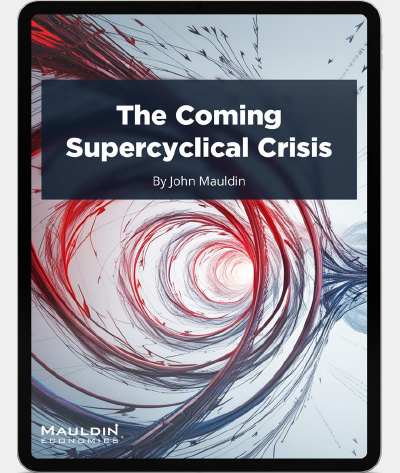
The Debt Supercycle theory traces the increasing transfer of private debt to government balance sheets, highlighting its implications, the unique constraints of government debt management, and potential future scenarios—including the limits of government borrowing, the role of bond vigilantes, and the risk of a major fiscal crisis if current trends continue.
Get this free report delivered to your inbox when you fill out the form below.