
China’s Disturbing Vision

And once you see it, you cannot unsee it.
I’m not alone. Here is what we are observing at macro scale:
That it has been common knowledge—something we all knew that we all knew—since the Nixon years that by simply exporting capitalism and free enterprise, we would unshackle the forces of freedom in China.
That this common knowledge is [now] breaking.
Today, we all know that we all know that the influence of the Chinese Communist Party over what youand I do hasbeen aided, not thwarted, by the nominal Chinese embrace of capitalism.I think that this—not the NBA, or Hearthstone, or Disney, but common knowledge about the distorting effects of concentrated power on the efficiency of market outcomes—is the real main event.
—Rusty Guinn, Epsilon Theory
I have been writing about China for almost the entire 20-year history of this letter. We have had multiple intense and focused sessions on China at the Strategic Investment Conference. It is highly likely that we will do so again next year.
China’s growth has been one of the most important economic events in human history. It has moved more than 300 million people from what was essentially a medieval bare-bones existence to fabulous cities, built one of the most incredible transportation and railroad systems in the world, all the while allowing entrepreneurs (what a concept for a communist regime) to create some of the world’s largest and most creative companies. All this is staggering.
On the other hand, China did this on an incredible mountain of debt raised in just the last few decades while generating some of the worst pollution in history. Their monetary system is a potential nightmare. Two-thirds of the population still lives in utter poverty. Over one million Uighurs are locked up in what are, for all intents and purposes, concentration camps. Citizens are routinely arrested and tortured for resisting government edicts. The stories coming from China are frightening to Western minds.
This sort of thing isn’t new. Millions died of starvation because of bureaucratic ineptitude and fear during Mao Zedong’s “Great Leap Forward.” Not to mention the purges of intellectuals who disagreed with Mao.
And then came the Cultural Revolution:
The movement was fundamentally about elite politics, as Mao tried to reassert control by setting radical youths against the Communist Party hierarchy. But it had widespread consequences at all levels of society. Young people battled Mao’s perceived enemies, and one another, as Red Guards, before being sent to the countryside in the later stages of the Cultural Revolution. Intellectuals, people deemed “class enemies” and those with ties to the West or the former Nationalist government were persecuted. Many officials were purged. Some, like the future leader Deng Xiaoping, were eventually rehabilitated. Others were killed, committed suicide or were left permanently scarred. (NY Times)
We in the West simply cannot understand the soul-searing aspect of the Cultural Revolution. It was the Great Depression to our grandparents’ generation on steroids. It cemented the power of the top-down, authoritarianism of the Communist Chinese Party. That imperative underlies the entire culture today.
But then came Deng Xiaoping. And while he allowed (and may have ordered) the killing of students in Tiananmen Square, he also embraced some aspects of capitalism. Then Kissinger and later Nixon went to China, and as Rusty Guinn said in the quote above:
That it has been common knowledge—something we all knew that we all knew—since the Nixon years that by simply exporting capitalism and free enterprise, we would unshackle the forces of freedom in China.
And thus was born the pervasive idea that China’s embrace of capitalism would unleash something that at least resembled a Western sense of values and liberty, a country we could do business with.
The potential was indeed huge. One Western company after another was swept up in the allure of breaking into the China market, willingly surrendering intellectual property and control for the potential of massive profits.
That common knowledge, something I readily admit to embracing because it fit into the world that I knew and understood, basically stayed the same until the last few years. Although there have been cautious voices about China for decades, the main narrative has always been that of China will somehow change.
That seems to have ended now, initially for economic reasons, then more and more because the Chinese government’s actions began more obviously diverging from the naïve view of China that a large majority of the West previously held.
Yes, we were all aware of the continual affronts to intellectual property, disregard for basic civil liberties, the treatment of minorities, and the increasing encroachment of the surveillance state, something only mildly hinted at in George Orwell’s 1984.
But surely, we can work a trade deal? One that protects intellectual property and opens up the Chinese market to American companies? That seems to be the narrative that markets are looking for. But it may not be the narrative we get…
Hong Kong and the NBA
In Hong Kong, somewhere between 1–2 million people (out of a 7+ million population) have taken to the streets protesting an extradition bill proposed by Beijing. These protests have been ongoing and persistent. That the extradition bill has now been withdrawn is seemingly not enough to satisfy a smaller but active protest group.
And then came the furor over the NBA. The general manager of the Houston Rockets, Daryl Morey, tweeted out a small and rather innocuous message of support for the Hong Kong protesters. Note that Twitter is not allowed inside of China. This should have been a nonevent. Almost any NBA referee would have overseen it as no harm, no foul.
But it set off a furor within China. Contracts were canceled and the government demanded Morey be fired.
Think about that for a second. Some low-level bureaucrat pressured businesses to cancel contracts and then demanded an American organization tell one of its members to fire one of its employees who had exercised what we over here think of as free speech.
Note that NBA basketball is one of China’s most popular sports. China is a growing market and moneymaker for the NBA. To his credit, NBA Commissioner Adam Silver defended the right of free speech and says there was “no chance” the league would discipline Morey over that tweet.
This was business as usual from the Chinese perspective. It is something every American company that does business in China has to deal with. You don’t criticize the Chinese government. You block access to information the government wants hidden. You use maps that are Chinese-government approved. The list goes on and on.
The key “tell” is that the Chinese actually expected a reaction and felt they had the right to dictate to US companies and organizations, which because of prior acquiescence on the part of companies and organizations, led them to believe they would be successful. Most of their “arm-twisting” is done behind closed doors and out of the view of the public. This was not…
And this is where the common knowledge narrative is beginning to break down.
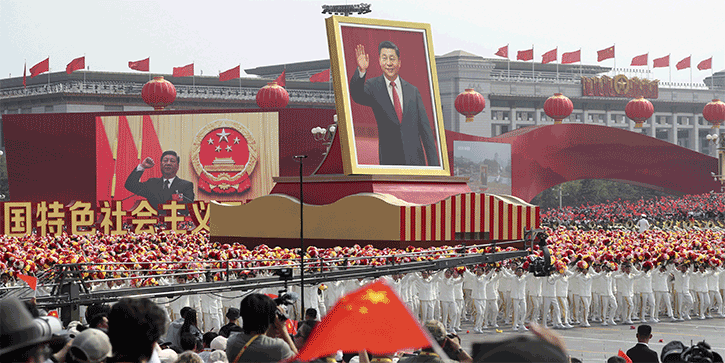
The United States and the rest of the West are not dealing with 1.3 billion Chinese citizens and human beings. The country is run by the Chinese Communist Party which controls almost every facet of life for everyone there.
Over the last three or four years I’ve become increasingly uncomfortable with China’s ambitions. There has been a surge of research pointing to the fact that the Chinese military has openly planned to be the dominant world power by 2049. And while many of these documents have been withdrawn, there is no doubt that they were written. I have talked to people who have been in the libraries and read them in China. This desire for dominance has always been a latent force, but one that was convenient to ignore, except that now we can no longer ignore it.
China’s Vision of Victory
One of the best current books on the topic is Dr. Jonathan Ward’s brilliant and well-written analysis in his book, China’s Vision of Victory. Jonathan is the founder of Atlas Organization, a Washington DC- and New York-based consultancy focused on the rise of India and China, and on US-China global competition. He is a frequent guest on numerous TV shows talking about China. A US citizen, Dr. Ward studied philosophy, Russian, and Chinese at Columbia University as an undergraduate. He earned his Master’s in Global and Imperial History and his PhD in China-India relations at the University of Oxford. He speaks Russian, Chinese, Spanish, and Arabic, and spent 10 years backpacking and studying throughout China, India, Russia, Latin America, Southeast Asia, Europe, and the Middle East. He is one of the most interesting and earnest young men I have met in a long time.
I’m going to summarize a few of his thoughts and then expect we will go into more detail next week, along with discussing other experts. That being said, there is a growing consensus that behind the Chinese economic colossus is a threat to not just the United States and other Western democracies, but the very concepts of free speech and personal liberty, not to mention property rights and the rule of law, that we consider the foundations of civilization.
If something so utterly meaningless as a tweet about Hong Kong rises to the level that it requires “thought control” then what is next? Let’s look at a few of Jonathan’s main points:
China’s leaders envision a world in which China becomes the dominant global superpower—and breaks apart the US-led rules-based order
China’s leaders, from Mao Zedong to Xi Jinping, have passed along a vision of “national resurrection.” This is known today as “the great rejuvenation of the Chinese nation.”
This “rejuvenation” is an ideological vision in which China’s premodern position as the world’s dominant empire will at last be restored. This will end what China’s leaders call “the century of humiliation” at the hands of other imperial powers. This concept and its variations have been communicated for decades to the Chinese public, and it remains the guiding ideology of the CCP.
The CCP’s ambition is not regional, but global. It wants to create a new global order with China at the center, known as the “Community of Common Destiny for Mankind.” This means breaking apart the US and Allied world order and replacing it with a system in which China’s values, power, and restored national glory emerge victorious.
The core of China’s global strategy is economic and industrial power
China’s strategy is built upon economic and industrial power. China’s leaders have exploited decades of engagement with the advanced industrial economies to harvest technology and make advancements on a grand scale.
The result has been the creation of an industrial base that now holds competitive advantages against the rest of the world economy. China has become the entire world’s manufacturing base. It has a $14 trillion GDP that some think will surpass the US economy in real terms within a decade. It has already surpassed the US in terms of total global trade volume.
China’s economic plan includes dominance of key regions and industries:
“The Belt and Road Initiative” envisions the integration of Europe, Africa, Asia, and even Latin America into an economic system with China at its center.
“Made in China 2025” envisions manufacturing dominance in strategic industries from robotics to shipping and aerospace.
If the economic and industrial foundation is laid, global Chinese military power and submission to Chinese interests will follow
China’s leaders are also busy converting their civilian industrial base into military power.
Both the “Belt and Road Initiative” and “Made in China 2025” intertwine with military endeavors:
The “Belt and Road Initiative” is also the geography of an expanding Chinese military: Chinese naval exercises with Russia and Pakistan take place throughout the geography of the Belt and Road. From the South China Sea to the Mediterranean, China’s expanding military has been tasked with protecting “the ceaseless expansion of national interests.”
“Made in China 2025” harmonizes with the program of “Civil Military Fusion”: this instructs that innovation in the civilian industrial base must be brought to the Chinese military as it seeks to “close the gap” with the US military and US Allies. China now seeks dominance across fields as diverse as undersea warfare, outer space, artificial intelligence, quantum computing, next generation IT, and joint force warfighting.
In the meantime, Xi Jinping speaks regularly of “preparing to fight and win wars.” From Europe to the Middle East, from the Indian Ocean to the Pacific, there is no region that is left out of China’s strategies for economic or military influence: China even has diplomatic engagement strategies for Africa, Latin America, and the polar regions.
If the economic foundations are laid, then the rest will follow.
We were talking about 1984-style government surveillance long before 1984. It took time but now the technology is here. The Chinese government is enthusiastically embracing it. Chinese citizens receive a “social credit” score that essentially measures their value to the regime. Facial recognition systems keep track of movement. The government logs who you talk to, what you buy, where you eat, and where you are traveling, not to mention your reading and media habits.
Set aside whether this is compatible with human rights. This surveillance is a lot of work and expense, so you have to ask: Why do it? I’m not sure we know. Of course, it’s the government that is interested in self-preservation. But, other than in Hong Kong, Chinese people don’t seem particularly bothered by the watching, or the things the government might do with the information. The cultural imperatives are alien to American minds.
With the exception that that acceptance may be less widespread than it seems. This tweet came across my inbox last week:
When 22–36% of any group of citizens in a country if given the chance to leave would do so, that says the underlying unrest is much greater than we think. And we know there are thousands of protests, generally about local issues, every year within China.
Regardless, it is happening, and it forces us to face some uncomfortable facts. Our largest trading partner has a radically different view of personal freedom and the role of government. Are we okay with that?
Whatever you may think, this creates a serious problem for American brands that want access to the Chinese market. They have to obey local laws in the places they operate, and it gets sticky when countries have polar opposite requirements.
Herein lies the problem. If Xi Jinping simply wanted to rule his country in his way, and was willing to let the US system operate as it does, we could probably have a manageable relationship. There would be friction but we could trade and get along. But no, what he wants is to censor all criticism of his government from anyone, anywhere.
And why is that? Because modern technology means that criticism anywhere will get back to China. Yes, they have their “Great Firewall” and they try to control the media. They’re pretty good at it but not perfect. Even small leaks are big problems.
This sets up a clash with Western values that I’m not sure anyone can possibly resolve. The US is not going to stop our citizens and visitors from exercising free speech. It is a core value to us and one that American companies must respect. But that makes it very difficult and maybe impossible for those same companies to sell their products in China.
But the problem may go even deeper.
Unlike the Cold War years, in this order there will be no “Third World.” Every country will have to adopt either US or Chinese technology standards, then align its entire economy around them. That’s going to put some governments in tough spots. Japan, the EU, UK, and others will want to have a foot in both camps. That’s not going to be possible.
This will force a serious re-engineering on the multinational companies who heretofore thought they could serve both worlds. They can’t. They will have to choose as well, and then adjust their marketing strategies, product plans, and supply chains. This will take years and be very expensive. Investors will likewise have to rethink valuations, particularly for those companies with Chinese growth plans.
This is not to say that we simply disengage entirely from China. That will not happen nor should it. But we should stop giving them the technology and tools to improve their military and the potential for their control of our economic livelihoods not to mention our liberties and free speech. It is actually that important. But that will wait for next week.
Quick business mention: If you would like to find out what types of investments I think are interesting given my outlook, I invite you to visit Mauldin Securities and find out what my “Team Mauldin” network can do for you. We work with investors at all net worth levels, and who may be looking for either total wealth management or specific opportunities that fit my philosophical framework. There are a number of private partnerships and offerings that I find very intriguing, especially those that are geared toward producing income. (In this regard, I am president and a registered broker with Mauldin Securities, LLC, member FINRA and SIPC. I am also an investment advisor working with CMG. Please note, Mauldin Securities LLC receives compensation from its partners for my referrals. Mauldin Securities is not affiliated with Mauldin Economics.) Find out what my network and my partners at Team Mauldin can do for you.
Houston, Philadelphia, and Dallas
Sometime in the next few weeks I have to get to Houston, then later in November I will be traveling to Philadelphia to look at potential biotech and antiaging opportunities, before returning to Dallas for Thanksgiving weekend.
We are coming up on the expiration date of our Over My Shoulder package offer. For just a few more days, you can avail yourself of the full-length video collection from our ”7 Deadly Economic Sins” week, combined with a discounted monthly subscription to our service and a second valuable bonus gift.
If even a few of those deadly economic sins hit us as hard as I predict they will, your Over My Shoulder subscription will be more than worth the small monthly fee. After all, being prepared for the future is priceless. Click here for the details.
And with that, I’ll hit the send button and wish you a great weekend.
Your watching the tectonic plates of geopolitics shift analyst,

John Mauldin
P.S. If you like my letters, you'll love reading Over My Shoulder with serious economic analysis from my global network, at a surprisingly affordable price. Click here to learn more.
Read important disclosures here.
YOUR USE OF THESE MATERIALS IS SUBJECT TO THE TERMS OF THESE DISCLOSURES.
Put Mauldin Economics to work in your portfolio. Your financial journey is unique, and so are your needs. That's why we suggest the following options to suit your preferences:
-
John’s curated thoughts: John Mauldin and editor Patrick Watson share the best research notes and reports of the week, along with a summary of key takeaways. In a world awash with information, John and Patrick help you find the most important insights of the week, from our network of economists and analysts. Read by over 7,500 members. See the full details here.
-
Invest in longevity: Transformative Age delivers proven ways to extend your healthy lifespan, and helps you invest in the world’s most cutting-edge health and biotech companies. See more here.
-
Macro investing: Our flagship investment research service is led by Mauldin Economics partner Ed D’Agostino. His thematic approach to investing gives you a portfolio that will benefit from the economy’s most exciting trends—before they are well known. Go here to learn more about Macro Advantage.


Thoughts from the Frontline
Follow John Mauldin as he uncovers the truth behind, and beyond, the financial headlines. This in-depth weekly dispatch helps you understand what's happening in the economy and navigate the markets with confidence.
Let the master guide you through this new decade of living dangerously
John Mauldin's Thoughts from the Frontline
Free in your inbox every Saturday
By opting in you are also consenting to receive Mauldin Economics' marketing emails. You can opt-out from these at any time. Privacy Policy